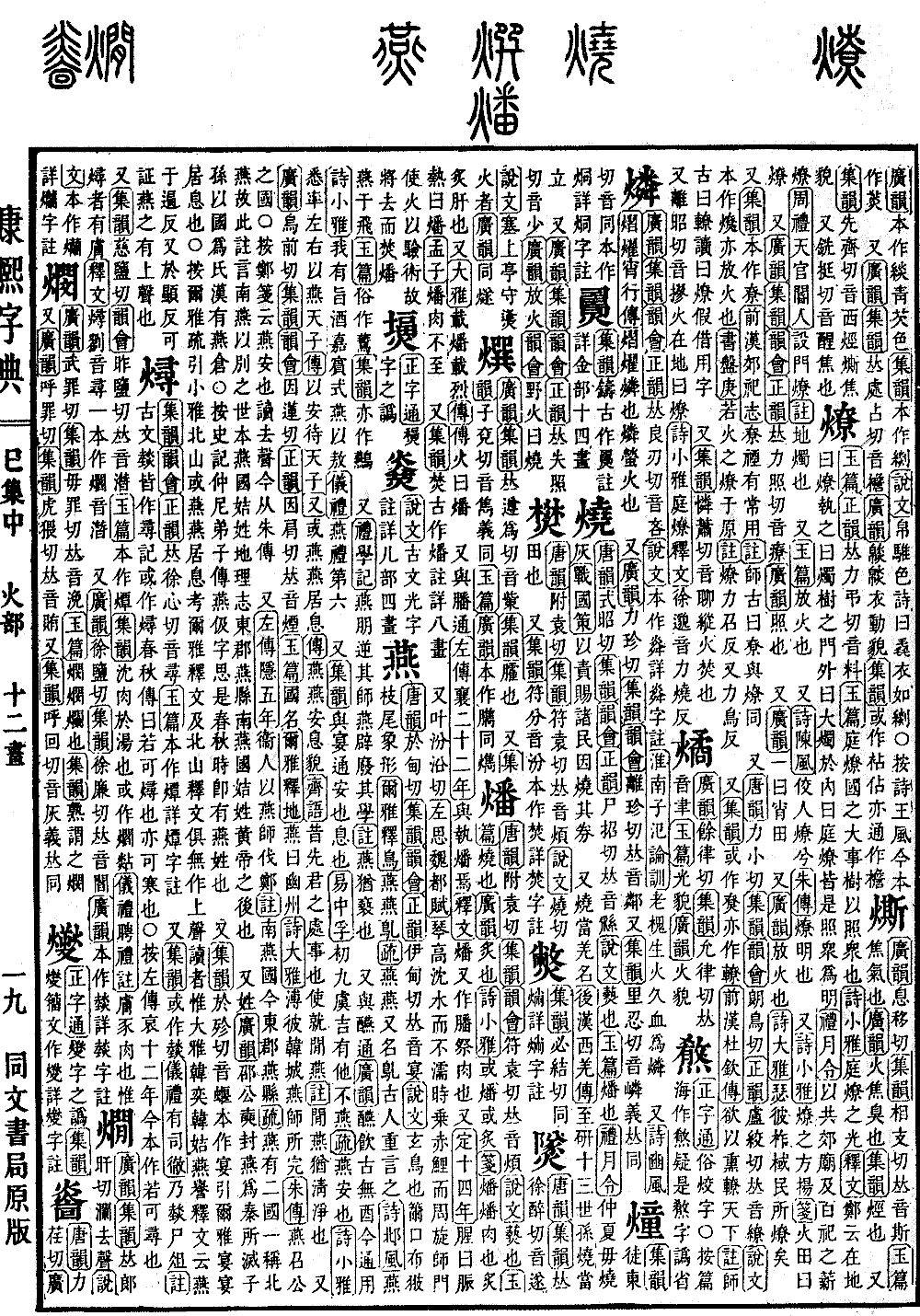
Si Collection, Middle Volume Radical: Fire (huǒ) Kangxi Strokes: 16 Page 683, Entry 16
Pronounced yan (fourth tone).
Shuowen Jiezi (Explanation of Writing and Analysis of Characters) interprets this as a type of bird. It possesses a beak like a pair of tongs, wings that expand, and a forked tail; the character shape mimics its form.
Erya (Approaching Elegance), section on birds, states: The bird described as yan-yan is this bird.
Commentary explains: Yan-yan is also called this. The ancients used the term redundantly.
Book of Odes (Shijing), Beifeng section, contains the line: The swallows are flying.
Yupian (Jade Chapters) states that the common variant is written as the character with a bird radical.
Jiyun (Collection of Rhymes) also notes it is written as that same variant.
Additionally, Liji (Book of Rites), Xueji chapter, states: If one treats friends with levity, one goes against one's teacher; if one is lax in conduct, one abandons learning.
Note explains: Yan means to treat with levity or to be lacking in seriousness.
It is also interchangeable with the character yan (a feast).
Guangyun (Broad Rhymes) says that in ancient times, the usage for a feast did not include the unit radical, but it is now commonly written with the radical for Yan.
Book of Odes (Shijing), Xiaoya section, contains the line: I have fine wine; honorable guests feast and enjoy themselves.
Yili (Ceremonial and Rituals) contains the chapter titled The Sixth Feast Ritual.
Furthermore, Jiyun states it is interchangeable with the character yan (to be at peace). It signifies comfort and rest.
I Ching (Book of Changes), regarding the Zhongfu hexagram, says: In the first line, keeping to one's own affairs brings good fortune; to have other interests does not bring peace.
Commentary explains: Yan means comfort.
Book of Odes (Shijing), Xiaoya section, contains the line: We attend to those on the left and right to provide comfort to the Emperor.
Commentary explains: This means to treat the Emperor with such care as to provide him comfort.
Another line reads: Some rest in peaceful seclusion.
Commentary explains: Yan-yan is the appearance of being at leisure and resting.
Guoyu (Discourses of the States), Qiyu chapter, says: In the past, when the sage kings placed scholars, they allowed them to seek leisure and peace.
Note explains: Leisure and peace is like being in a state of purity and stillness.
Pronounced yan (level tone).
Yupian defines this as the name of a feudal state.
Erya (Approaching Elegance), section on geography, states: The land of Yan is called Youzhou.
Book of Odes (Shijing), Daya section, contains the line: Vast is that city of Han, which the army of Yan completed.
Zhu Commentary explains: Yan was the fief of the Duke of Shao. Note: Zheng Xuan's annotation says Yan means stability, and it is pronounced in the falling tone. We currently follow the Zhu Commentary.
Furthermore, Zuo Zhuan (Commentary of Zuo), Year 5 of Duke Yin, records: The people of Wei used the army of Yan to attack Zheng.
Note explains: The Southern Yan state is the present-day Yan County in Dong Commandery.
Commentary explains: There were two Yan states, one called Northern Yan, so this annotation specifies Southern Yan to distinguish between them. The Shibet (Genealogical Records) records that the Yan state was of the Ji surname. Hanshu (Book of Han), Geography Treatise, records: The Yan County of Dong Commandery was the Southern Yan state, of the Ji surname, and they were descendants of the Yellow Emperor.
It is also a surname.
Guangyun records: The Duke of Shao Shi was enfeoffed in Yan, and later, when the state was extinguished by the Qin, his descendants used the state name as their surname. In the Han dynasty, there was a person named Yan Cang. Note: Records of the Grand Historian (Shiji), Biography of Confucius' Disciples, records: Yan Ji, whose courtesy name was Zisi. This shows that the surname Yan already existed during the Spring and Autumn period.
Pronounced yan (rising tone).
The original character is the word for a feast. Citing Erya: To feast means to rest. Note: The commentary on Erya cites the Book of Odes (Shijing), Xiaoya, Beishan section: Some rest in peaceful seclusion, as evidence. Upon examination of the text and commentaries of Erya and Beishan, there is no record of the rising tone, except for the commentary on the Book of Odes (Shijing), Daya, Hanyi section: Yan, pronounced like the word for go. It is also pronounced like the word for manifest. This proves the character Yan has a rising tone pronunciation.
Verification: In Qiyu: In the past, when our former lord placed scholars, he allowed them to seek leisure and peace. We have prudently followed the original text by changing former lord to sage kings and affair to scholar.