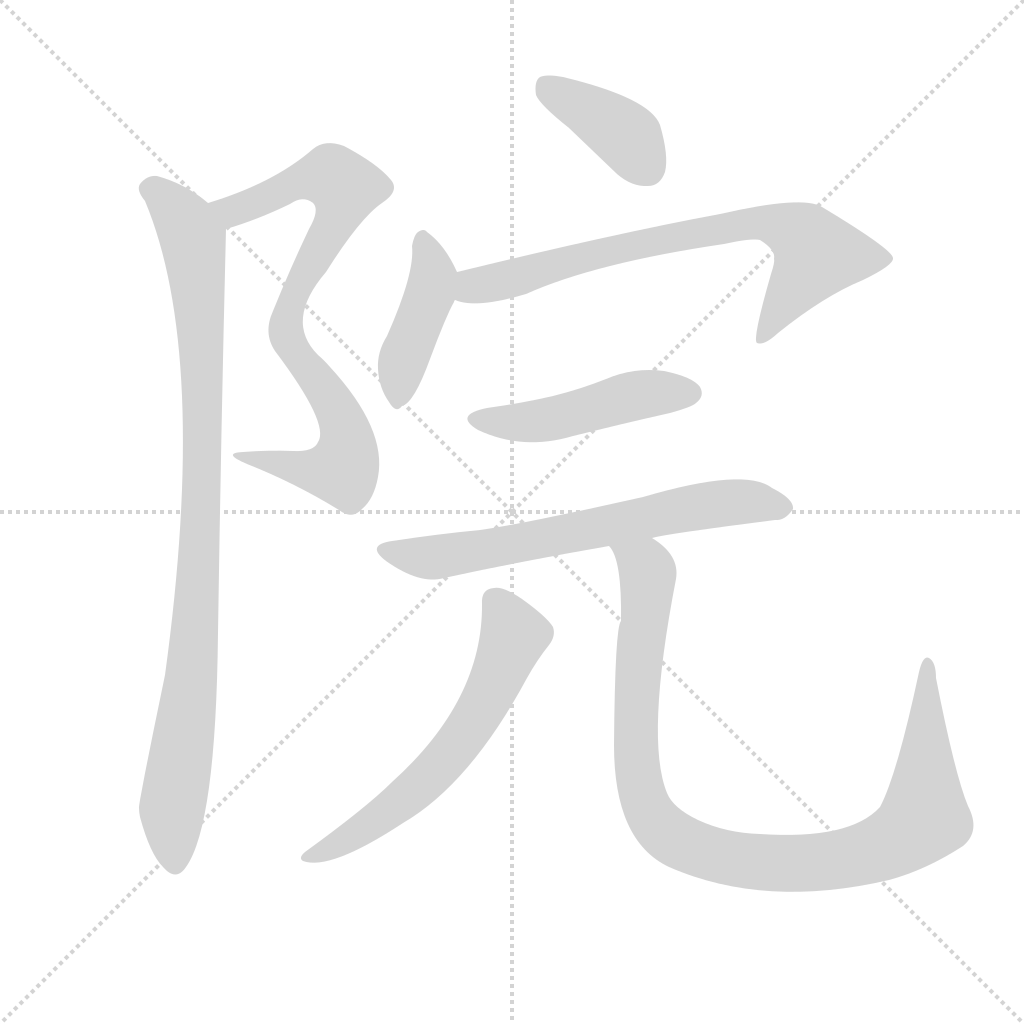
Xu Collection, Middle Volume
Radical: Mound (fù)
Kangxi Stroke Count: 15
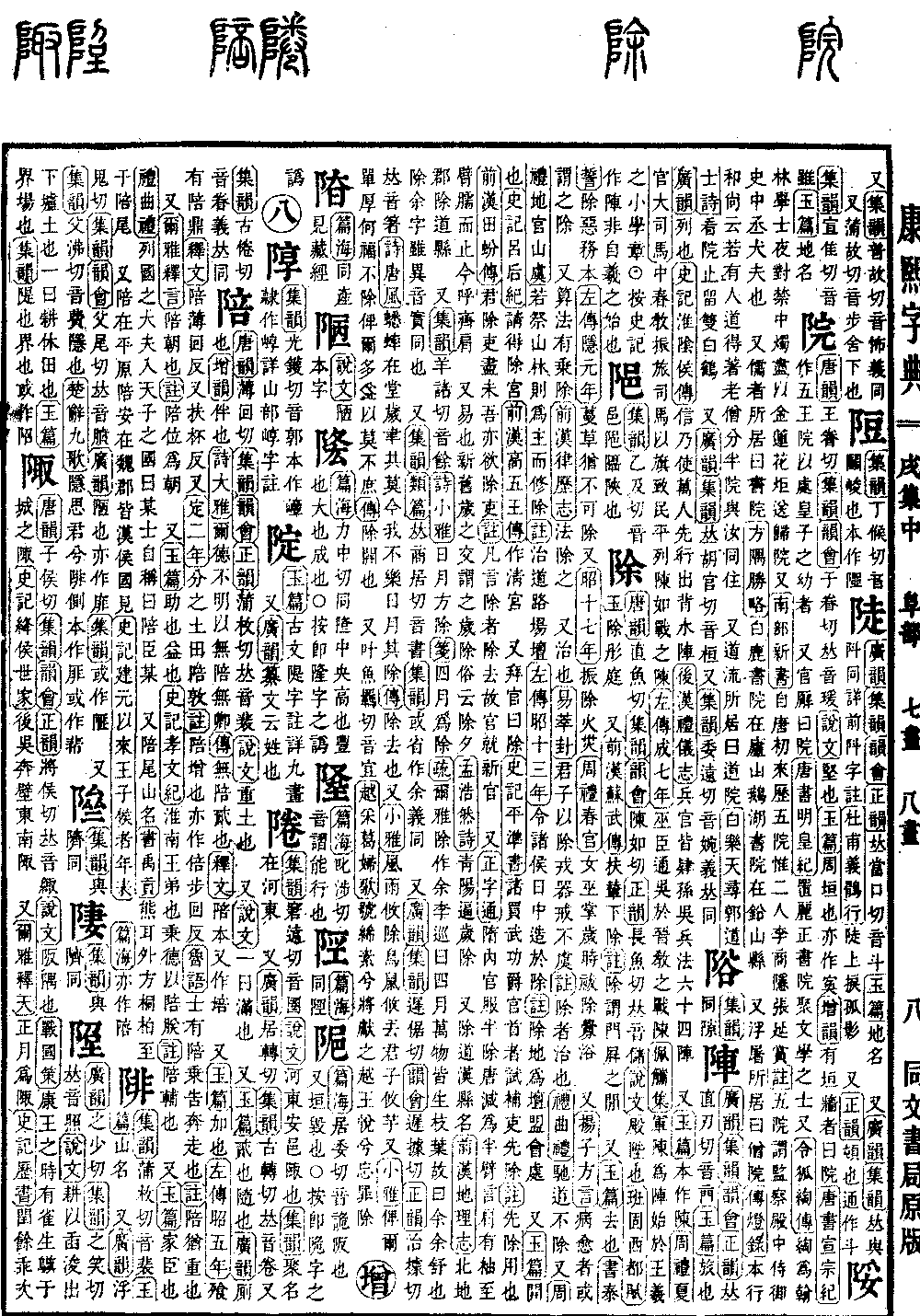
Page 1352, Entry 04
According to the Tang Rhyme dictionary, the pronunciation is given as wáng juàn qiè. According to the Collected Rhymes (Jiyun) and the Rhyme Compendium (Hui), the pronunciation is given as yú juàn qiè, similar to yuàn.
The Explanations of Characters (Shuowen Jiezi) defines it as "firm" or "solid."
The Jade Chapters (Yupian) defines it as "surrounding walls." It is also written as guàn.
The Augmented Rhymes (Zengyun) states that a residence with surrounding walls is called yuàn.
The History of Tang (Tangshu), Annals of Emperor Xuanzong, records the establishment of the Five Princes' Courts (Wuwangyuan) to house young imperial princes.
Also, government offices are called yuàn.
The History of Tang (Tangshu), Annals of Emperor Minghuang, records the establishment of the Lizheng Academy (Lizhengshuyuan) to gather literati.
Also, in the Biography of Linghu Tao, it is recorded that when Linghu Tao, serving as a Hanlin academician, had his candle burn out during an evening audience in the palace, the emperor ordered that he be escorted back to the Hanlin Academy (Hanlinyuan) with a golden lotus torch.
Also, the New Book of the Southern Region (Nanbu Xinshu) records that since the early Tang dynasty, only two individuals had held positions in all Five Courts (Wuyuan): Li Shangyin and Zhang Yanshang.
Note: The Five Courts refer to the Censorate Court (Jianchayuan), the Palace Central Court (Dianzhongyuan), the Court of Investigating Censors (Shiyushiyuan), the Censor-in-Chief's Court (Zhongchengyuan), and the Grand Master's Court (Dafuyuan).
Also, places where Confucian scholars resided and lectured were called academies (shuyuan).
The Brief Record of Scenic Spots (Fangyu Shenglue) records: Bailu Academy (Bailushuyuan) is on Mount Lu, and Ehu Academy (Ehushuyuan) is in Qianshan County.
Also, places where Buddhist monks resided were called monastic courts (sengyuan).
The Record of the Transmission of the Lamp (Chuandenglu) records that Master Benxing said: "If someone can articulate the principle, this old monk will share half of his monastic court with you."
Also, places where Daoist practitioners resided were called Daoist courts (daoyuan).
A poem by Bai Juyi, "Seeking Daoist Guo," contains the line: "The court keeper only keeps two white cranes."
Also, according to the Extensive Rhymes (Guangyun) and the Collected Rhymes (Jiyun), the pronunciation is given as hú guān qiè, similar to huán.
Also, according to the Collected Rhymes (Jiyun), the pronunciation is given as wěi yuǎn qiè, similar to wǎn.
The meaning is the same as above.