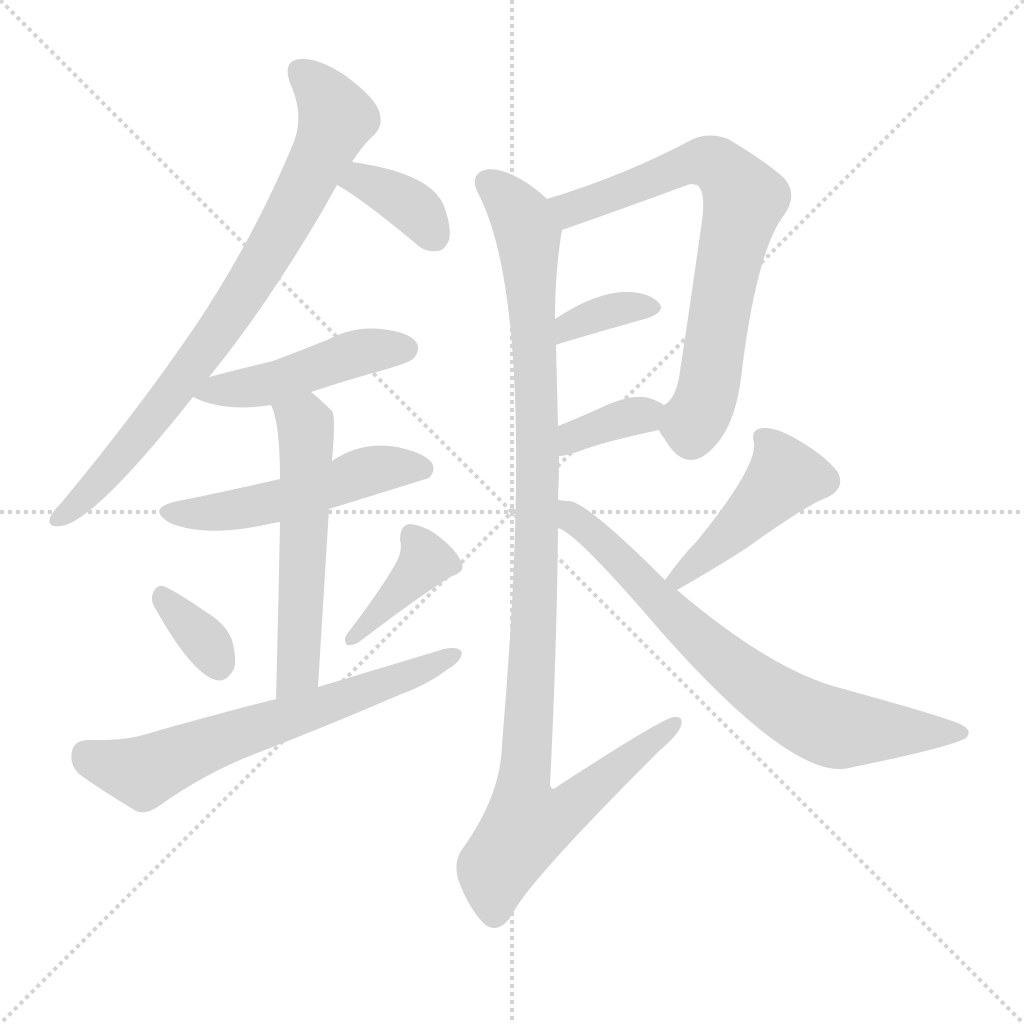
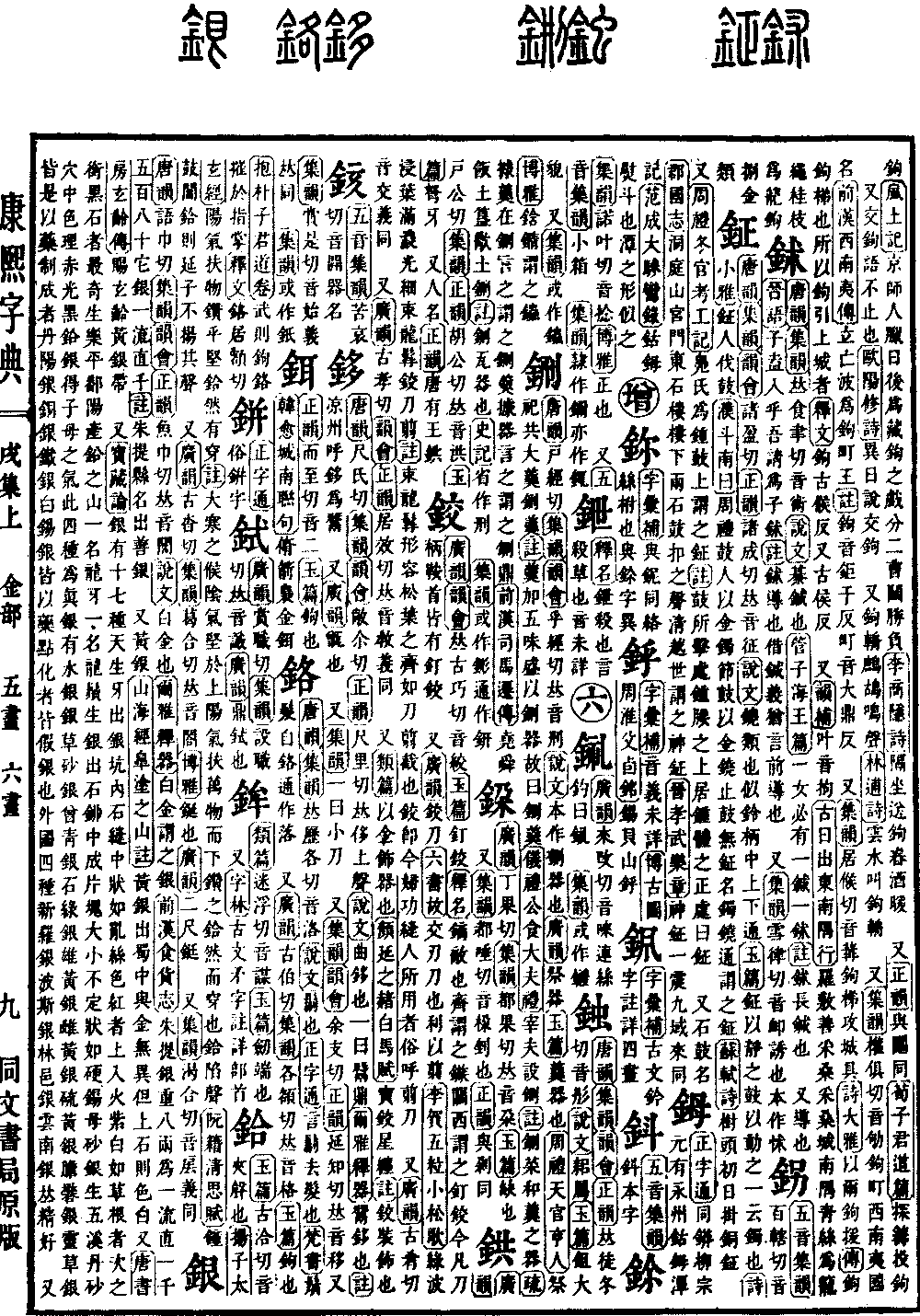
Xu Collection, Upper Volume. Radical: Metal (jīn). Yin. Kangxi strokes: 14. Page 1303, Entry 25.
According to the Tang Rhymes (Tangyun), it is pronounced yin. According to the Collection of Rhymes (Jiyun), the Rhyme Collection (Yunhui), and the Correct Rhymes (Zhengyun), it is pronounced yin. According to the Explaining Graphs and Analyzing Characters (Shuowen), it is white metal. According to the Erya (Erya), in the section explaining tools, white metal is called silver. In the History of the Former Han (Qianhan Shu), in the treatise on food and money, it mentions Zhu-ti silver, weighing eight liang (taels) per unit, valued at one thousand five hundred and eighty, while other silver units were valued at one thousand. The commentary notes that Zhu-ti is the name of a county where high-quality silver is produced. There is also yellow silver. The commentary on the Classic of Mountains and Seas (Shanhaijing) regarding Mount Gaotu states that yellow silver is produced in Shu and is no different from gold, but its color changes to white when placed upon stone. Also, in the Old Book of Tang (Tangshu), in the biography of Fang Xuanling, it is recorded that Fang Xuanling was bestowed with a belt of yellow silver. The Treasure Store Treatise (Baozang Lun) states that there are seventeen types of silver. Natural silver teeth emerge from the cracks in stones within silver mines, shaped like tangled silk; those with a red color are of the highest grade and turn a purple-white color when placed in fire; those resembling grass roots are of the secondary grade. Those containing black stone are the most peculiar, produced in the mountains of Leping and Poyang where lead is found; they are also called dragon teeth or dragon whiskers. Raw silver originates from within stone, forming sheets or chunks of varying size, shaped like hard tin. Mother-sand silver is produced in the cinnabar mine pits of the Five Streams region, with a red color and glossy texture. Black-lead silver contains the qi of both mother and child. These four types are considered genuine silver. There are also mercury silver, grass-sand silver, azurite silver, malachite silver, realgar silver, orpiment silver, sulfur silver, blue vitriol silver, and medicinal-herb silver, all of which are smelted using various medicinal substances. Danyang silver, copper silver, iron silver, and white-tin silver are all transmuted using drugs and are considered fake silver. There are four types from foreign lands: Silla silver, Persian silver, Linyi silver, and Yunnan silver, all of which are of excellent quality. There is also mercury. In the History of the Former Han, in the biography of Liu Xiang, it is written that mercury was used to create rivers and seas. The Guhai Yuheng Zhi states that in places where cinnabar is abundant in Yongzhou, mercury flows out naturally after excavation. There is also black silver. The Compendium of Materia Medica (Bencao Gangmu) cites Zangqi as saying that people today use sulfur to fumigate silver, and after two nights, they remove it, turning the color black. Artisans use it to craft vessels, and those seeking longevity use such vessels to decoct medicine to ward off impurity. It also serves as a surname. According to the Zhengzitong, there was a person named Yin Mu during the Han dynasty, and during the Zhengde period of the Ming dynasty, there was a magistrate of Jize named Yin Jing. It also serves as a place name. In the Gongyang Commentary (Gongyang Zhuan), for the eleventh year of Duke Zhao, it is recorded that a meeting was held at Quyin. The Zuo Commentary (Zuozhuan) and the Guliang Commentary (Guliang Zhuan) write this as Jueyin. According to the Jiyun, it is the name of a prefecture in the region where the White Di people of the Northern Zhou resided, known as Yin Prefecture. According to the Zihui, it is read with a rising tone. In the Nine Palaces Rhapsody (Jiugong Fu) by Huang Xiang, it reads, gazing at the rising sun while sharpening the silver. The commentary explains this as analogous to meticulous study. According to the Tongwenzhuo, it is identical to the character for bank (yin). In the Xunzi, in the Chengxiang chapter, it says to guard its bank. According to the Zihuibu, it refers to sharp edges or points. The Book of Rites of Dai (Da Dai Liji) states that with hands like silver, appearing as if severed, this refers to the conduct of Bu Shang. According to the Yunbu, it is rhymed with yan. In the Harmony Poem (Hehuan Shi) by Yang Fang, it reads: the long road is winding and treacherous, with autumn grass growing on both sides. The yellow flowers are like layered gold, and the white flowers are like scattered silver.