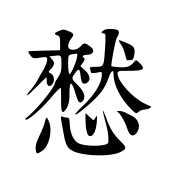
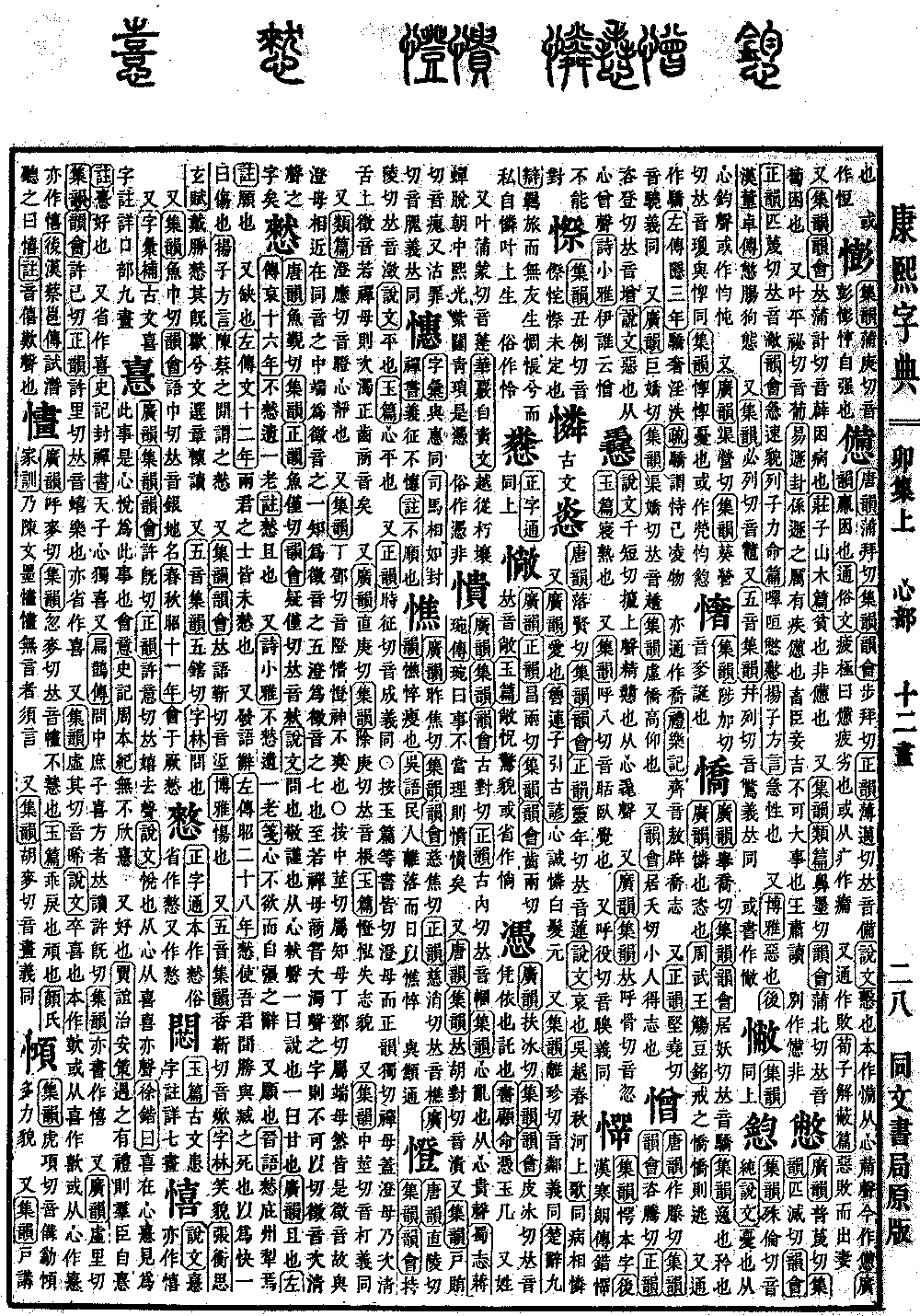
Mao Collection, Upper Volume
Radical: Heart (xīn)
Yin (16 strokes)
Page 402, Entry 21
Pronounced yin (rising tone).
Shuowen Jiezi (Explanation of Graphs and Analysis of Characters) defines it as to ask, and also as respectful caution. Formed from the heart radical with yin as the phonetic component. One interpretation is to be willing. Another is to be sweet.
Guangyun (Broad Rime) defines it as for the time being.
Zuo Zhuan (Chronicle of Zuo), 16th year of Duke Ai: Does not for the time being leave behind one old man. The commentary defines it as for the time being.
Book of Odes (Shijing), Xiaoya: Does not for the time being leave behind one old man. The Mao commentary states this is an expression of forced intent despite a lack of desire in the heart.
Also means to wish. Discourses of the States (Guoyu), Jin section: Wishing to protect Zhouli. The commentary defines it as to wish.
Also means a lack or deficiency. Zuo Zhuan, 12th year of Duke Wen: The soldiers of the two lords were both not yet lacking.
Also serves as an introductory particle. Zuo Zhuan, 28th year of Duke Zhao: If only we could make our lord hear of the deaths of Sheng and Zang, that would be satisfying.
Another interpretation is to harm. Yang Xiong, Regional Dialects (Fangyan): Between Cai and the surrounding regions, it is referred to as yin.
Pronounced yin (falling tone).
Guangya (Expanded Encyclopedia) defines it as to grieve.
Pronounced xin (falling tone).
Zilin (Forest of Characters) defines it as the appearance of smiling. Zhang Heng, Rhapsody on Thinking (Si Fu): Wearing the head ornament and smiling, for he is already joyful. Annotated in the Selected Works of Literature (Wenxuan).
Pronounced xia (entering tone).
Zilin defines it as to ask.
Pronounced yin (level tone).
A place name. Spring and Autumn Annals (Chunqiu), 11th year of Duke Zhao: A meeting was held at Jueyin.