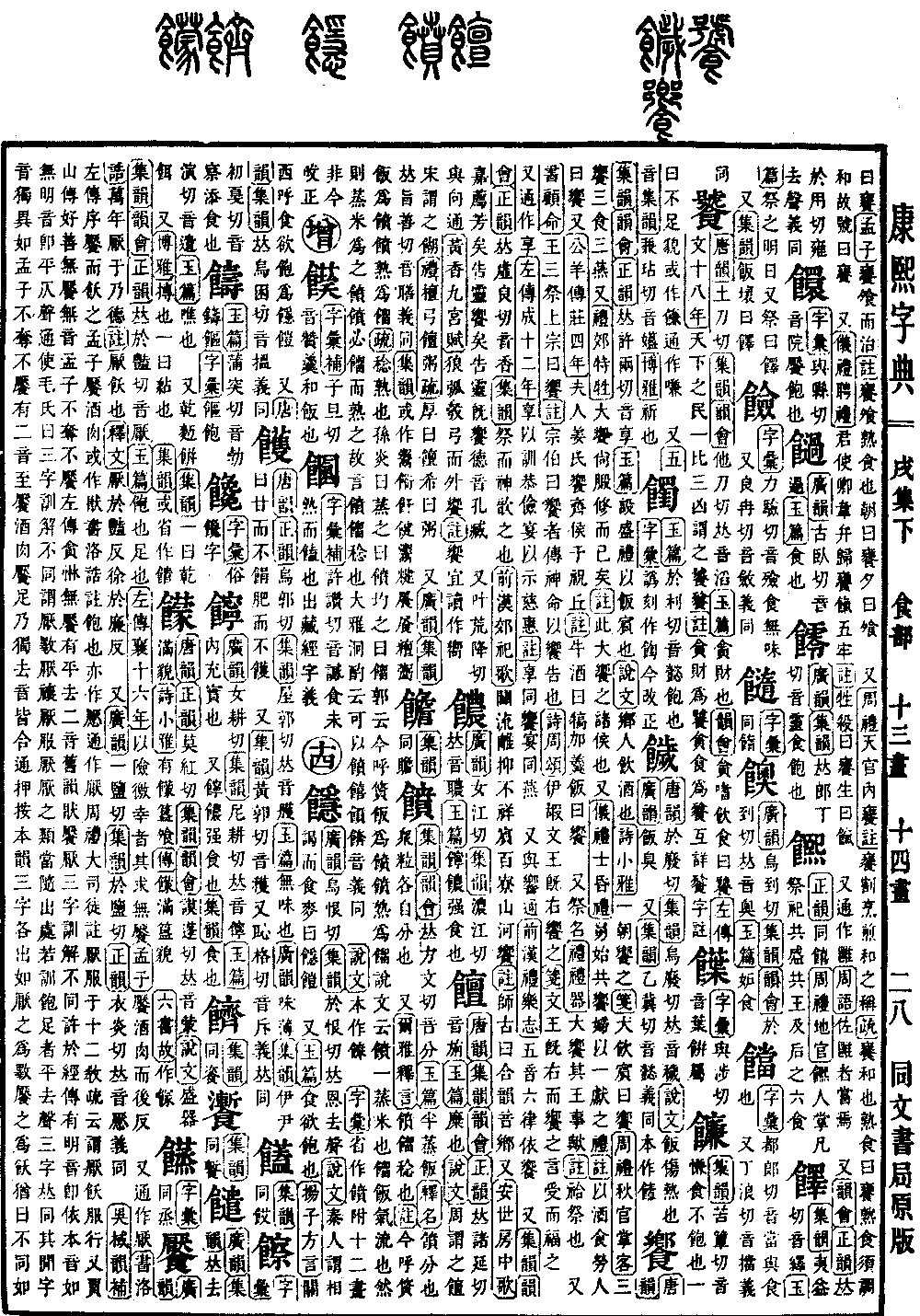
Xu Collection, Lower Volume
Radical: Food (shí)
饜
Kangxi strokes: 23
Page 1426, Entry 34
Broad Rhymes (Guangyun), Collected Rhymes (Jiyun), Rhyme Meetings (Yunhui), Correct Rhymes (Zhengyun): Pronounced yan (falling tone).
Jade Chapters (Yupian): Full, satisfied.
Commentary on Zuo (Zuo Zhuan), 16th Year of Duke Xiang: Those who rely on dangerous paths for luck will have insatiable desires.
Mencius: To be satiated with wine and meat before returning.
Also used interchangeably with the character pronounced yan (falling tone).
Classic of History (Shangshu), Announcement of Luo (Luogao): May you be satiated with your virtue for ten thousand years. Commentary: To be satiated, to be full.
Explication of Texts (Shiwen): Pronounced yan (falling tone); Xu pronounces it lian (rising tone).
Also, Broad Rhymes (Guangyun): Pronounced yan; Collected Rhymes (Jiyun): Pronounced yan; Correct Rhymes (Zhengyun): Pronounced yan. Same meaning.
Wu Yu, Rhyme Supplement (Yunbu): In the preface to the Commentary on Zuo (Zuo Zhuan), it is written as satiated and full. In Mencius, it is written as satiated with wine and meat. Sometimes written in a variant form. Commentary in the Classic of History (Shangshu), Announcement of Luo (Luogao): To be full. Also written as the variant form yan. Often used interchangeably with the character pronounced yan (falling tone).
Rites of Zhou (Zhouli), Commentary on the Office of the Great Arbiter: To be fully obedient to the twelve teachings. The sub-commentary states: This means to be satisfied and practice them.
Also, Biography of Jia Shan: A love for goodness that is never satiated. There is no specific pronunciation; in Mencius, it is written as not seized and not satiated. In the Commentary on Zuo (Zuo Zhuan), it is written as greedy and insatiable. There are both level and falling tone pronunciations.
In the old rhyme dictionaries, the three characters for satiated are explained differently. Xu states that if a specific pronunciation is provided in the classics, one should follow that base pronunciation. If no specific pronunciation is provided, the level and oblique tones may be used interchangeably.
Mao states: The three characters are explained differently, such as when referring to weariness, exorcism, or obedience, and one should follow the context. If referring to being full or satisfied, the level and falling tones of the three characters are the same. In cases where the pronunciation is unique, such as in Mencius, it has two pronunciations, but when referring to being satiated with wine or meat, it only uses the falling tone; all these cases may be treated as interchangeable.
According to the original rhymes, the three characters are listed separately, such as using one for weariness and one for being full, which shows they are indeed different. The claim that they are merely simplified forms is incorrect. Please see the detailed commentary on the character for weariness.