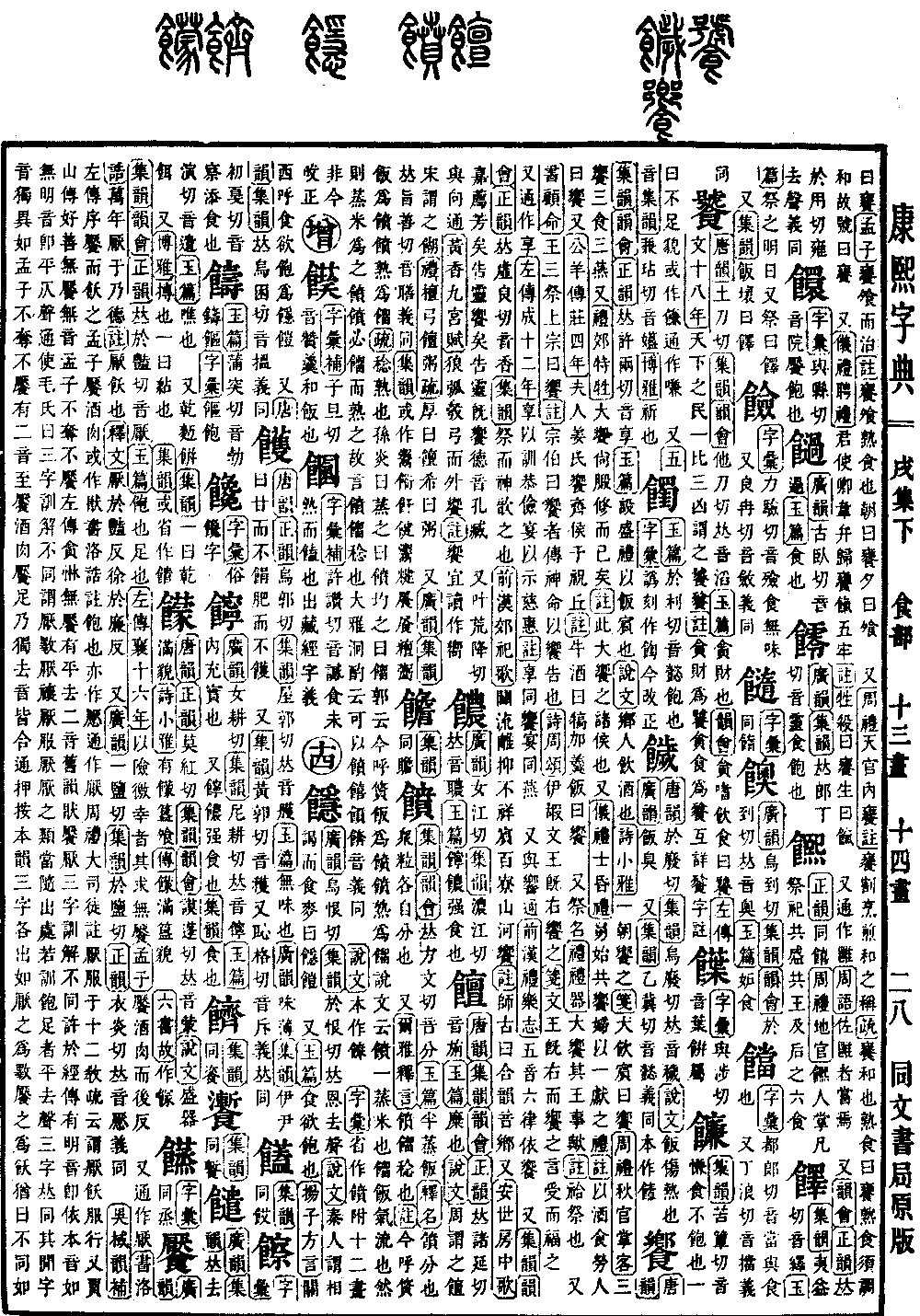
Xu Collection, Lower Volume
Radical: Food (shí)
Page 1426, Entry 01
Pronounced yan (falling tone).
In Guangyun (Guangyun), Jiyun (Jiyun), Yunhui (Yunhui), and Zhengyun (Zhengyun), the pronunciation is yan (falling tone).
In Yupian (Yupian), it means to be full or to be satisfied.
Zuo Zhuan (Zuozhuan), sixteenth year of Duke Xiang: Those who court good fortune through dangerous means have cravings that can never be satisfied.
Mencius (Mengzi): Only after being satisfied with wine and meat do they return.
It is also used interchangeably with the character pronounced yan (falling tone).
Book of Documents (Shujing), Announcement regarding Luo (Luogao): May you be satisfied with your virtue for ten thousand years. Commentary: The character pronounced yan (falling tone) means to be sated.
Explication of Pronunciations (Shimen): The character pronounced yan (falling tone) is pronounced yan (falling tone), and according to Xu, it is pronounced lian (rising tone).
Also in Guangyun, pronounced yan (level tone). In Jiyun, pronounced yan (level tone). In Zhengyun, pronounced yan (level tone). The meaning is the same.
Wu Yu in Supplement to Rhymes (Yunbu): In the preface to Zuo Zhuan, it says to be satisfied and sated. In Mencius, it says satisfied with wine and meat. It is sometimes written as the variant form yan. In the commentary to the Announcement regarding Luo, it means to be full. It is also written as yan. It is used interchangeably with the character pronounced yan (falling tone).
Rites of Zhou (Zhouli), Commentary on the Great Minister of Instruction: To be satisfied and compliant with the twelve teachings. The sub-commentary states: This refers to being satisfied, sated, and compliant in practice.
Also, in the Biography of Jia Shan: To love goodness without being satisfied. There is no specific pronunciation indicated, though in Mencius it is said not to seize and not to be satisfied, and in Zuo Zhuan it is said that greed and craving know no satisfaction. There are both level and falling tone pronunciations.
In the old rhyme dictionaries, the three characters pronounced yan are defined differently. If the classics provide a clear pronunciation, one should follow that specific reading. If no clear pronunciation is provided, the level and oblique tones may be used interchangeably.
Mao states: The three characters have different definitions, such as when pronounced yan (falling tone) to mean to be bored with, to exorcise, to be satisfied with, or to be compliant. One must follow the context of the source. If the meaning is to be full or satisfied, the three characters are identical in both level and falling tone, though their individual phonetic entries vary. For example, in Mencius, the phrase not to seize and not to be satisfied has two pronunciations, while in the phrase satisfied with wine and meat, it only has the falling tone. They are all acceptable for use in rhyming.
According to the original rhyme books, the three characters are listed separately. For example, the character pronounced yan (falling tone) as to be bored, and the character pronounced yan (falling tone) as to be sated, shows that they are different. To treat them as simplified forms of one another is a mistake. Refer to the note under the character pronounced yan (falling tone) for further details.