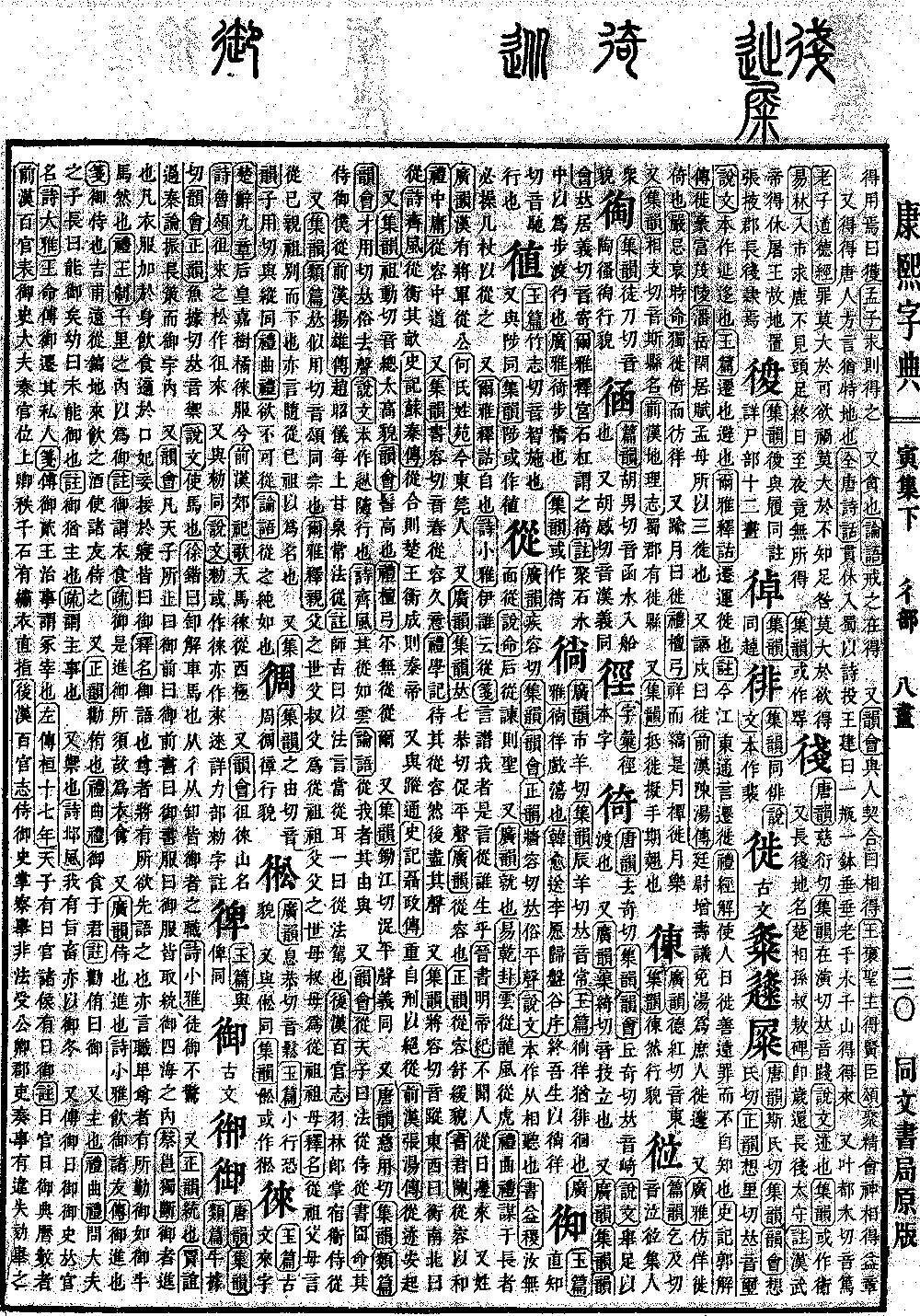
Yin Collection, Lower Volume
Radical: Step (chì)
Kangxi Strokes: 11
Page 368, Entry 05
Ancient form. Pronounced si (rising tone).
According to the Explaining Graphs and Analyzing Characters (Shuowen Jiezi), it was originally written in a variant form. It means to shift or relocate.
According to the Jade Chapters (Yupian), it means to move or to avoid.
According to the Erya, a dictionary of synonyms (Erya), the movement or transport of objects is defined as xi. Commentary: In the region east of the Yangtze River, it is commonly referred to as qianxi.
According to the Book of Rites (Liji), one should cause people to daily move toward goodness and move away from transgression without their own awareness.
According to the Records of the Grand Historian (Shiji), the wealthy and powerful were relocated to Maoling.
According to the Rhapsody on Living in Seclusion (Xianju Fu) by Pan Yue, this refers to why Mencius's mother moved three times.
It also refers to exile or penal servitude. According to the History of the Former Han (Qian Hanshu), the Commandant of Justice Zeng Shou proposed to strip Tang of his rank and exile him to the frontier.
Also, it refers to pacing back and forth. According to the Lament for the Fate of the Times (Ai Shi Ming) by Yan Ji, he walked alone, pacing back and forth.
Also, a period of one month or more is called xi. According to the Book of Rites (Liji), during the period of minor mourning, the month of the sacrifice, one moves to the month of music.
Also, pronounced si. The name of a county. According to the History of the Former Han (Qian Hanshu), there was a Xi County in Shu Commandery.
Also, it refers to the motion of hands, as in reaching out or gesturing.