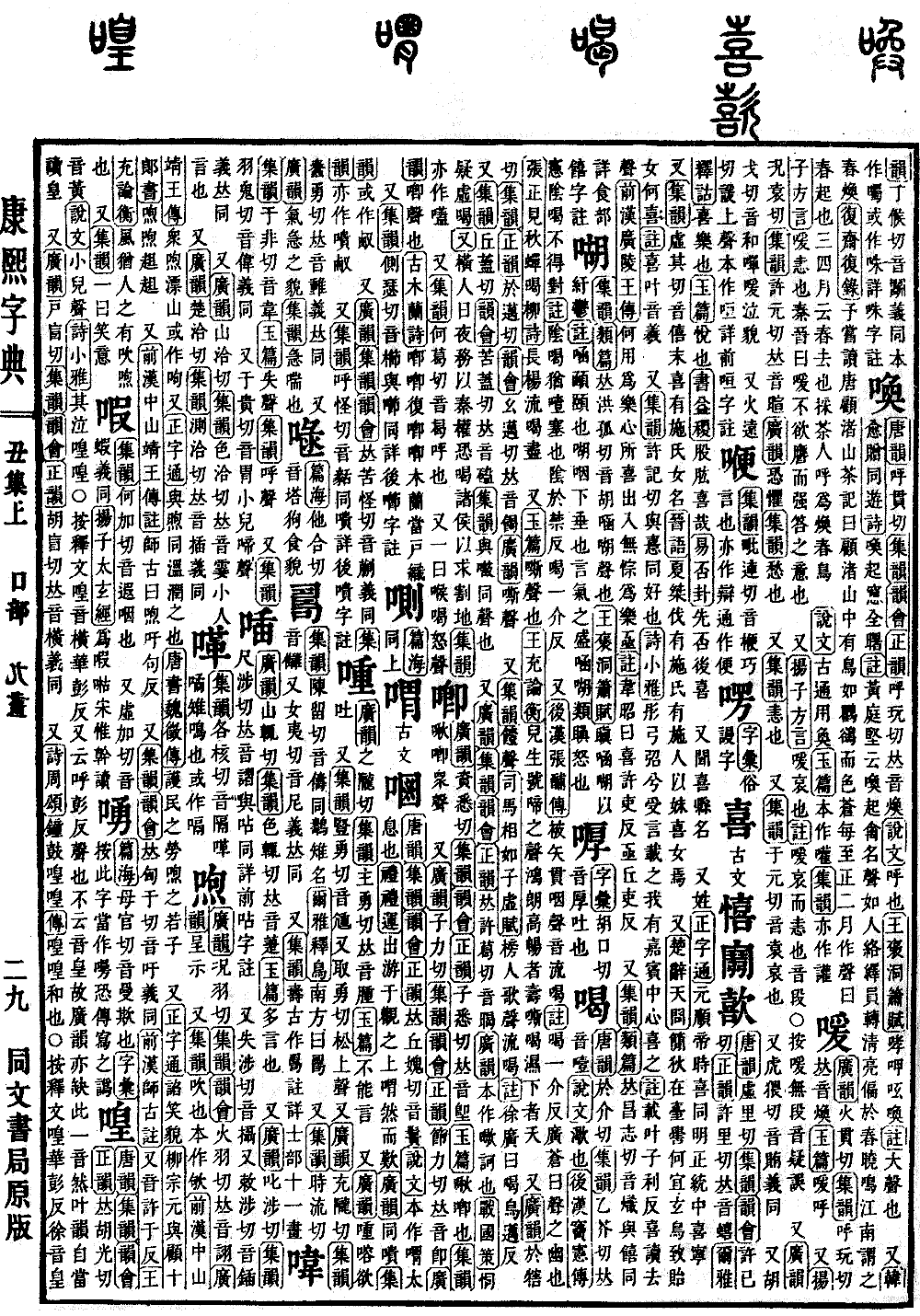
Chou Collection, Upper Volume
Radical: Mouth (kǒu)
喜; Kangxi strokes: 12; Page 199, Entry 05
In ancient scripts written as 憘, 歖.
According to the Tang Dynasty Rhyme Dictionary (Tangyun), pronounced xǐ; according to the Collected Rhymes (Jiyun) and the Compendium of Rhymes (Yunhui), pronounced xǐ; according to the Corrected Rhymes (Zhengyun), pronounced xǐ; the pronunciation is the same as the character 蟢.
In the Approach to History (Erya), in the section Explaining Ancient Terms (Shigu), it is explained: Xi means joy or happiness.
In the Jade Chapters (Yupian), it is explained: Joyful.
The Book of Documents (Shujing), in the section Benefit of Governance (Yiji), records: The supporting ministers are joyous indeed.
The Book of Changes (Yijing), in the hexaplex of Stagnation (Fou), records: First there is stagnation, then there is joy.
There is also a place name, Wenxi, which is the name of a county.
There is also a surname, Xi.
The Compendium of Correct Characters (Zhengzitong) records: During the reign of Emperor Shun of the Yuan Dynasty, there was a man named Xitong; during the Orthodox (Zhengtong) period of the Ming Dynasty, there was a man named Xining.
Also, according to the Collected Rhymes (Jiyun), pronounced xī; the pronunciation is the same as the character 僖. Mox, the name of a woman from the You-Shi clan.
The Discourses of the States (Guoyu), in the section Discourses of Jin, records: When King Jie of Xia attacked the You-Shi clan, the people of the You-Shi clan offered the woman Meixi (Mox) as a tribute.
Also, in the Songs of Chu (Chuci), in the section Heavenly Questions (Tianwen), the verse reads: When Jiandi was in the tower, why was Ku appropriate, and what joy did the bird bring to the woman.
Note: Here, Xi is rhymed and pronounced as xi.
Also, according to the Collected Rhymes (Jiyun), pronounced xǐ, which is the same as the character 憙. It means to love or to be fond of.
The Book of Odes (Shijing), in the section Lesser Odes of the Kingdom (Xiaoya), the verse reads: The red bows are unstrung, and I receive them and carry them. I have honorable guests, and my heart delights in them.
Note: Here, Zai is rhymed as zili and Xi is pronounced in the falling tone.
The History of the Former Han (Qianhan), in the Biography of the Prince of Guangling, records: Why do the things that the joyful heart delights in result in coming and going without joy.
Note: Wei Zhao says: Xi is pronounced xuli; Ji is pronounced qiuli.
Also, according to the Collected Rhymes (Jiyun) and the Classified Chapters (Leipian), pronounced chì; the pronunciation is the same as the character 饎. For a detailed explanation, see the entry for the character 饎 under the Radical: Food (shí).