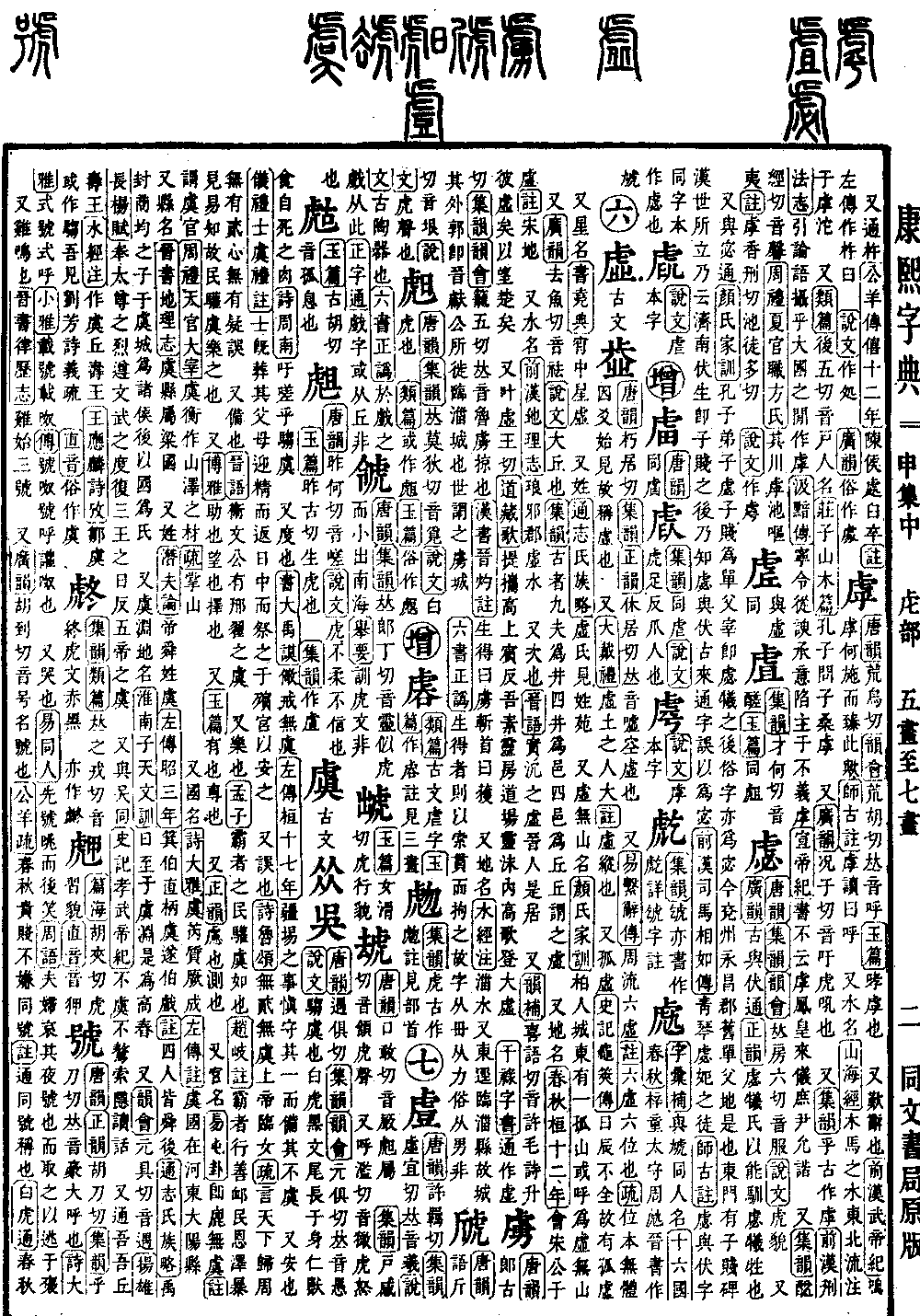
Shen Collection, Middle Volume
Radical: Tiger (hǔ)
Page 1074, Entry 11
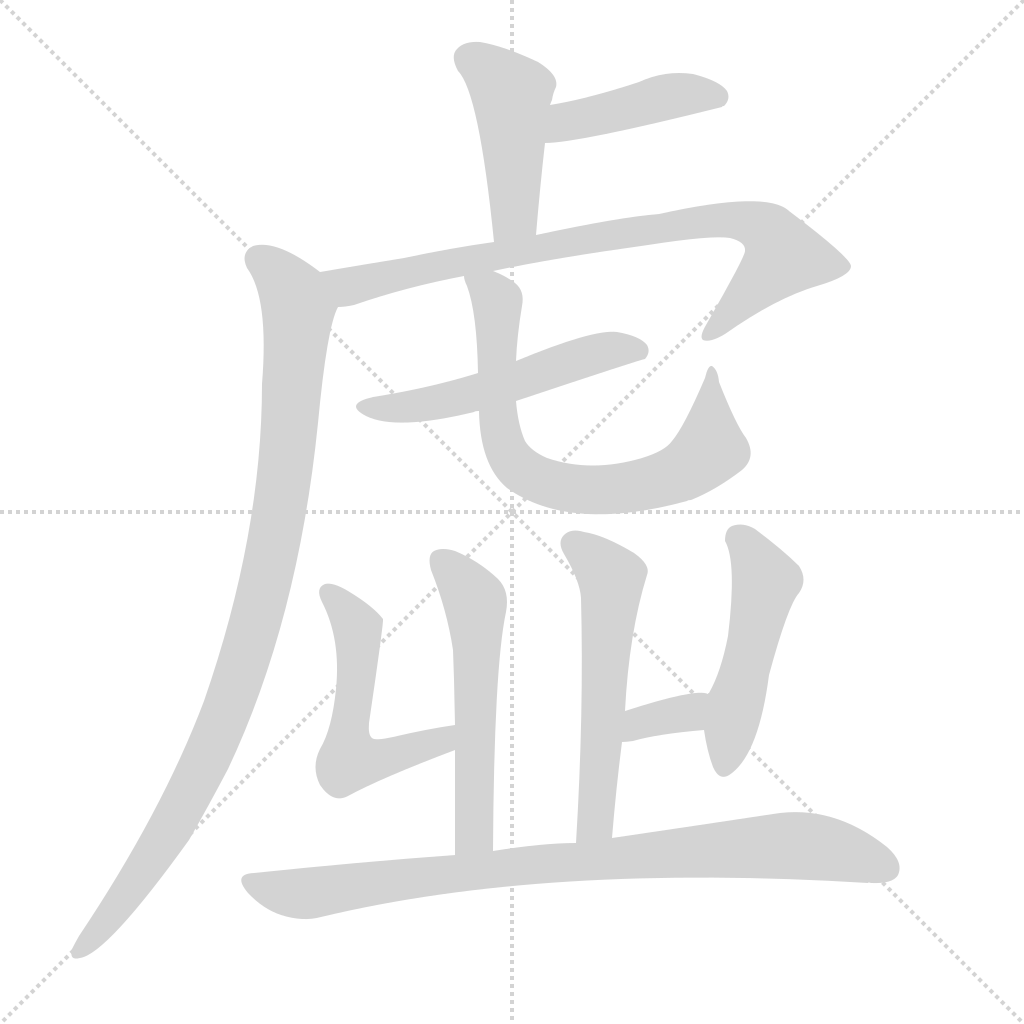
According to the Tang Rhyme (Tangyun), pronounced xü. According to the Collected Rhymes (Jiyun) and Orthography Rhymes (Zhengyun), pronounced xü. The meaning is empty or emptiness.
Also see the Book of Changes: Appended Statements (Yi Jing: Xici Zhuan): The six empty spaces circulate. Commentary: The six empty spaces refer to the six positions. Sub-commentary: This explains that the positions themselves lack substance; they only become manifest due to the presence of the lines (yao), hence they are called empty.
Also see the Record of Rites by Dai the Elder (Da Dai Liji): The people of the empty land are great. Commentary: Empty here means indulgent.
There is also the term isolated and empty (gu xü). Records of the Grand Historian: Biographies of Turtle and Yarrow Divination (Shiji: Guice Zhuan) records: When the days and hours are not complete, there is the phenomenon of isolated and empty.
It is also the name of a constellation. Book of Documents: Canon of Yao (Shangshu: Yaodian) records: At midnight, the empty star can be seen.
It is also a surname. Comprehensive Treatise on Clans and Lineages (Tongzhi: Shizulüe) records the Xu clan. Found in the Garden of Surnames (Xingyuan).
There is also Void-Nothingness (xuwu), the name of a mountain. Yan's Family Instructions (Yanshi Jiaxun) records: East of Bairen City there is an isolated mountain that some call Void-Nothingness Mountain.
According to the Expanded Rhymes (Guangyun), pronounced qü. Explanation of Graphs and Analysis of Characters (Shuowen Jiezi) defines it as a large hill. Collected Rhymes (Jiyun) explains that in ancient times, nine men constituted one well (jing), four wells constituted one settlement (yi), and four settlements constituted one hill (qiu); these hills were called empty (xü).
It is also a place name. Spring and Autumn Annals: Twelfth Year of Duke Huan (Chunqiu: Huan Gong Shier Nian) records: A meeting was held with the Duke of Song at the place called Xü. Commentary: Xü is a territory of the State of Song.
It is also the name of a river. History of the Former Han: Treatise on Geography (Qian Hanshu: Dilizhi) records: Langya Commandery has the Xü River.
It also indicates order or secondary rank. Discourses of the States: Discourses of Jin (Guoyu: Jinyu) records: The empty land of Shichen was occupied by the people of Jin.
According to the Rhyme Supplement (Yunbu), pronounced xǔ. The Book of Odes (Shijing) contains the line: Ascending that hill, gazing towards the land of Chu.
Also, for the sake of rhyme, pronounced wang. Daoist Canon Songs (Daozang Ge) sing: Leading the noble guests, returning to my pure spirit chamber. Within the spiritual foam of the ritual space, chanting directly upward into the Great Void. Administrative Record of Characters (Ganlu Zishu) records: It is also written as a variant form (xü).