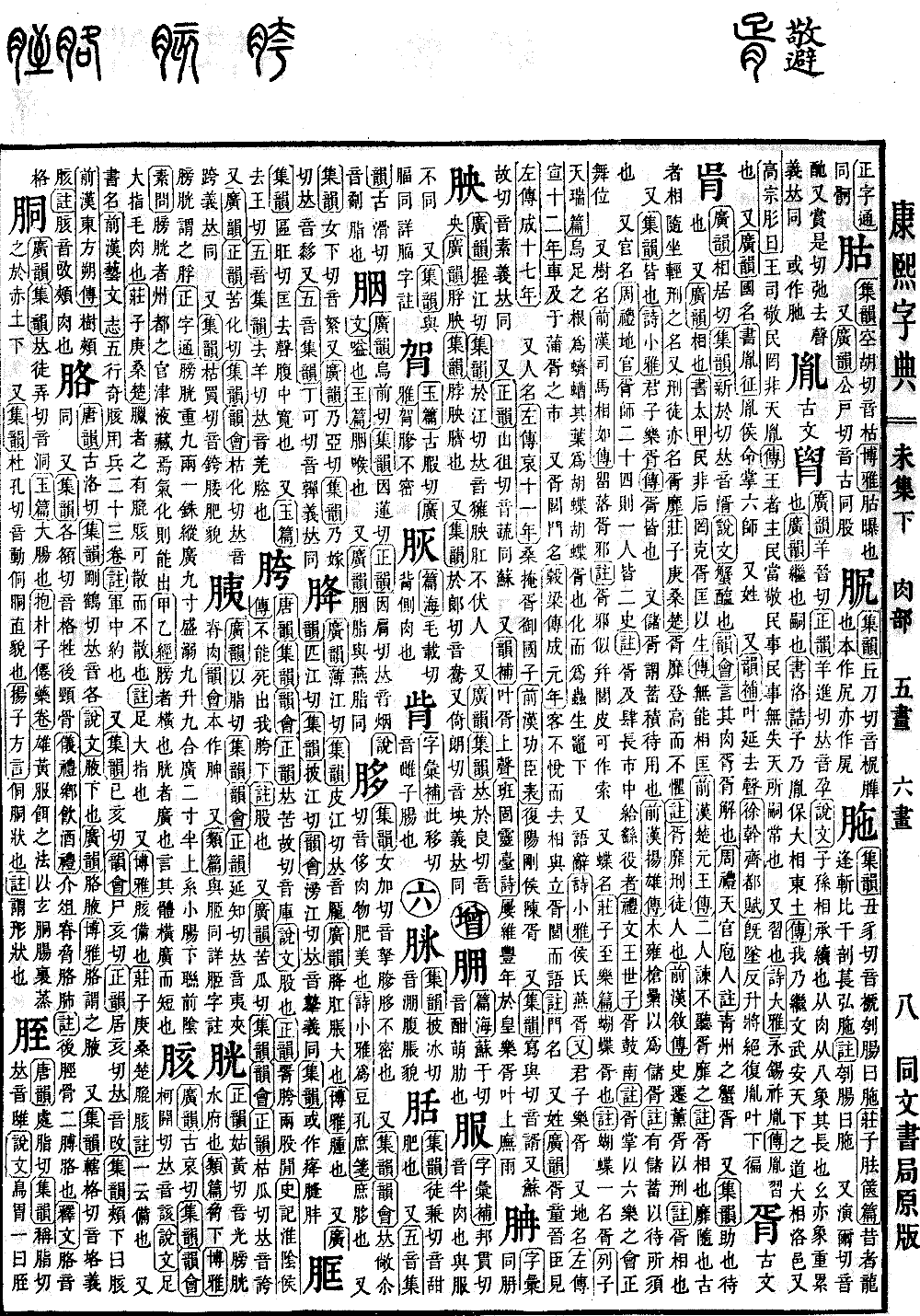
Wei Collection, Lower Volume
Radical: Meat (ròu)
Kangxi Strokes: 11
Page 980, Entry 06
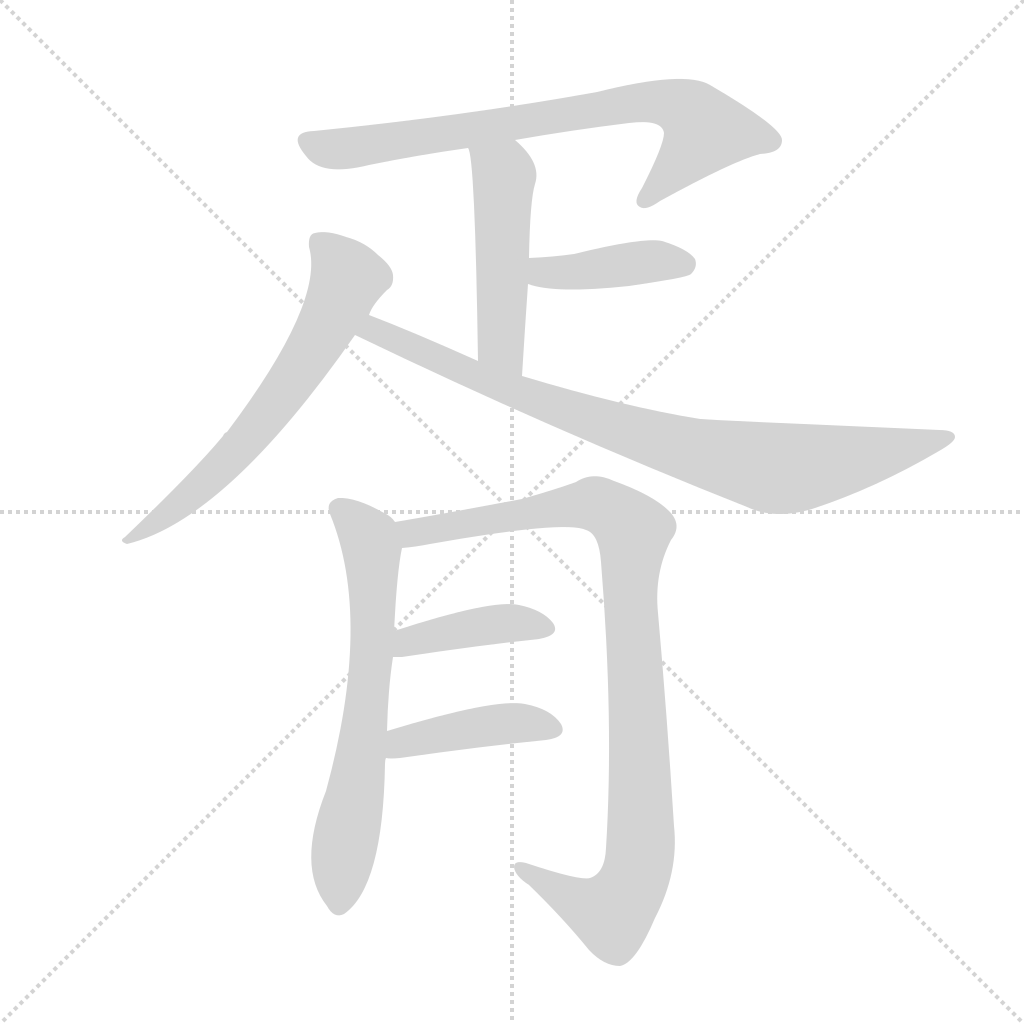
Ancient script. Pronounced xu.
Shuowen Jiezi (Explaining and Analyzing Characters): Crab paste.
Yunhui (Collection of Rhymes): It refers to meat that becomes loose and separates.
Zhou Rites (Zhouli), Offices of Heaven, Note on the Cook: Crab paste from Qingzhou.
Additionally, in Jiyun (Collection of Rhymes), it means to help or to wait.
Additionally, in Guangyun (Broad Rhymes), it means mutually.
Book of Documents (Shujing), Taijia: Without a ruler, the people cannot mutually assist each other to survive. Commentary: Unable to mutually assist.
History of the Former Han (Hanshu), Biography of Prince Chu Yuan: When the two men’s remonstrances were not heard, they were punished with the xumi penalty. Note: Xu means mutually; mi means to follow. In ancient times, this referred to light punishments incurred through mutual involvement. Penal laborers were also called xumi.
Zhuangzi, Gengsang Chu: Penal laborers climb high without fear. Note: Xumi, those who perform hard labor.
History of the Former Han (Hanshu), Collected Biographies: Sima Qian was involved and met with disaster. Note: Xu means mutually.
Additionally, in Jiyun, it means all or entirely.
Book of Odes (Shijing), Xiaoya: The noblemen are all joyful. Commentary: Xu means all.
Additionally, chuxu refers to accumulation for later use.
History of the Former Han (Hanshu), Biography of Yang Xiong: Using trees and bamboo poles to build layers of fencing as a reserve. Note: Refers to having reserves to wait for times of need.
Additionally, a title for officials.
Zhou Rites (Zhouli), Offices of Earth: The Xushi (Superintendent of the Xushi) manages every twenty shops, with one official assigned, each supported by two scribes. Note: The Xu and the Sichang (Market Superintendent) are officials who provide labor in the markets.
Book of Rites (Liji), Wenwang Shizi: The Xuguan (Superintendent of the Xu) is responsible for striking the southern music. Note: The Xuguan is in charge of using the coordination of the six types of music to calibrate dance positions.
Additionally, a type of tree.
History of the Former Han (Hanshu), Biography of Sima Xiangru: Liuluo and Xuya. Note: The Xuya resembles the binglü palm tree; its bark can be used to make ropes.
Additionally, a name for a butterfly.
Zhuangzi, Zhi Le: The butterfly is known as the Xu. Note: The butterfly is also called the Xu.
Liezi, Tianrui: The roots of the wuzu plant transform into beetle larvae, and its leaves transform into butterflies. The butterfly is the Xu. It transforms again into an insect, born under the cooking stove.
Additionally, a modal particle.
Book of Odes (Shijing), Xiaoya: The feudal lords are feasting. Also: The noblemen are joyful.
Additionally, a place name.
Zuo Tradition (Zuozhuan), Year 12 of Duke Xuan: The war chariots reached the market of Puxu.
Additionally, Xulu is the name of a gate.
Guliang Tradition (Guliang Zhuan), Year 1 of Duke Cheng: The guest left in displeasure, and they stood talking under the Xulu Gate. Note: The name of a gate.
Additionally, a surname.
Guangyun (Broad Rhymes): Xu Tong, a minister of the Jin state. See Zuo Tradition (Zuozhuan), Year 17 of Duke Cheng.
Additionally, a personal name.
Zuo Tradition (Zuozhuan), Year 11 of Duke Ai: Sang Yanxu drove the chariot for Guozi.
History of the Former Han (Hanshu), Table of Meritorious Officials: The Fuyang Gang Marquis Chen Xu.
Additionally, in Jiyun, pronounced xu. Additionally, pronounced su. The meaning is the same.
Additionally, in Zhengyun (Correct Rhymes), pronounced shu. Identical to su.
Additionally, in Yunbu (Rhyme Supplement), the rhyme is categorized with xu (rising tone).
Ban Gu, Lingtai Poem: Successive years of abundant harvests. Ah, the king is happy. Rhymes with the preceding words wu and yu.
Textual Research: Zhou Rites (Zhouli), Offices of Earth: The Xushi manages twenty-four shops, with one official assigned, each supported by two scribes. Corrected according to the original text from twenty-four to twenty shops.