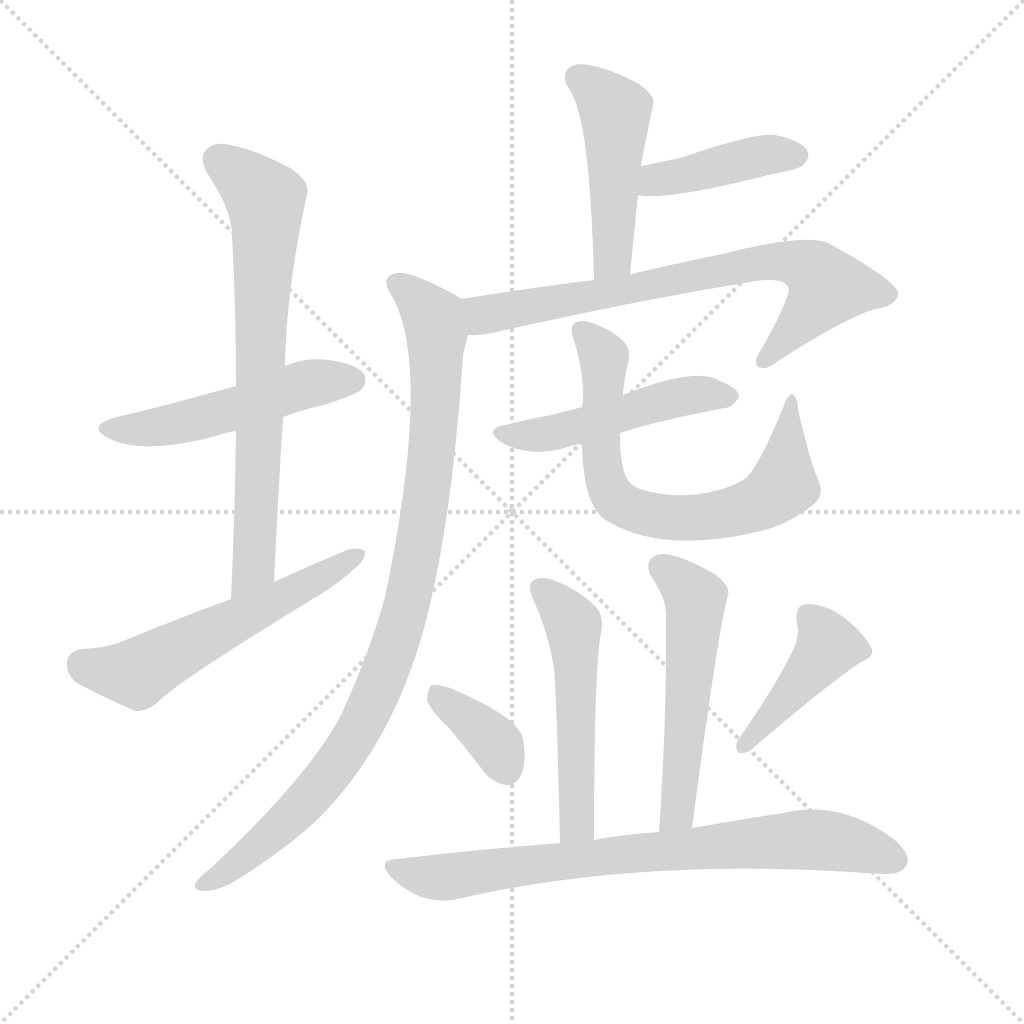
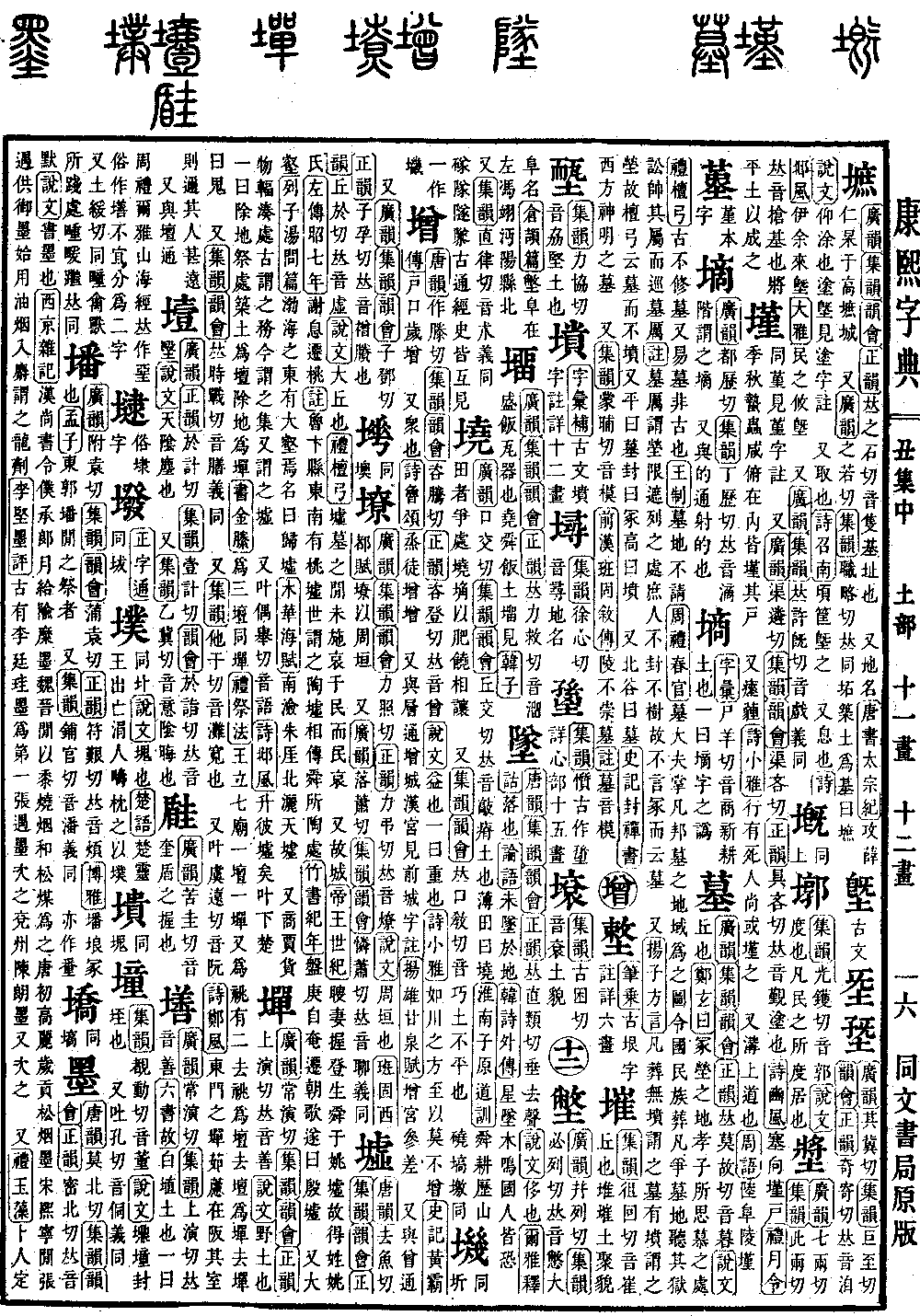
Chou Collection, Middle Volume. Radical: Earth (tǔ). Kangxi brush strokes: 15. Page 238, Entry 28.
Pronounced xu.
According to the Explaining Graphs and Analyzing Characters (Shuowen Jiezi), it refers to a large mound. In the Book of Rites (Liji), specifically the Tan Gong chapter, it states: In the space between mounds and graves, when mourning had not yet been formally enacted for the people, the people already mourned.
It also refers to an ancient city site. The Records of Emperors and Kings (Diwang Shiji) notes: The wife of Sou, named Wodeng, gave birth to Shun at Yao Mound, which is why he took the surname Yao. The Zuo Tradition (Zuo Zhuan), in the seventh year of Duke Zhao, mentions the relocation of Xie to Tao. The commentary states: Southeast of Bian County in the state of Lu there is Tao Mound, commonly known as Potters Mound, traditionally said to be the place where Shun made pottery. The Bamboo Annals (Zhushu Jinian) states: Pan Geng moved from Yan to Chao Ge, which subsequently became known as the Yin Ruins.
It also refers to a great abyss. The Liezi, in the Tang Wen chapter, states: East of the Bohai Sea is a great abyss, known as Gui Mound. Mu Hua in his Rhapsody on the Sea (Hai Fu) writes: To the south it washes the Vermilion Cliff, to the north it sprinkles the Celestial Mound.
It also refers to a place where merchants and goods gather. In ancient times this was called a service, today it is called a gathering, and it is also called a mound.
Also pronounced yu. In the Book of Odes (Shijing), Beifeng section: I ascended that mound. Rhymes with the following chu.