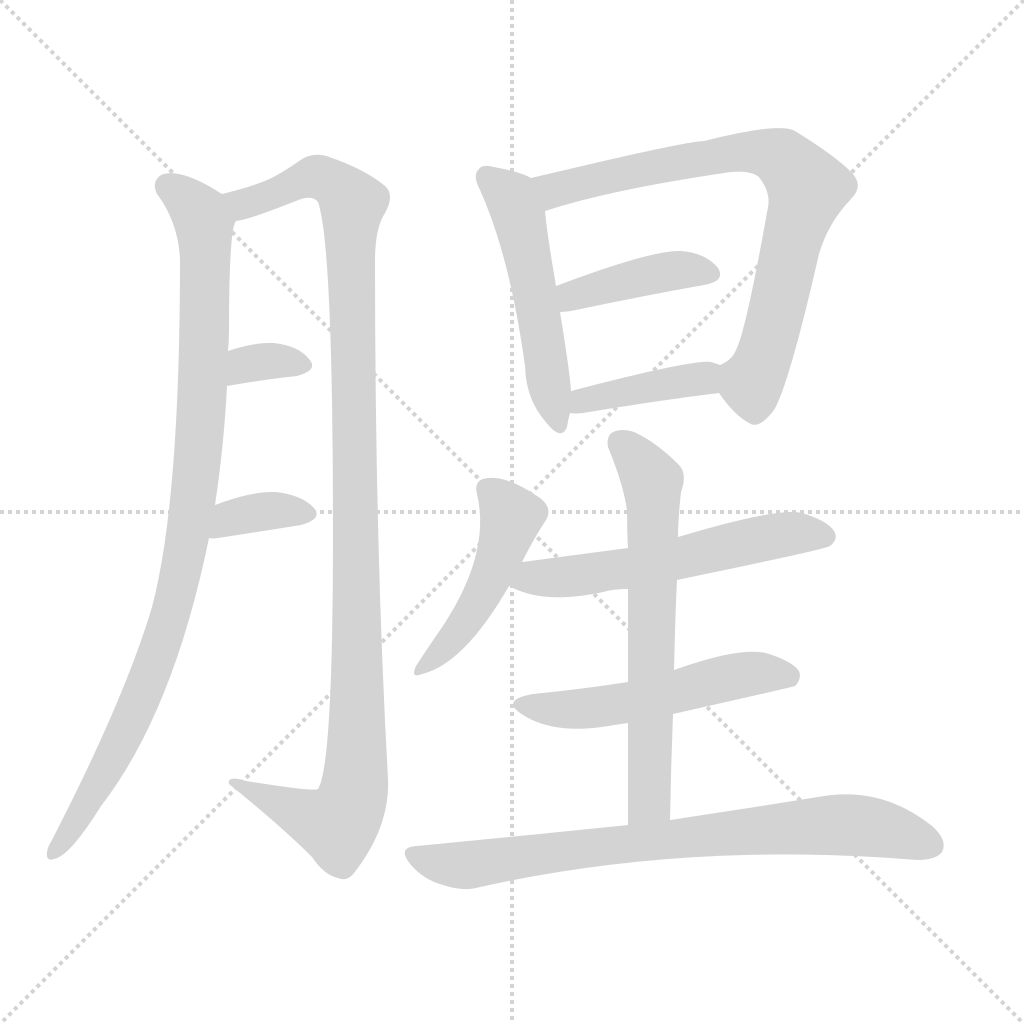
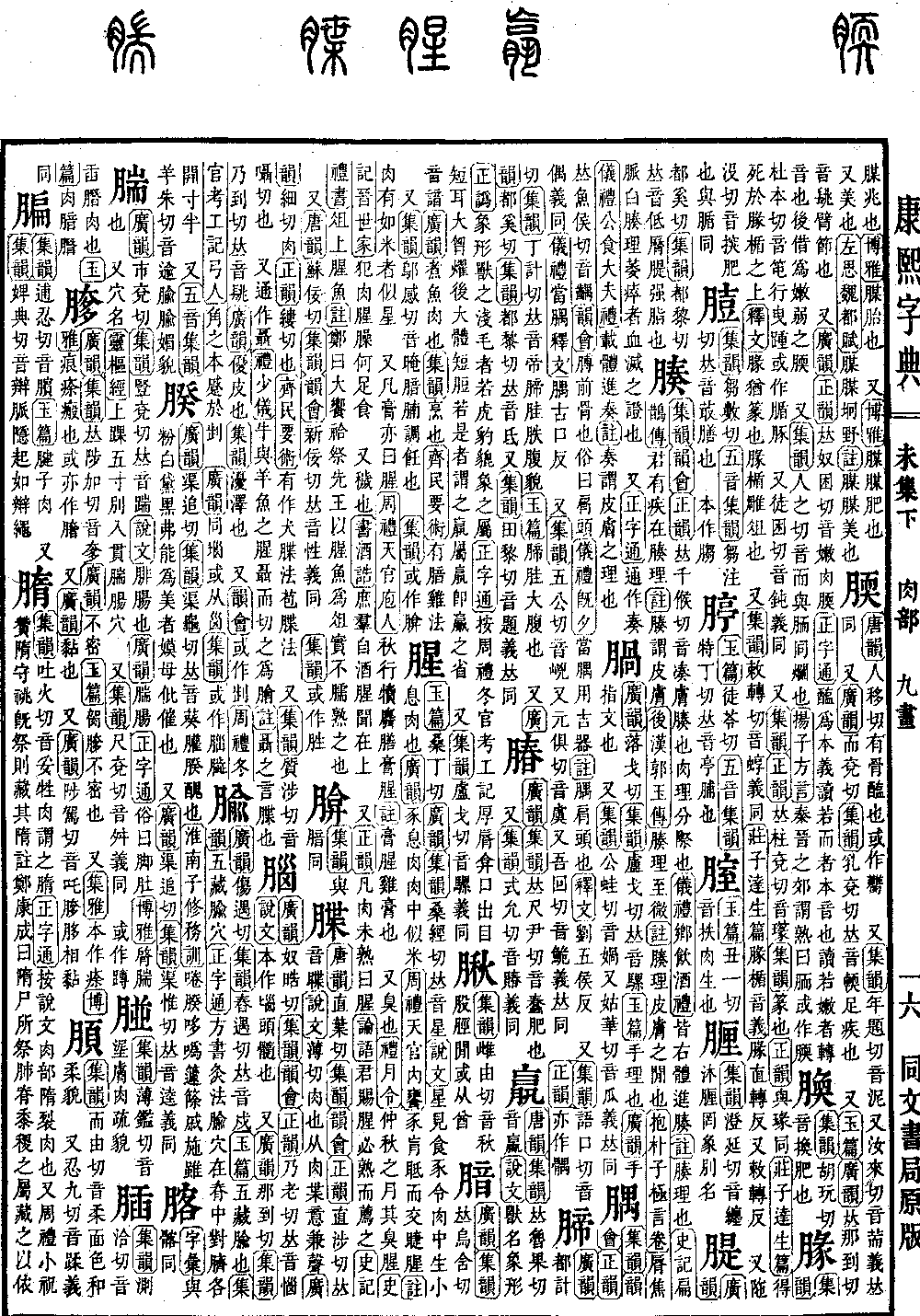
Wei Collection, Lower Volume
Radical: Meat (ròu)
Kangxi Strokes: 15
Page 988, Entry 17
According to the Jade Chapters (Yupian), pronounced xing. According to the Wide Rhymes (Guangyun) and Collected Rhymes (Jiyun), pronounced xing, with the sound of star.
In the Discussion of Script (Shuowen), it refers to the appearance of small, grain-like cysts in pork meat. In the Wide Rhymes, it is described as pig cysts, which resemble grains of rice within the flesh.
In the Rites of Zhou (Zhouli), Book of Heaven (Tianguan), Internal Chef section: When pigs have cataracts and their lashes touch, the meat is called xing. The commentary notes that meat containing grain-like cysts resembles stars.
Additionally, animal fat is also called xing. In the Rites of Zhou (Zhouli), Book of Heaven (Tianguan), Chef section: In autumn, one should serve the meat of calves and fawns with animal fat. The commentary notes that this fat is specifically chicken fat.
It also means foul-smelling. In the Book of Rites (Liji), Monthly Ordinances (Yueling): During the second month of autumn, the foul smell is that of xing. In the Records of the Grand Historian (Shiji), Annals of Jin: Consuming foul, raw meat, what is there to eat?
It also means filth. In the Book of Documents (Shujing), Announcement on Wine (Jiugao): The common people become intoxicated with wine, and the stench rises to the heavens above.
According to the Orthography Rhymes (Zhengyun), all meat that is uncooked is called xing. In the Analects (Lunyu): When the ruler bestowed raw meat, one had to cook it before offering it in sacrifice. In the Records of the Grand Historian (Shiji), Book of Rites: Raw fish placed on the sacrificial stand. The commentary by Zheng notes: For great ancestral sacrifices, raw fish is used as a sacrificial offering, and it is not cooked or boiled.
Also, according to the Tang Rhymes (Tangyun), pronounced xing; according to the Collected Rhymes (Jiyun) and the Rhyme Collection (Yunhui), pronounced xing. The meaning is the same. According to the Collected Rhymes, it is sometimes written as a variant form (sheng).