Wei Collection, Lower Volume
Radical: Mortar (jiù)
Xing; Kangxi Stroke Count: 15; Page: 1005
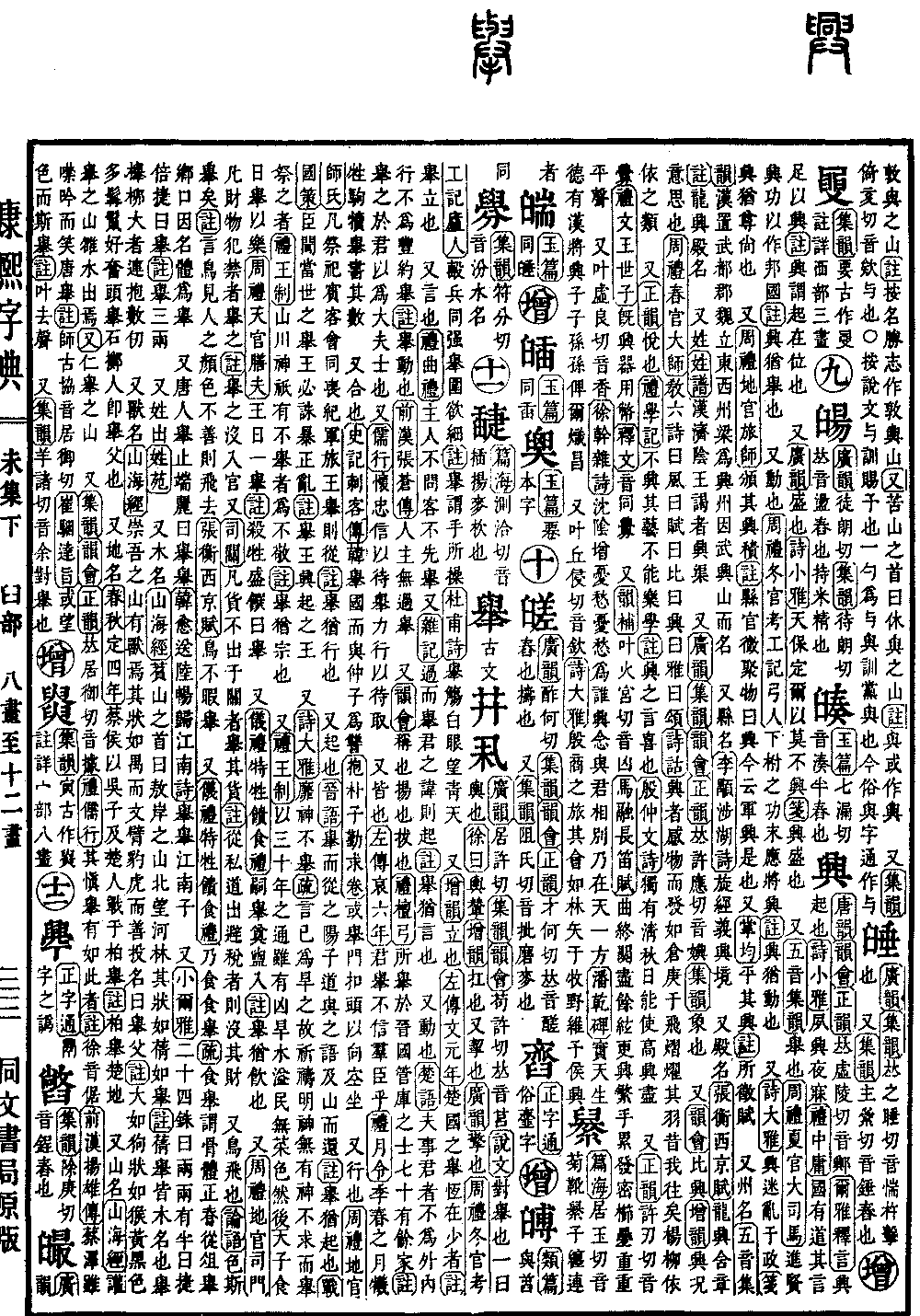
Tang Rhymes (Tangyun), Rhyme Collection (Yunhui), and Correct Rhymes (Zhengyun) all provide the fanqie pronunciation using the initial of xu and final of ling, pronounced xing. Erya, Explaining Words (Shiyan) states that xing means to rise or start. Book of Odes (Shijing), Minor Odes (Xiaoya) mentions rising early and sleeping late. Book of Rites (Liji), Doctrine of the Mean (Zhongyong) states that when the state follows the Way, one's words are sufficient to cause one to rise. The commentary notes that here xing refers to serving as an official in court. Also, Expanded Rhymes (Guangyun) defines it as flourishing. Book of Odes, Minor Odes states that Heaven protects and establishes you, so that nothing does not flourish. The note explains that xing means flourishing. Also, Collected Rhymes of the Five Sounds (Wuyin Jiyun) defines it as to raise or promote. Rites of Zhou (Zhouli), Summer Officials, Minister of War mentions promoting the worthy and raising up those with merit to build the state. The commentary notes that xing is used like the word for recommendation. Also, it means to move. Rites of Zhou, Winter Officials, Artificers' Record (Kaogongji), Bow Maker mentions that when the lower handle is worked, the ends respond and will move. The commentary notes that xing is used like the word for move. Also, Book of Odes, Greater Odes (Daya) mentions promoting confusion in the government. The note explains that xing is used like the word for honor or esteem. Also, Rites of Zhou, Earth Officials, Travelers' Master mentions distributing the collected stores. The commentary notes that government collection of materials is called xing, similar to what is now called military mobilization or junxing. Also, in the Overseer of Crops (Sijia) section, it mentions regulating the levies. The commentary notes this refers to the taxes collected. Also, the name of a prefecture. Collected Rhymes of the Five Sounds states that during the Han dynasty, Wudu Commandery was established, and the Wei state established East and West Prefectures; during the Liang dynasty, it was called Xing Prefecture, named after Mount Wuxing. Also, the name of a county. Li Yong's poem Crossing the Lake (Shehu Shi) mentions soon passing through the border of Yixing. Also, the name of a palace hall. Zhang Heng's Western Capital Rhapsody (Xijing Fu) mentions Longxing and Hanzhang. The commentary notes that Longxing is the name of a palace hall. Also, a surname. Genealogy of Surnames (Xingpu) mentions Xing Qu, an attendant to the Prince of Jiyin during the Han dynasty.
Also, Expanded Rhymes, Collected Rhymes (Jiyun), Rhyme Collection, and Correct Rhymes provide the fanqie pronunciation using the initial of xu and final of ying, pronounced xing in the departing tone. Collected Rhymes defines it as a symbol. Also, Rhyme Collection mentions comparison and evocative imagery or bixing. Augmented Rhymes (Zengyun) states that xing refers to metaphorical meaning. Rites of Zhou, Spring Officials, Grand Master mentions teaching the six types of poetry: ballads, narration, comparison, evocative imagery, elegantiae, and hymns. Explanations of the Odes (Shigu) states that xing refers to being moved by external things and expressing it, such as the orioles are flying, their feathers gleaming, or when I left long ago, the willows were fresh and green. Also, Correct Rhymes defines it as joy. Book of Rites, Record of Learning (Xueji) states that if one does not take interest in the arts, one cannot find joy in learning. The commentary notes that xing refers to liking or taking interest. Yin Zhongwen's poem mentions that only clear autumn days can make one's high spirits reach their peak.
Also, Correct Rhymes provides the fanqie pronunciation using the initial of xu and final of ren, pronounced similarly to xin. Book of Rites, King Wen as Heir Apparent (Wenwang Shizi) mentions after the ritual vessels have been consecrated with blood and the silks used. The textual explanation notes the pronunciation is the same as the word for consecrating with blood or xin.
Also, Rhyme Supplement (Yunbu) provides a rhyming pronunciation like xiong. Ma Rong's Rhapsody on the Long Flute (Changdi Fu) mentions that when the tune ends and the piece is finished, the remaining strings rise again; the busy hands play repeatedly, like the dense teeth of a comb. Also, a rhyming pronunciation like xiang. Xu Gan's Miscellaneous Poems (Zashi) mentions that deep gloom increases sorrow, and for whom does this sorrow rise; thinking of the parting from you, you are at the other end of the sky. Pan Qian's work states that truly Heaven bestows virtue, and the Han shall rise; may your sons and grandsons be numerous and prosperous. Also, a rhyming pronunciation like qin. Book of Odes, Greater Odes mentions that the troops of Yin and Shang were like a forest; they were deployed at Muye, and we rose up as lords.
Textual Research: Regarding the phrase regulating the levies originally attributed to Zhangjun, note that the Rites of Zhou has no official called Zhangjun. The citation actually comes from the Earth Officials, Overseer of Crops. Zhangjun is hereby corrected to Sijia.