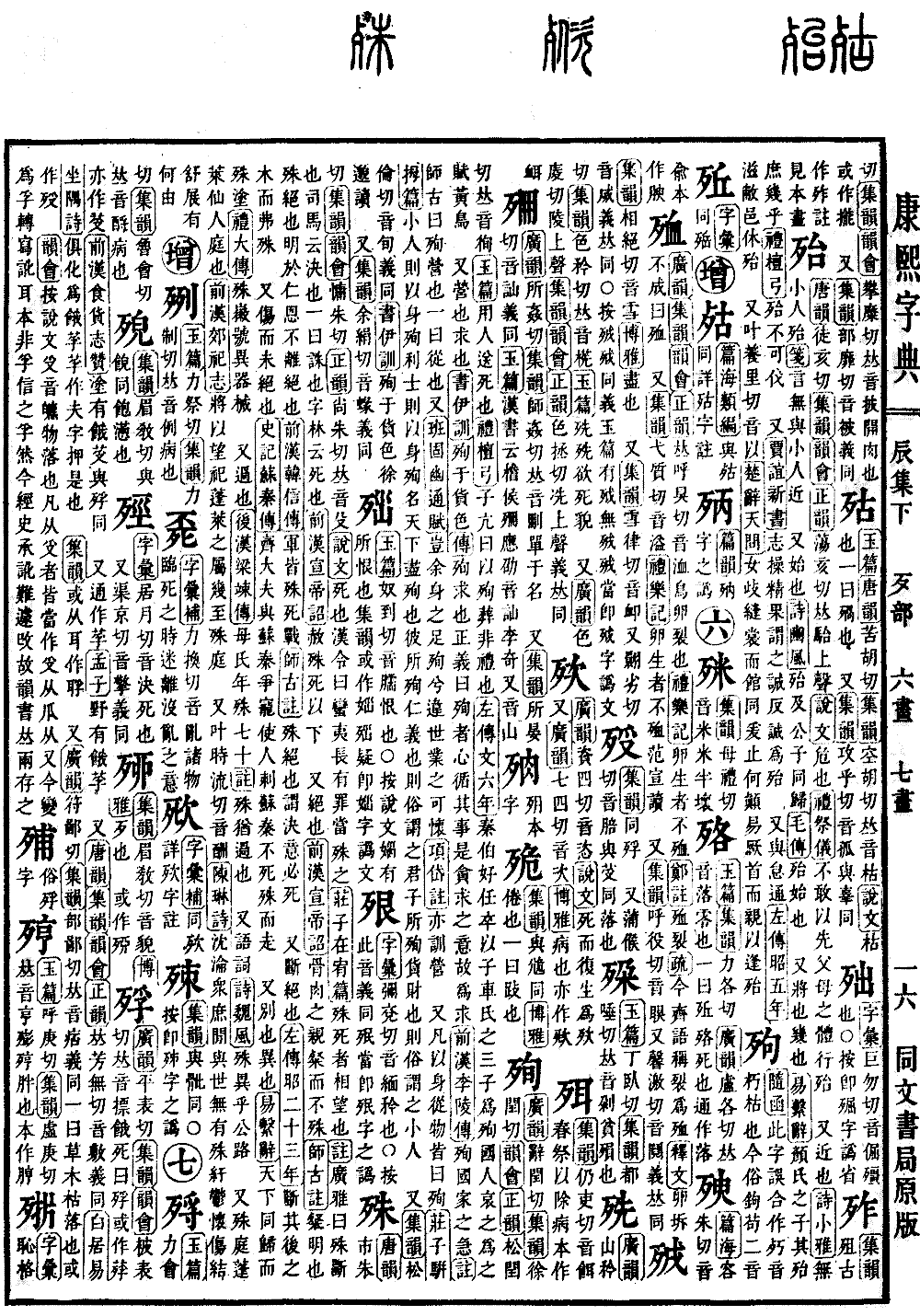
Chen Collection, Lower Volume
Radical: Bad (dǎi)
Kangxi Strokes: 10
Page 580, Entry 22
Pronounced xùn.
As defined in the Yu Pian, the act of using people to accompany the deceased in burial.
From the Book of Rites (Liji): Zikang said, using living people for burial is not in accordance with the rites.
From the Zuo Tradition (Zuozhuan): When Duke Mu of Qin (Qinbo Renhao) passed away, three sons of the Ziche clan were used for burial. The people of the Qin state mourned them and composed the poem Yellow Bird (Huangniao).
Also refers to managing or pursuing.
From the Book of Documents (Shangshu): To be obsessed with wealth and women. The commentary states, to be obsessed is to be greedy. The sub-commentary states, to be obsessed means the mind revolves around a certain matter, which is greed, therefore it is interpreted as pursuit.
From the Book of Han (Hanshu): To sacrifice oneself for the urgent needs of the state. The commentary by Yan Shigu states, to sacrifice is to manage. Another interpretation is to follow.
Also, from the You Tong Fu by Ban Gu: Is it worthy for me to follow this with my own body, abandoning the career passed down through generations that is worth remembering? The commentary by Xiang Dai also interprets this as managing.
Furthermore, any act of sacrificing oneself to pursue something is called sacrifice.
From the Zhuangzi: Small men sacrifice their lives for profit, and scholars sacrifice their lives for fame; everyone in the world is making sacrifices. Those who sacrifice for benevolence and righteousness are called gentlemen by the worldly, while those who sacrifice for wealth are called small men.
Pronounced xùn. The meaning is the same. As mentioned in the Book of Documents (Shangshu), to be obsessed with wealth and women. This is the reading provided by Xu Miao.
Pronounced yuán. The meaning is the same.
Textual research: In the Zuo Tradition, the text mentions Duke Mu of Qin passing away. It should be noted that in the original text, the name has been corrected from Ren Hao to Ren Hao.