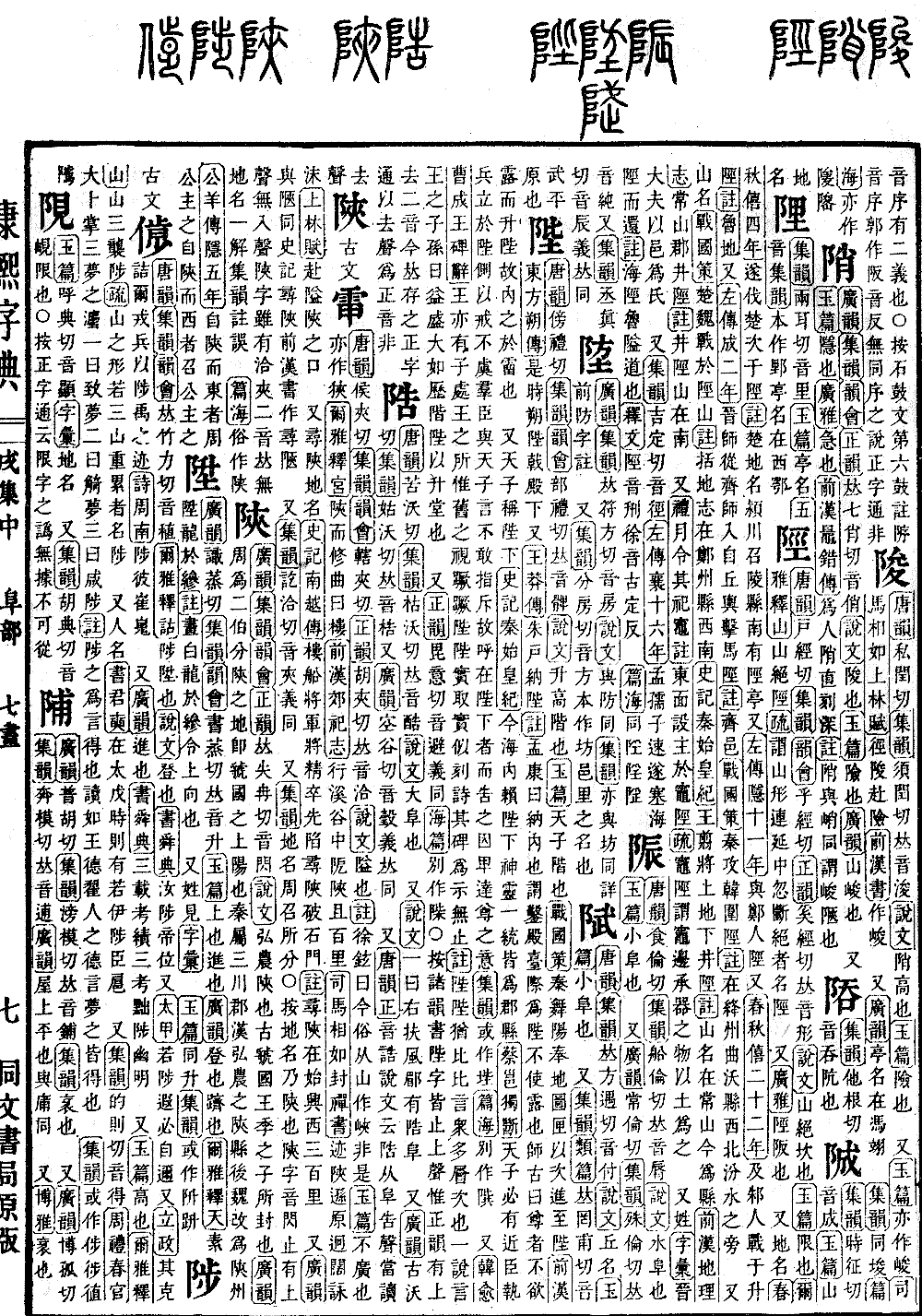
Xu Collection, Middle Volume. Radical: Mound (fù). Xing. Kangxi stroke count: 15. Page 1351.
According to the Tang Rime (Tangyun), the pronunciation is a combination of the sounds hù and jīng. According to the Collected Rimes (Jiyun) and the Collected Assembly of Rimes (Yunhui), it is a combination of hū and jīng. According to the Correct Rimes (Zhengyun), it is a combination of xī and jīng. It is pronounced like xíng.
According to the Explanation of Graphs and Characters (Shuowen Jiezi), it refers to a break or pit in a mountain range. According to the Jade Chapters (Yupian), it means a limit or boundary. According to the section on mountains in the Approaching the Correct (Erya), a break in a mountain range is called a xíng. The sub-commentary explains that when a mountain range is continuous but suddenly interrupted, it is called a xíng. According to the Broad Rimes (Guangyun), a xíng refers to a slope.
It is also used as a place name. In the Spring and Autumn Annals (Chunqiu), during the fourth year of Duke Xi, it is recorded that the army attacked Chu and halted at Xing. The commentary notes this was a location in Chu; south of Shaoling County in Yingchuan, there is a Xing Pavilion. In the Zuo Commentary (Zuozhuan), during the eleventh year of Duke Yin, it is recorded that he gave Xing to the people of Zheng. In the Spring and Autumn Annals, during the twenty-second year of Duke Xi, it is recorded that they fought with the people of Zhu at Shengxing. The commentary notes this was a place in the State of Lu. In the Zuo Commentary, during the second year of Duke Cheng, the Jin army followed the Qi army, entered through Qiuyu, and attacked Maxing. The commentary notes this was a city in the State of Qi. In the Strategies of the Warring States (Zhanguoce), it is recorded that Qin attacked Han and besieged Xing. The commentary notes it was located northwest of Quwo County in Jiangzhou, by the Fen River.
It is also used as a mountain name. In the Strategies of the Warring States, it is recorded that Chu and Wei fought at Mount Xing. The Record of the Land (Kuodizhi) notes it was southwest of Zhengzhou County. In the Records of the Grand Historian (Shiji), in the Annals of Qin Shi Huang, it is recorded that Wang Jian took the upper lands and descended to Jingxing. The commentary notes this is a mountain name in Changshan, currently a county. In the Book of Han (Hanshu), in the Treatise on Geography, it mentions Jingxing in Changshan Commandery. The commentary notes Mount Jingxing is in the south.
In the Book of Rites (Liji), in the section Monthly Ordinances (Yueling), the commentary on the sacrifice to the Stove God mentions facing east and placing the ancestral tablet at the zàoxíng. The sub-commentary states that the zàoxíng refers to the earthen structure beside the stove used for supporting vessels.
It is also a surname. According to the Lexicon of Characters (Zihui), it was the name of a high official of the State of Jin who took his surname from his fief.
Furthermore, according to the Collected Rimes, it is also pronounced as a combination of jí and dìng, sounding like jìng. In the Zuo Commentary, during the sixteenth year of Duke Xiang, it is recorded that Meng Ruzi Su then blocked Haixing and returned. The commentary notes Haixing was a narrow pass in the State of Lu. The Explanations of Text (Shiwen) provides the pronunciation of xíng. The scholar Xu provides a pronunciation using the combination of gǔ and dìng. The Sea of Characters (Pianhai) provides the same information.