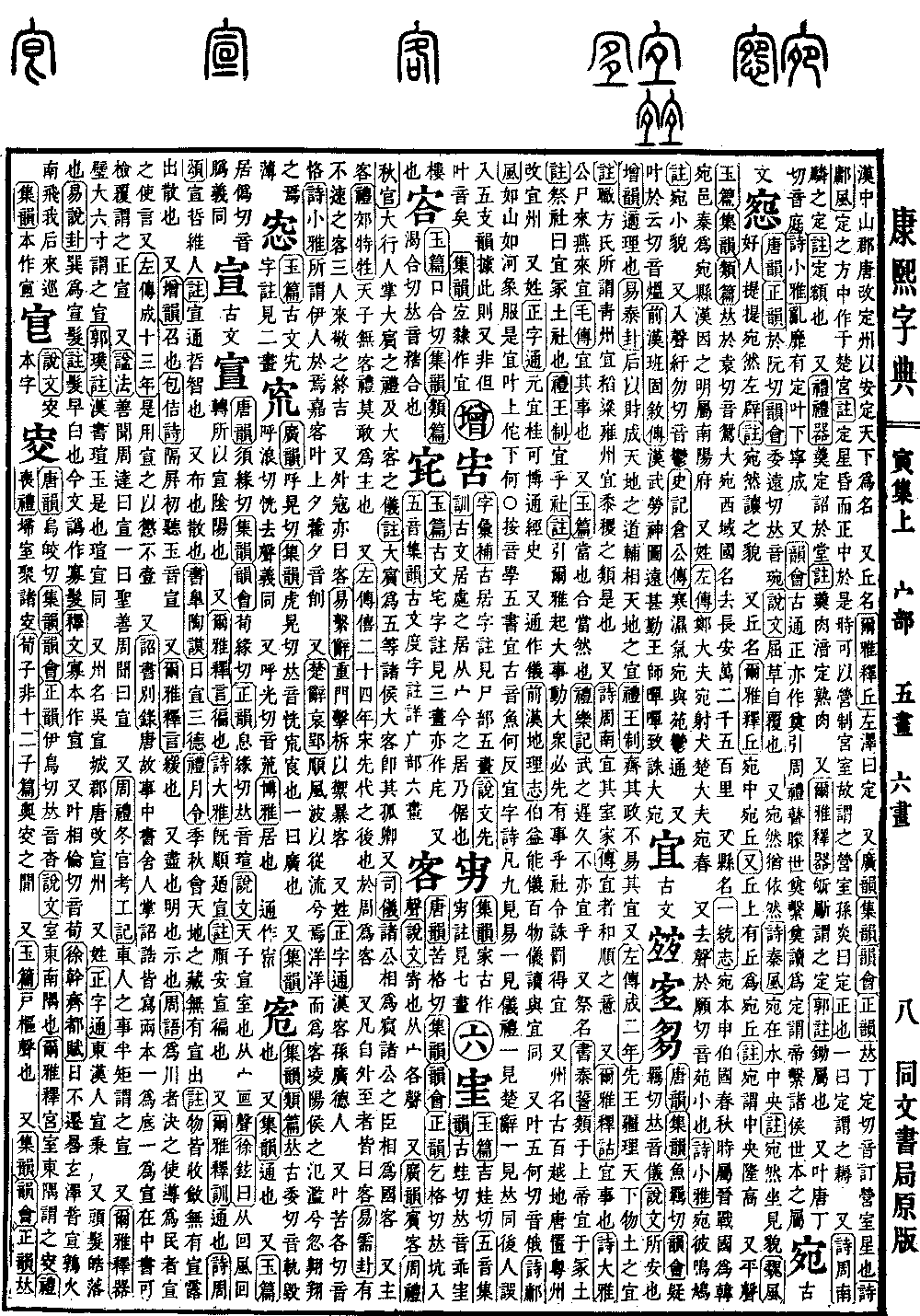
Yin Collection, Upper Volume
Radical: Roof (bù)
宣
Kangxi Stroke Count: 9
Page 284, Entry 16
Ancient Phonology: Tang rhymes, pronounced xuan. Collected Rhymes and Rhyme Collection, pronounced xuan. Correct Rhymes, pronounced xuan.
Explanation of Graphs (Shuowen): The Xuan chamber of the Son of Heaven. The character is formed by the radical for roof, with the phonetic component meaning to extend. Xu Xuan comments: It is formed from returning, representing wind circling and flowing, used to circulate and conduct yin and yang.
Additionally: Meaning to reach everywhere. Book of Odes (Shijing): Already peaceful, then reach everywhere. Annotation: Smooth, peaceful. Xuan means to reach everywhere.
Additionally: Meaning to connect or comprehend. Zuo Tradition (Zuozhuan), Jia Kui annotation: To comprehend. Book of Odes (Shijing): To comprehend and be wise is the foundation of being human. Annotation: Xuan means to comprehend. Zhe means wisdom.
Additionally: Meaning to announce or disperse. Classic of History (Shangshu): Daily proclaim three kinds of virtue. Book of Rites (Liji), Monthly Ordinances (Yueling): In the late autumn season, one should harmonize with the heaven and earth's energy of storage; one must not allow for leakage or dispersal. Annotation: All things should be restrained; there must be no leakage or spreading.
Additionally: Expanded Rhymes (Zengyun): Meaning to summon. Bao Ji poem: Through a screen, one first hears the sound of the ruler summoning.
Additionally: Literary Exegesis (Erya, Shiyan): Meaning relaxed or slow.
Additionally: Meaning to exhaust, clarify, or express. Discourses of the States (Guoyu, Zhouyu): Those who govern rivers should dredge them to make them flow freely; those who govern the people should guide them to speak their minds.
Additionally: Zuo Tradition (Zuozhuan), Year 13 of Duke Cheng: Therefore, make it known to the masses to punish those who are not single-minded.
Additionally: Records of Imperial Edicts: Under the old system of the Tang dynasty, the Secretariat Drafters in charge of imperial edicts had to copy them twice: one copy was the base copy, and one was the public copy, which could be verified in the Secretariat, known as the official proclamation.
Additionally: Canon of Posthumous Titles: Those who are good at listening and universally comprehending are titled Xuan. Another theory states that those who are sagely, virtuous, and widely knowledgeable are titled Xuan.
Additionally: Rites of Zhou (Zhouli), Winter Bureau, Artificers' Record: In the work of a wheelwright, a half-square angle is called Xuan.
Additionally: Literary Exegesis (Erya, Shiqi): A jade disc with a diameter of six inches is called Xuan. Guo Pu annotation: The Xuan jade mentioned in the Book of Han (Hanshu) is this. Xuan and Xuan are the same.
Additionally: A prefecture name. During the Three Kingdoms period, Wu established Xuan Cheng Commandery; the Tang dynasty renamed it Xuan Prefecture.
Additionally: A surname. Zhengzitong: In the Eastern Han dynasty, there was Xuan Bing.
Additionally: Hair turning gray or falling out. Book of Changes (Yijing), Explanation of the Trigrams: The Xun trigram symbolizes sparse hair. Annotation: Hair turning gray early. Modern texts mistakenly write it as sparse hair. Commentary: The character for sparse was originally written as Xuan.
Additionally: Rhyming with the character for xun. Xu Gan, Qi Capital Rhapsody: The sun's shadow has not moved, and the grace is widely announced. The Quail Fire star flies south, and my ruler subsequently makes an inspection. Collected Rhymes: The original character is written as such.
Textual Criticism: Literary Exegesis (Erya, Shixun): To comprehend. I respectfully note that the Erya does not contain this text. It has been changed to the Zuo Tradition (Zuozhuan) Jia Kui annotation. The Jia annotation appears in Records of the Grand Historian (Shiji), Volume 42.