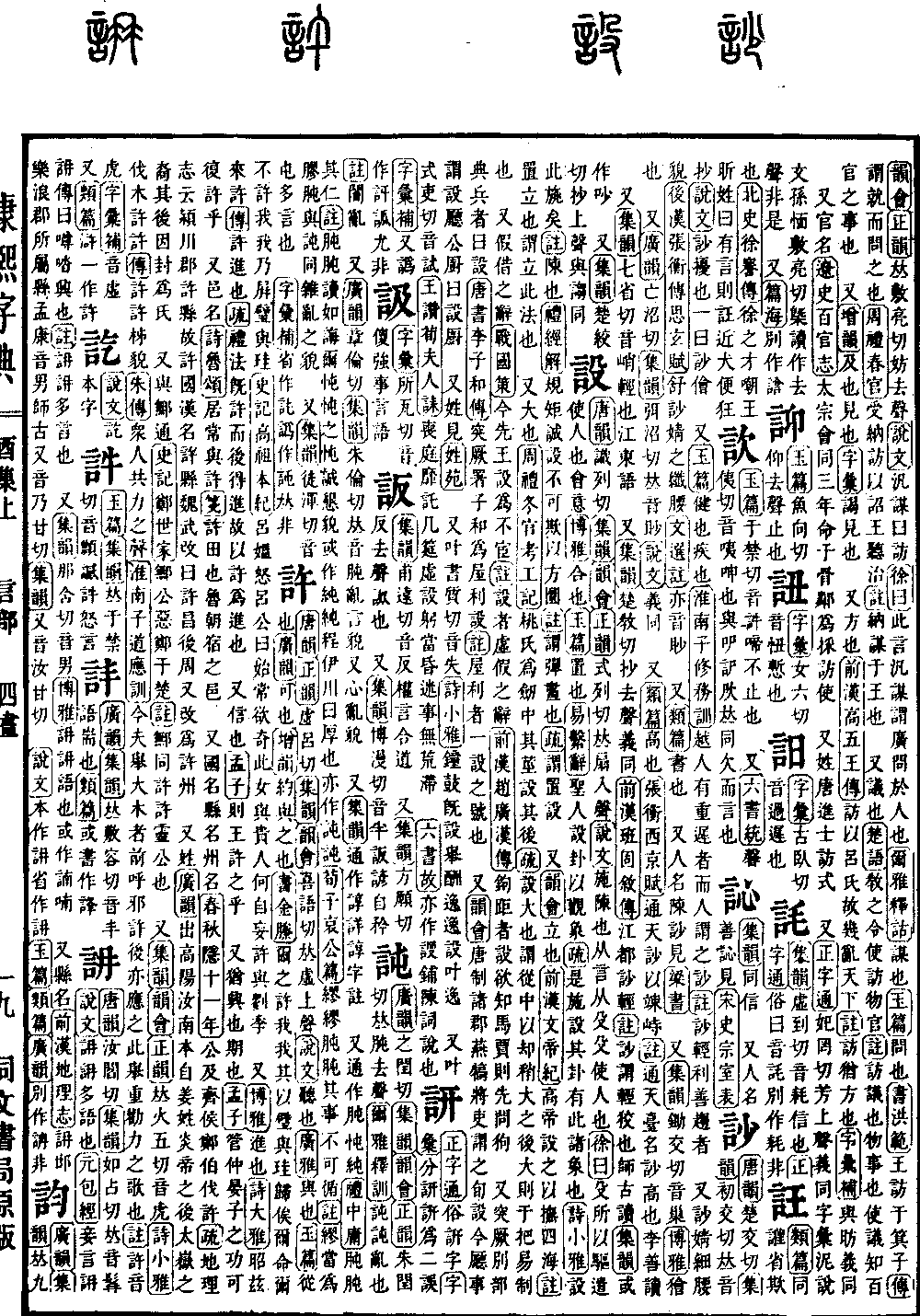
You Collection, Upper Volume
Radical: Speech (yán)
Xu
Kangxi strokes: 11
Page 1151, Entry 01
Pronounced xǔ (rising tone)
According to the Shuo Wen Jiezi (Shuo Wen), it means to listen. In the Guang Ya, it means to give. In the Yu Pian, it means to follow. In the Guang Yun, it means to permit. In the Zeng Yun, it means to promise to give. In the Book of Documents (Shangshu), specifically the Metal-bound Coffer (Jinteng) chapter: If you promise me, I shall return with the jade disk and the jade scepter and await your command. If you do not promise me, I shall discard the jade disk and the jade scepter. In the Records of the Grand Historian (Shiji), Biography of Gaozu: Mother Lu was angry. Father Lu said: I always thought this girl was extraordinary and should be with a noble person, why did I rashly promise her to Liu Ji? Also, in the Bo Ya, it means to advance. In the Book of Odes (Shijing), Greater Odes of the Kingdom: Brightly he comes to advance. The commentary states: Xu means to advance. The sub-commentary states: Since the ritual laws have permitted it, only then may one advance, therefore Xu is taken to mean advance. It also means to believe. In Mencius: Then would the King believe him? It also means to rise or to expect. In Mencius: Can the achievements of Guan Zhong and Yan Zi be expected to be repeated? Also, the name of a place. In the Book of Odes (Shijing), Odes of Lu: He dwelt in Chang and Xu. The commentary states: Xu is a field, a town where the ruler of Lu stayed overnight on his travels. Also, the name of a state, a county, and a prefecture. In the Spring and Autumn Annals (Chunqiu), 11th year of Duke Yin: The Duke, the Marquis of Qi, and the Earl of Zheng attacked Xu. The sub-commentary states: The Treatise on Geography states: Yingchuan Commandery, Xu County, was the former State of Xu. During the Han Dynasty it was called Xu County; Cao Cao of the Wei Dynasty changed it to Xuchang, and during the Northern Zhou Dynasty it was changed to Xu Prefecture. Also, a surname. In the Guang Yun: Originating from Gaoyang and Runan, they are originally of the Jiang surname, descendants of the Flame Emperor, and offspring of Taiyue; later, they took the title of their fief as their surname. Also, interchangeable with the character Xu (xǔ). In the Records of the Grand Historian (Shiji), House of Zheng: The Duke of Xu slandered Zheng to Chu. The commentary states: Xu is the same as Xu, referring to Duke Ling of Xu.
Pronounced hǔ
In the Book of Odes (Shijing), Lesser Odes of the Kingdom: Felling trees with a sound. The commentary states: A sound while felling trees. Zhu Xi's commentary states: The sound of a crowd exerting strength together. In the Huainanzi, Dao Ying Xun: When lifting a heavy log, those in front call out and those behind respond, this is the song for encouraging strength while lifting heavy objects. The commentary states: Xu is pronounced hǔ. The Zi Hui Bu states: It is pronounced xū.
In the Lei Pian, the character Hu (hǔ) is sometimes written as Xu.