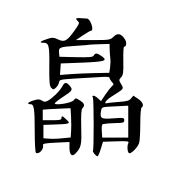
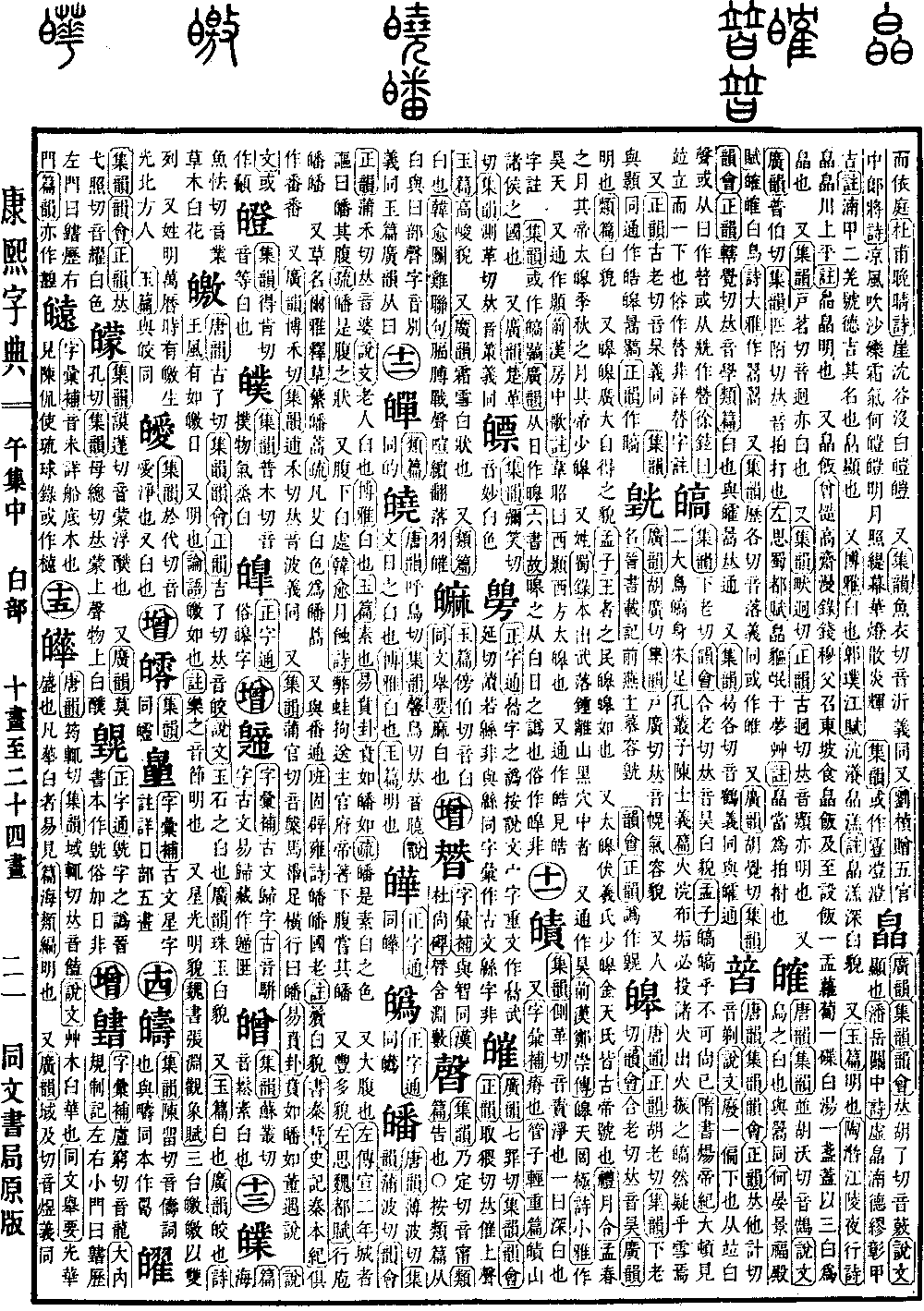
Wu Collection, Middle Volume
Radical: White (bái)
Kangxi stroke count: 15
Page 789, Entry 01
Guangyun (Broad Rhymes), Jiyun (Collected Rhymes), and Yunhui (Compendium of Rhymes) all record the pronunciation as xiao (rising tone).
Shuowen (Explaining Graphs and Analyzing Characters) states it means to reveal or make manifest.
Pan Yue, Ode on Guanzhong: To manifest the virtue of Nan and Jia. Annotation: Nan and Jia were the titles of two Qiang tribal leaders. Virtue and Ji were their names. Xiao here means to manifest or make bright.
Also, according to the Guangya (Expanded Er Ya), it means white.
Guo Pu, Rhapsody on the Yangtze River: Vast and deep, white and shimmering. Annotation: Xiao yao describes the appearance of deep, white water.
Also, according to the Yupian (Jade Compendium), it means bright.
Tao Qian, Night Travel on the Yangtze River: Brightly shimmering across the river plains. Annotation: Xiao xiao refers to a bright and clear appearance.
Also, Xiao rice. According to the Gaozhai Manlu (Casual Records from the High Studio) by Zeng Zao, Qian Mufu invited Su Dongpo to eat Xiao rice. When he arrived, there was a bowl of rice, a dish of radishes, and a cup of plain water served; it turned out to be three white things used to represent the name Xiao rice.
Also, according to the Jiyun (Collected Rhymes), pronounced jiong. Also means white.
Also, according to the Jiyun (Collected Rhymes) and Zhengyun (Correct Rhymes), pronounced jiong. Also means bright.
Also, according to the Guangyun (Broad Rhymes) and Jiyun (Collected Rhymes), pronounced pai. Means to strike or pat.
Zuo Si, Rhapsody on the Capital of Shu: Striking the bears and the commoners in the dream-grass. Annotation: Xiao should be understood as pai, meaning to strike or pat.