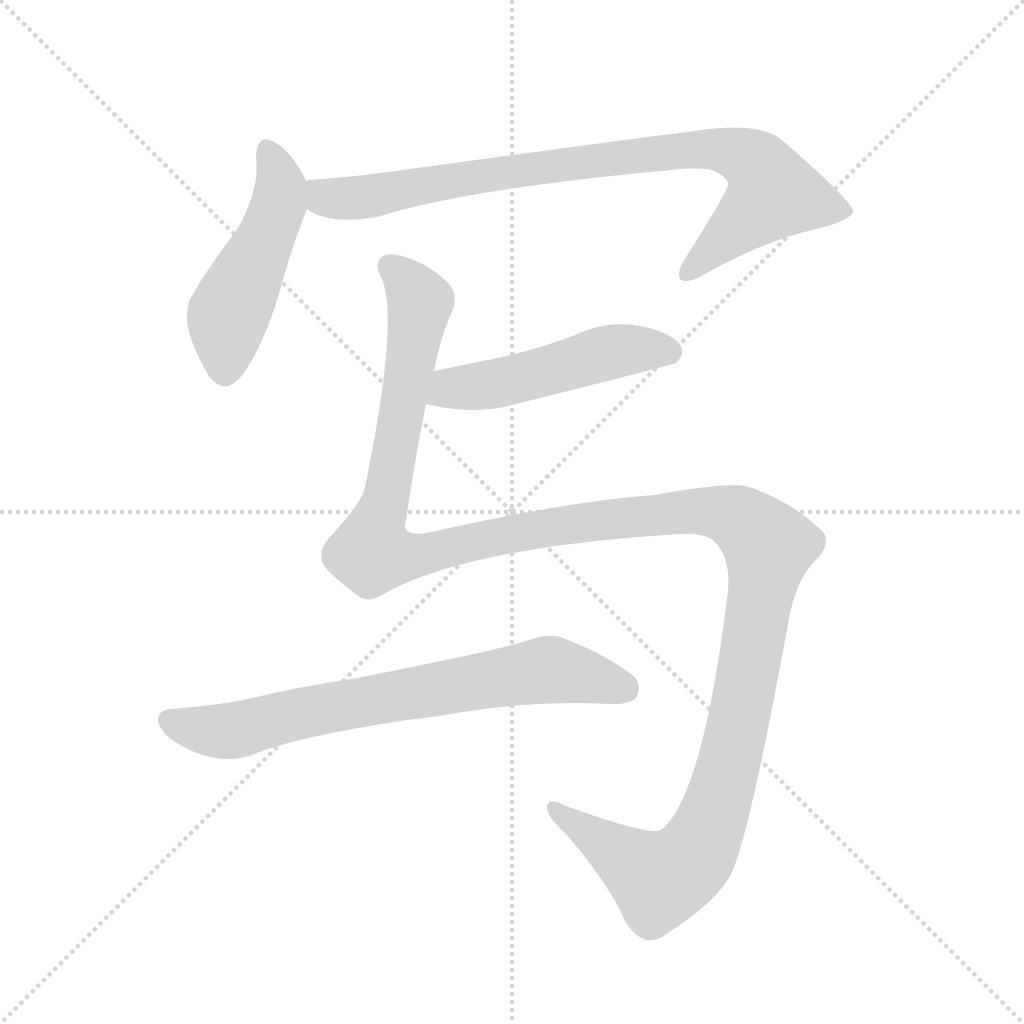
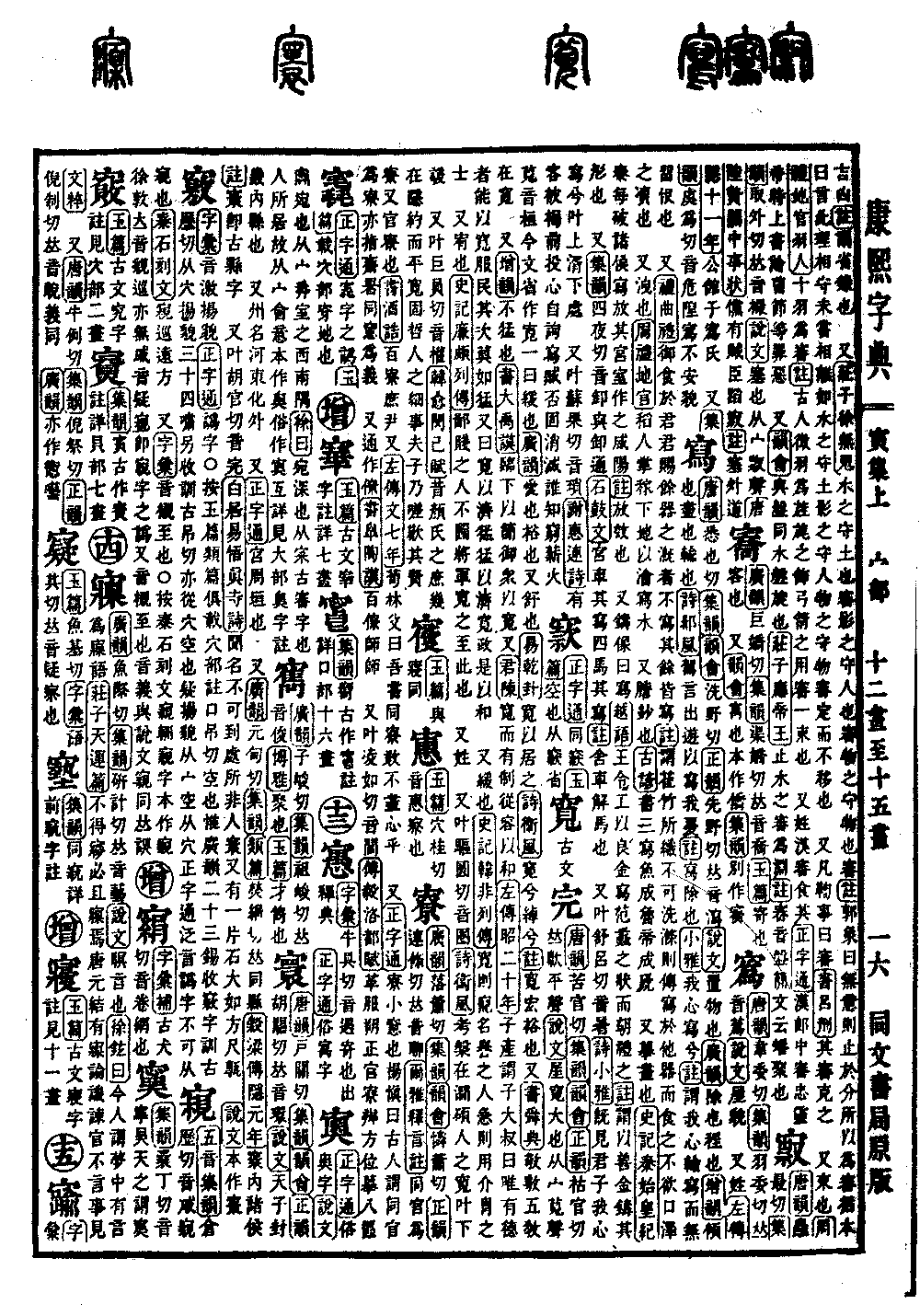
Yin Collection, Upper Volume. Radical: Roof (mian). Character: xie. Kangxi stroke count: 15. Page: 292.
According to the Tangyun, Jiyun, Yunhui, and Zhengyun, the pronunciation is xie.
The Shuowen Jiezi defines the character as placing or arranging items. The Guangyun defines it as removing or measuring. The Zengyun defines it as tilting, emptying, or pouring out.
I drive my carriage to roam about, so as to dispel my sorrow — Book of Odes (Shijing). The annotation states that the character means to remove.
My heart is relieved — Minor Odes of the Kingdom (Xiaoya). The annotation states that this means the heart has poured out its contents, leaving no lingering resentment.
When serving a meal to a ruler, if the ruler bestows the remaining vessels that can be washed, one does not transfer the food; for all others, one transfers the food — Book of Rites (Liji). The annotation states that this refers to vessels woven from reeds or bamboo which cannot be washed; in such cases, the food is transferred or transcribed into another vessel to eat to avoid defiling the original vessel with saliva.
It also means to drain. The Rice Man oversees the planting of low-lying lands, using canals to drain the water — Rites of Zhou (Zhouli).
It also means to transcribe or copy. An old proverb states: When a book is copied three times, the character for fish (yu) becomes lu, and the character for emperor (di) becomes si.
It also means to depict or draw. Whenever Qin defeated the feudal lords, he would depict and imitate their palaces and replicate them in Xianyang — Records of the Grand Historian (Shiji). The annotation states that the term fang means to imitate.
It also refers to casting a statue. The King ordered the craftsmen to cast the likeness of Fan Li using fine gold and then paid respects to it — Discourses of the States (Guoyu). The annotation states that this refers to casting his form with high-quality metal.
The Jiyun also provides the pronunciation xie, which is used interchangeably with the character for unloading (xie). The imperial carriage is unloaded, and the four horses are unharnessed — Stone Drum Inscriptions (Shiguwen). The annotation states that this means unhitching the carriage and releasing the horses.
It is also used as a rhyme pronounced shu. Now that I have seen my lord, my heart is relieved — Minor Odes of the Kingdom (Xiaoya). In this context, it rhymes with the characters xu and chu.
It is also used as a rhyme pronounced suo. A guest in coarse clothing comes forward, offering his heart to seek counsel and express himself. Praise and blame naturally vanish; who knows of the dying firewood? — Poem by Xie Huilian.