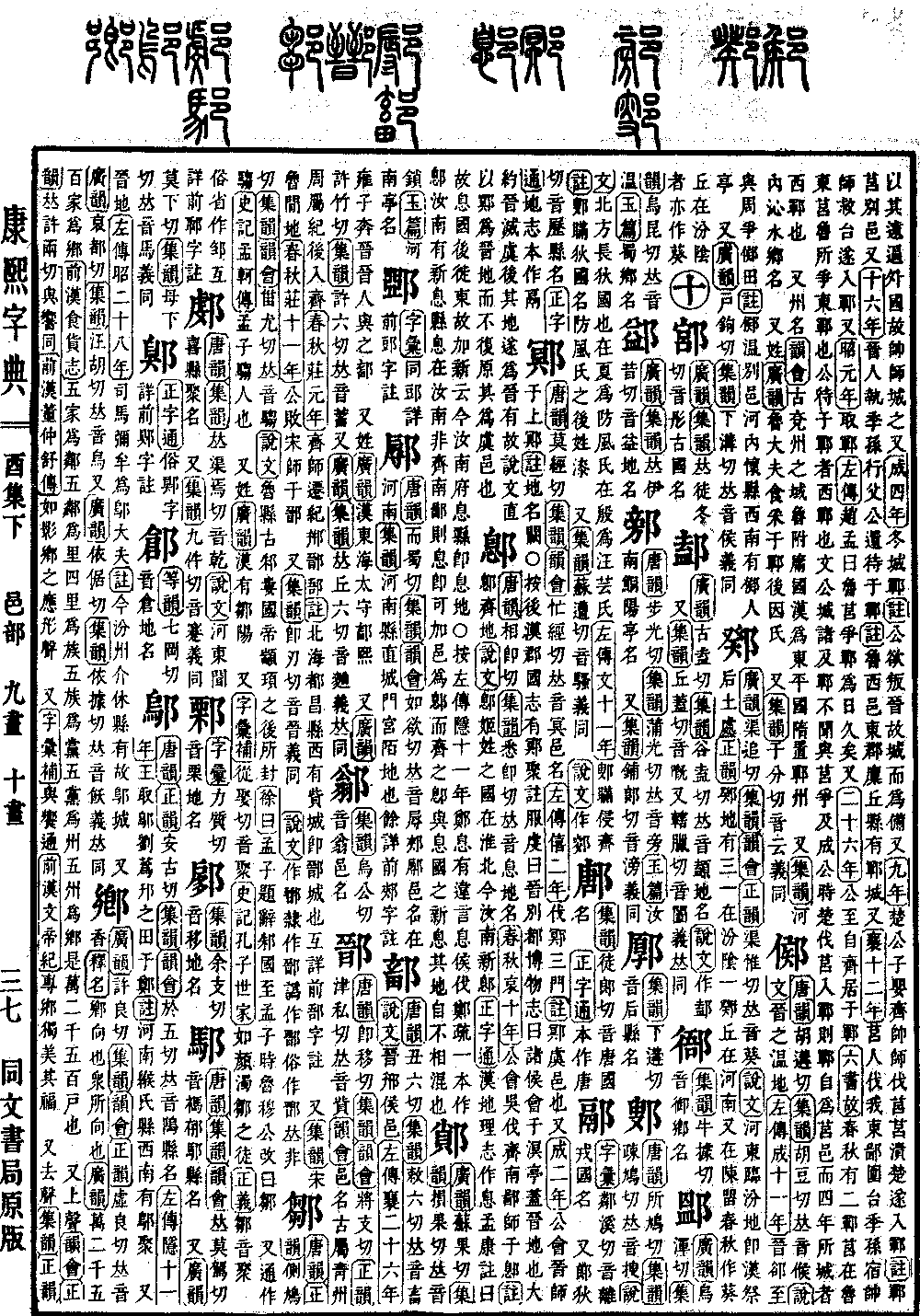
You Collection, Lower Volume
Radical: City (yì)
乡; Kangxi strokes: 17; Page: 1275, Position 29
Guangyun (Guǎngyùn) gives the pronunciation xǔliángqiē. Jiyun (Jíyùn), Yunhui (Yùnhuì), and Zhengjun (Zhèngyùn) give xūliángqiē, pronounced xiāng. According to Explanation of Names (Shìmíng), xiāng means xiàng, something towards which everyone turns. Guangyun (Guǎngyùn) states that twelve thousand five hundred families constitute a xiāng. In the Treatise on Food and Money (Shíhuò Zhì) of the Former Han (Qiánhàn) History: "Five households form a neighborhood (lín), five neighborhoods form a village (lǐ), four villages form a clan (zú), five clans form a district (dǎng), five districts form a prefecture (zhōu), and five prefectures form a xiāng, which amounts to twelve thousand five hundred households."
Also pronounced with a rising tone. Yunhui (Yùnhuì) and Zhengjun (Zhèngyùn) give xǔliǎngqiē, the same as xiǎng. In the Biography of Dong Zhongshu (Dǒng Zhòngshū Zhuàn) in the Former Han (Qiánhàn) History: "like a shadow responding to a form, or an echo to a sound."
Also, according to Zihui Supplement (Zìhuì Bǔ), it is interchangeable with xiǎng (to feast, to enjoy). In the Annals of Emperor Wen (Wéndì Jì) in the Former Han (Qiánhàn) History: "exclusively enjoy its blessings."
Also pronounced with a falling tone. Jiyun (Jíyùn) and Zhengjun (Zhèngyùn) give xǔliàngqiē. It is the same as xiàng (towards). In the Book of Rites (Lǐjì), Chapter on the Rules of Conduct (Qūlǐ): "one must turn towards where the elder is looking." And "which direction should the mat be placed?"
Also, in the Er Ya (Ěryǎ), Explanation of Palaces (Shìgōng): "The space between two steps is called xiāng." The commentary states: "The ruler faces south, situated between the steps."
Also, the name for a window. In the Book of Rites (Lǐjì), Positions in the Mingtang (Míngtáng Wèi): "scrape the pillars to reach the xiāng." The commentary explains: "Each room has four doors and eight windows, and all windows and doors are opposite each other."
Also, in the Book of Etiquette and Rites (Yílǐ), Rites for Sacrificing to Ancestors of a Shi (Shì Yú Lǐ): "The invoker follows, opening the window xiāng as before." The commentary states: "Xiāng is another name for a window." The sub-commentary explains: "The north window is called xiāng; xiāng is also a window, hence it is said to be another name."
Also, according to Zhengzitong (Zhèngzìtōng), it means 'formerly' or 'in the past'. That which has gone is in front, that which is coming is behind; hence, that which has gone is called xiāng, and former days are called xiāng rì. In the Analects (Lúnyǔ): "Formerly, I saw the Master and asked about knowledge."
Also a surname. Jiyun (Jíyùn) states that it is interchangeable with xiàng (the character for a surname).