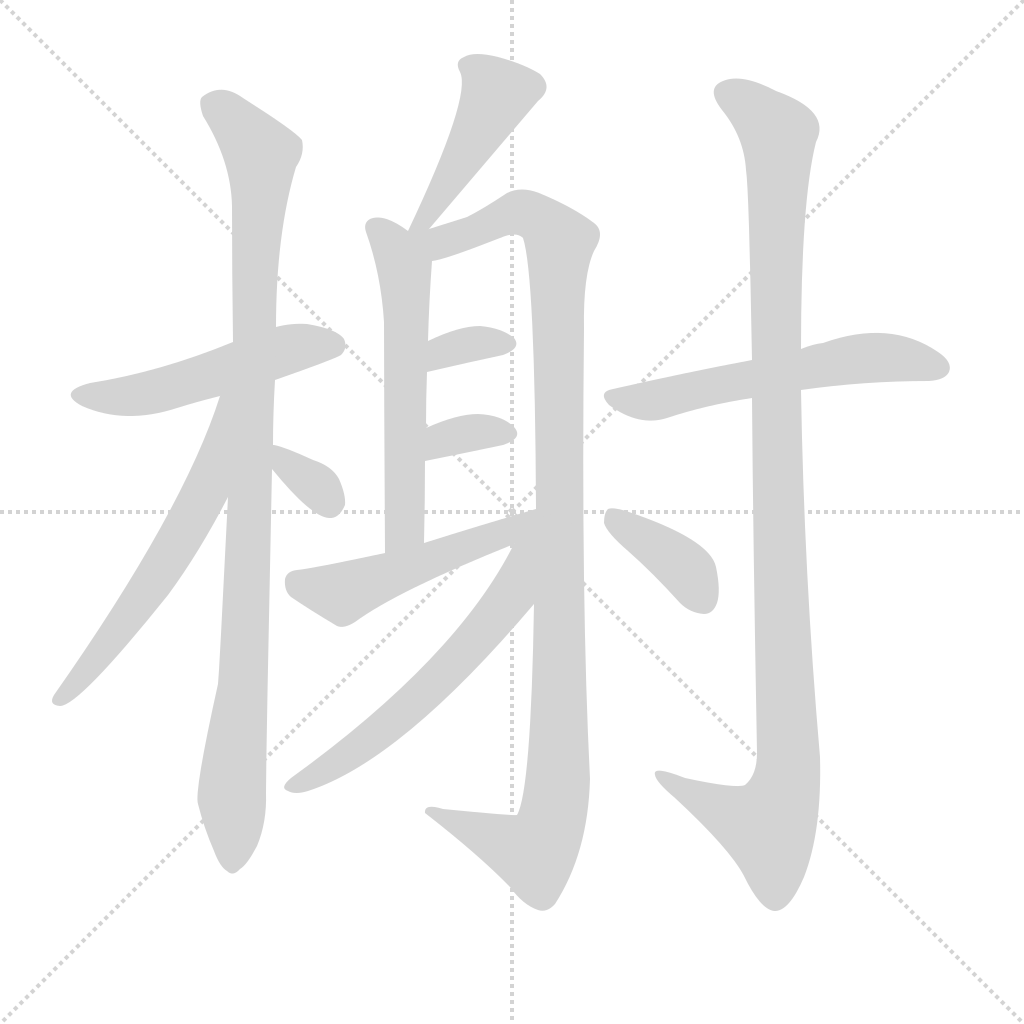
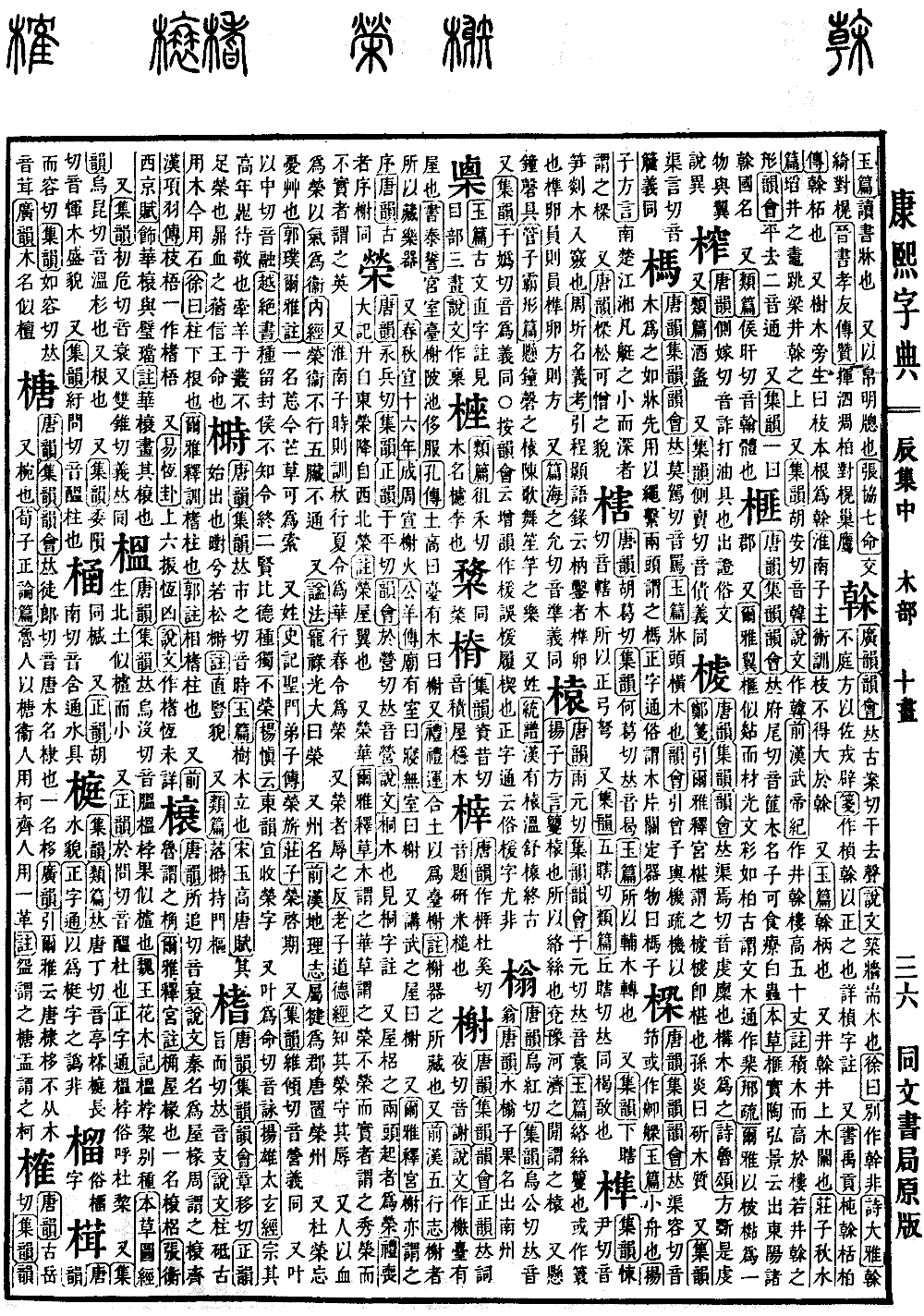
Chen Collection, Middle Volume. Radical: Tree (mù). Kangxi stroke count: 14. Page 544, Entry 16.
Tang Dynasty Rhyme (Tangyun), Collection of Rhymes (Jiyun), Rhyme Compendium (Yunhui), and Correct Rhymes (Zhengyun) state it is pronounced xie. According to the Shuowen Jiezi, it is written as a building with rooms situated upon a terrace. In the Book of Documents (Shujing), specifically the Great Oath (Taishi), it refers to palaces, terraces, and buildings, along with ponds and luxurious clothing. Kong Yingda notes that an earthen mound is called a terrace, and a structure with wooden architectural features built upon it is called a xie.
Furthermore, in the Book of Rites (Liji), specifically the Evolution of Rites (Liyun), it mentions mixing soil to construct terraces and buildings. The commentary notes that a xie is a place where implements are stored. Additionally, in the History of the Former Han Dynasty (Qianhan Shu), specifically the Treatise on the Five Elements, it states that a xie is a place where musical instruments are stored.
In the Spring and Autumn Annals (Chunqiu), in the sixteenth year of Duke Xuan, it is recorded that the Xuan Xie in Chengzhou caught fire. The Commentary of Gongyang (Gongyang Zhuan) notes that a building with rooms is called a sleeping chamber, while one without rooms is called a xie. It is also used to refer to a building where martial arts are practiced. It is also synonymous with the term xu. In the Book of Etiquette and Ceremonial (Yili), the text mentions that the xu is hooked to the pillars; the commentary notes that xu is pronounced the same as xie.
Textual verification: The Commentary of Gongyang states that a temple with rooms is called a sleeping chamber. Following the original text, the character for temple has been corrected to note. In the Er ya, it is stated that a xie is also called a xu. However, this text does not appear in the Er ya, so it has been corrected to say it is synonymous with xu, as seen in the Book of Etiquette and Ceremonial, where the xu is hooked to the pillars and the note states xu is pronounced the same as xie.