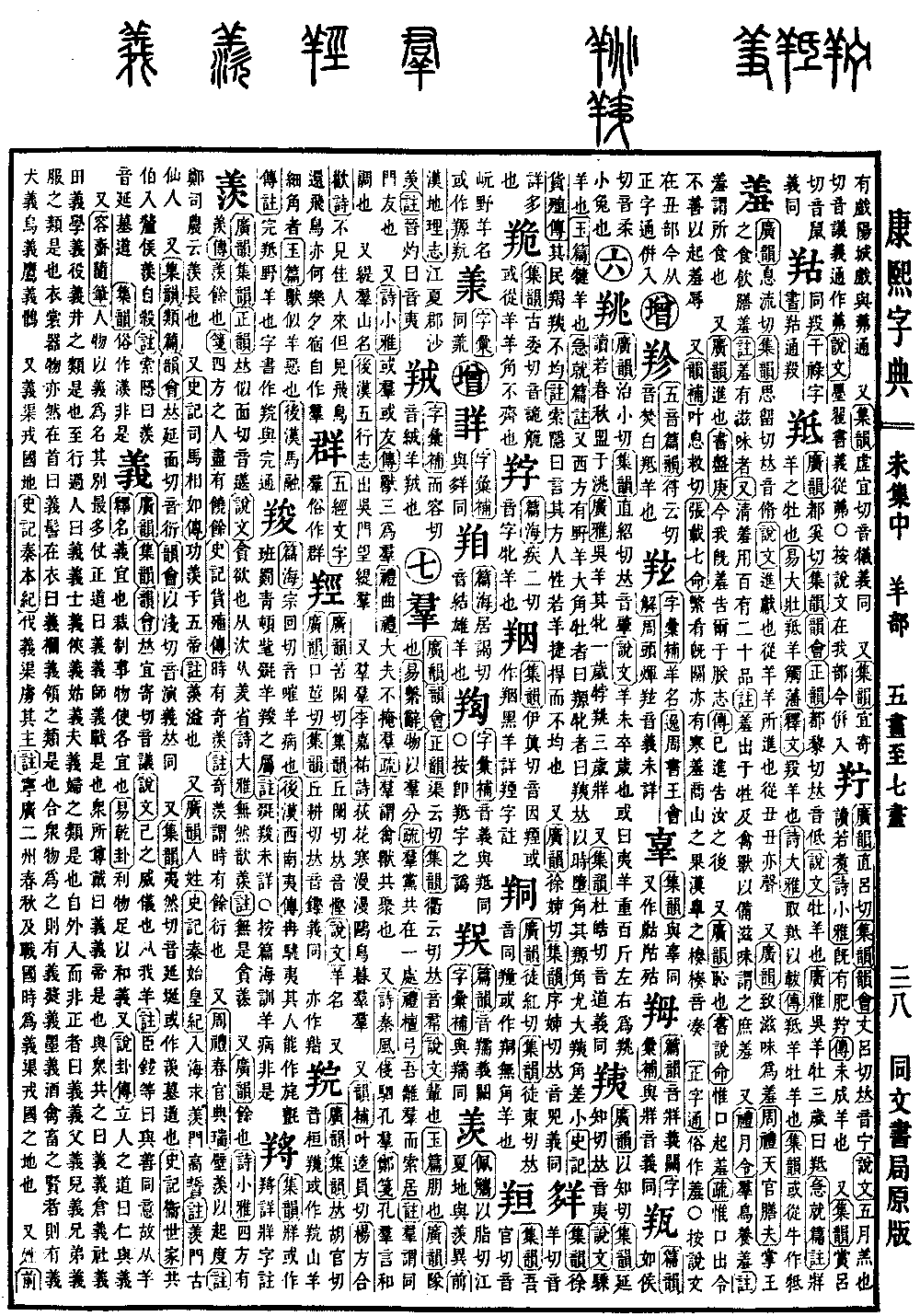
Wei Collection, Sheep Radical
Stroke Count: 12
Page 952, Entry 23
Xian (羨)
Pronounced yí zhì (falling tone) — a place name in the Jiangxia region. Different from the character "xiàn".
"Historical Records (Shiji), Treatise on Geography" records the place name "Sha xian" (沙羨) in Jiangxia Commandery.
Zhuo (晉灼) annotates: Pronounced yí (rising tone).
Xian (羨)
"Guangyun" (廣韻), "Jiyun" (集韻), "Zhengyun" (正韻) pronunciation: sì miàn (falling tone), same as "miàn".
"Explanations of Words (Shuowen Jiezi)" explains it as greed. The character is composed of parts of "mu" (目) and a simplified form of "you" (羑).
"Book of Odes (Shijing), Greater Odes, Daya" contains the line "wu ran xin xian" (無然歆羨).
Annotation: Means "do not be so greedy".
Also, "Guangyun" (廣韻) explains it as surplus.
"Book of Odes (Shijing), Lesser Odes, Xiaoya" contains the line "si fang you xian" (四方有羨).
Zhuan (傳) explains: "Xian" (羨) means surplus.
Jian (箋) explains: People from all directions have surplus.
"Historical Records (Shiji), Treatise on Monopolies" records "shi you qi xian" (時有奇羨).
Annotation: Explains "qi xian" (奇羨) as occasional surplus.
Also, "Rites of Zhou (Zhou Li), Official of Spring, Recorder of Auspicious Objects" records "bi xian yi qi du" (壁羨以起度).
Annotation: Zheng Sinong (鄭司農) explains: "Xian" (羨) means long.
Also, "Historical Records (Shiji), Biography of Sima Xiangru" records "gong xian yu wu di" (功羨於五帝).
Annotation: Explains "xian" (羨) as surpassing.
Also, "Guangyun" (廣韻) records it as a surname.
"Historical Records (Shiji), Annals of the First Emperor of Qin" records "ru hai qiu Xianmen Gaoshi" (入海求羨門高誓).
Annotation: Explains "Xianmen" (羨門) as the name of an ancient immortal.
Also, "Jiyun" (集韻), "Leipian" (類篇), "Yunhui" (韻會) pronunciation: yán miàn (falling tone), same as "yan" (衍).
"Yunhui" (韻會) pronunciation: yǐ qiǎn (falling tone), same as "yan" (演). The meaning is the same.
Also, "Jiyun" (集韻) pronunciation: yí rán (falling tone), same as "yan" (延). The character "shan" (埏) is sometimes written as "xian" (羨). It refers to a tomb passage.
"Historical Records (Shiji), House of Wei" records "Gong Bo ru, Li Hou xian zi sha" (共伯入,釐侯羨自殺).
Suoyin (索隱) annotates: "Xian" (羨) is pronounced "yan" (延), referring to a tomb passage.
"Jiyun" (集韻) indicates that the common form is written as "", which is incorrect.