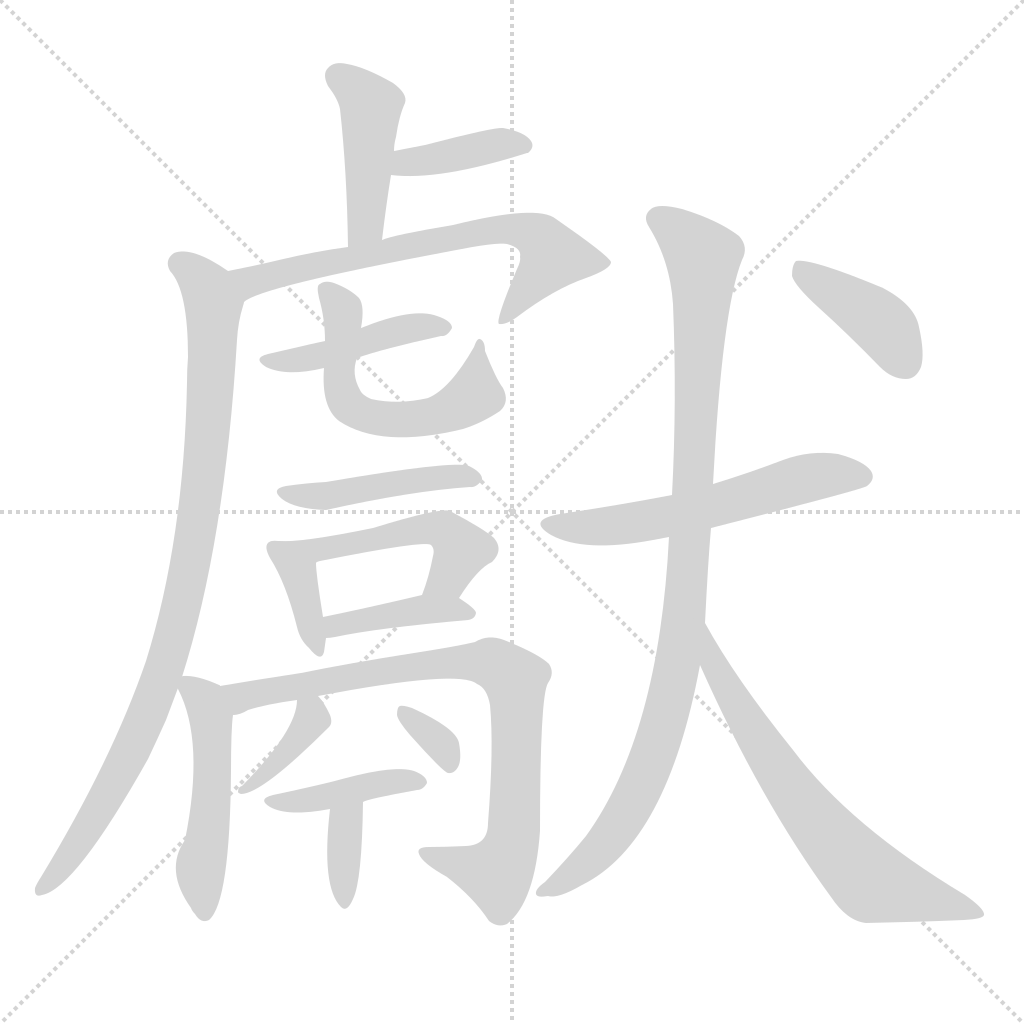
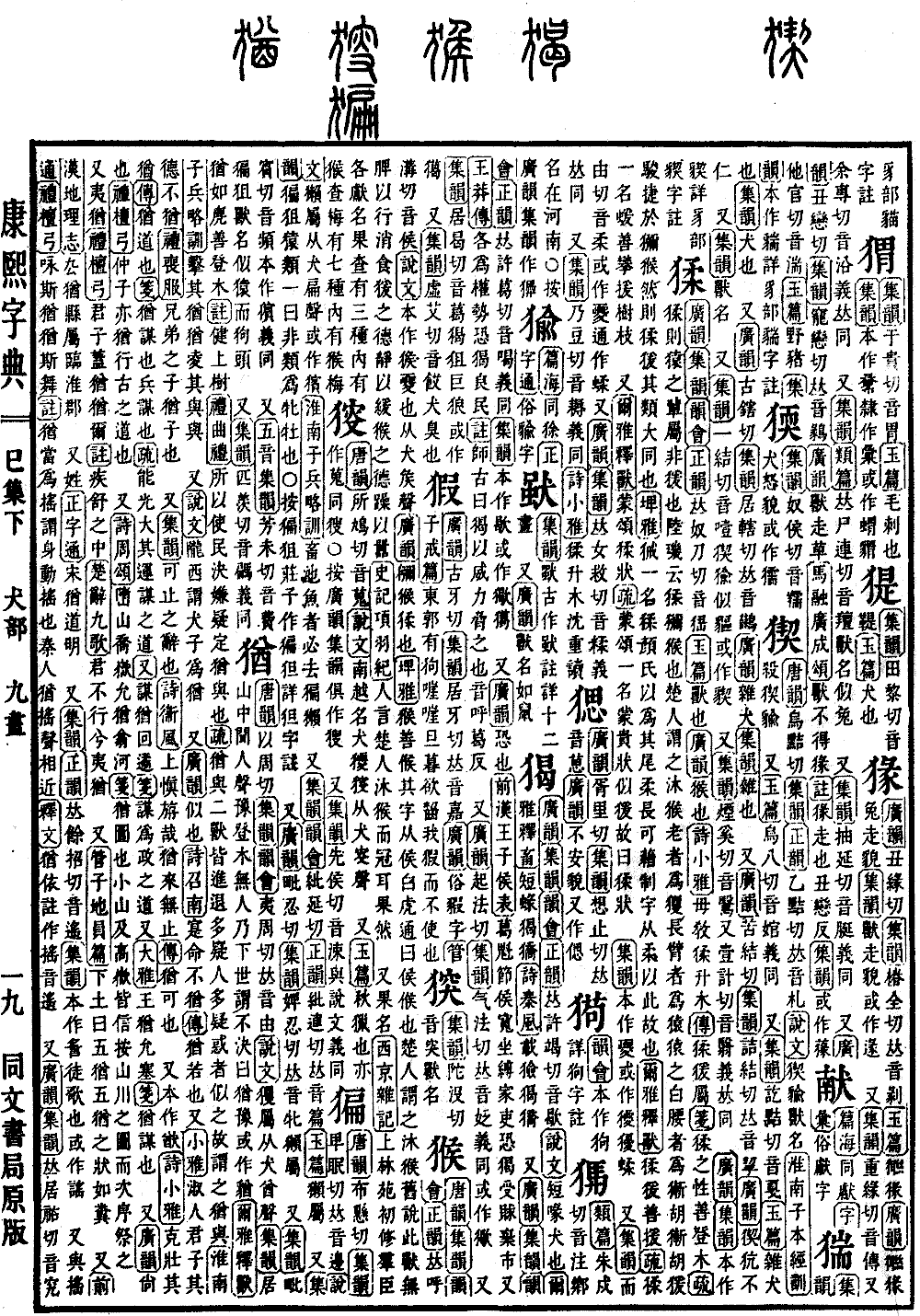
Si Collection, Lower Volume
Radical: Dog (quǎn)
Kangxi strokes: 20
Page 715, Entry 03
Pronounced xiàn.
According to the Shuowen Jiezi, it refers to the name of a dog offered as a sacrifice in the ancestral temple; it refers to a fat dog offered as a gift. It is composed of the radical for dog and the phonetic element yan.
In the Book of Rites (Liji), it states: A dog is called a gengxian.
Also, per the Guangyun dictionary, it means to present.
In the Erya, specifically the Shigu section, it means to offer or present. The commentary states: To present something to a superior is called xian.
In the Rites of Zhou (Zhouli), specifically the Tian Guan section concerning the minor prime minister, it mentions shanxian. The commentary states: Shanxian refers to game or delicacies offered.
In the section concerning the royal chef, it states: When the king holds a feast and drinks wine, one serves as the offering host.
In the Book of Documents (Shujing), specifically the Yiji section, it mentions the wise men of the myriad states. The commentary states: Xian means virtuous.
In the Analects of Confucius (Lunyu), it mentions that the literature and worthy men were insufficient.
In the Erya, specifically the Shiyan section, xian means wise or sage.
In the Shifa (Method of Posthumous Titles), it states: To be intelligent, wise, and perspicacious is called xian. To possess inherent knowledge and sagehood is called xian.
In the Erya, specifically the Shitian section, it states: When the grand year is in the position of hai, it is called dayuanxian.
It is also a surname. Per the Fengsu Tong (Customs and Traditions), there was a Qin dynasty official named Xian Ze.
Per the Jiyun, pronounced suo. It is the name of a wine vessel, decorated with kingfisher feathers; as explained by Zheng Sinong. It was originally written as the character for sacrificial ox, or sometimes written as the character for play. See the notes under the Ox radical for the character xih.
In the Book of Rites, specifically the Mingtang Wei section, it mentions the Zhou xian dou vessel. The commentary states: Xian means to carve or engrave in an openwork or sparse pattern. The sub-commentary states: The orthodox meaning is that xian is pronounced suo. Suo indicates a sparse or open pattern, hence it means to carve sparsely. The Shiwenzhu states: Pronounced su, with the rising tone.
Per the Jiyun, pronounced yi. It means ceremony or decorum. In the Rites of Zhou, specifically the Chun Guan section concerning the administrator of ceremonial vessels, it mentions the use of fragrant wine for the xian libation. The commentary states: Zheng Sinong said: Xian should be read as yi. Yi-zhuo refers to a libation performed with much dignity and decorum.
Per the Zhengyun, pronounced xi. In the History of the Former Han (Qian Hanshu), specifically the biography of Wang Mang, it mentions the establishment of the flower canopy and the construction of the douxian. The commentary by Yan Shigu states: Xian is pronounced xi, referring to the bowl-shaped end of the ladle of the Big Dipper constellation.
Also, rhymes with the sound xuan. In the Book of Odes (Shijing), specifically the Xiaoya section, it states: There is a rabbit, roast its head; roast it and grill it. The gentleman has wine; pour it and offer it to him.