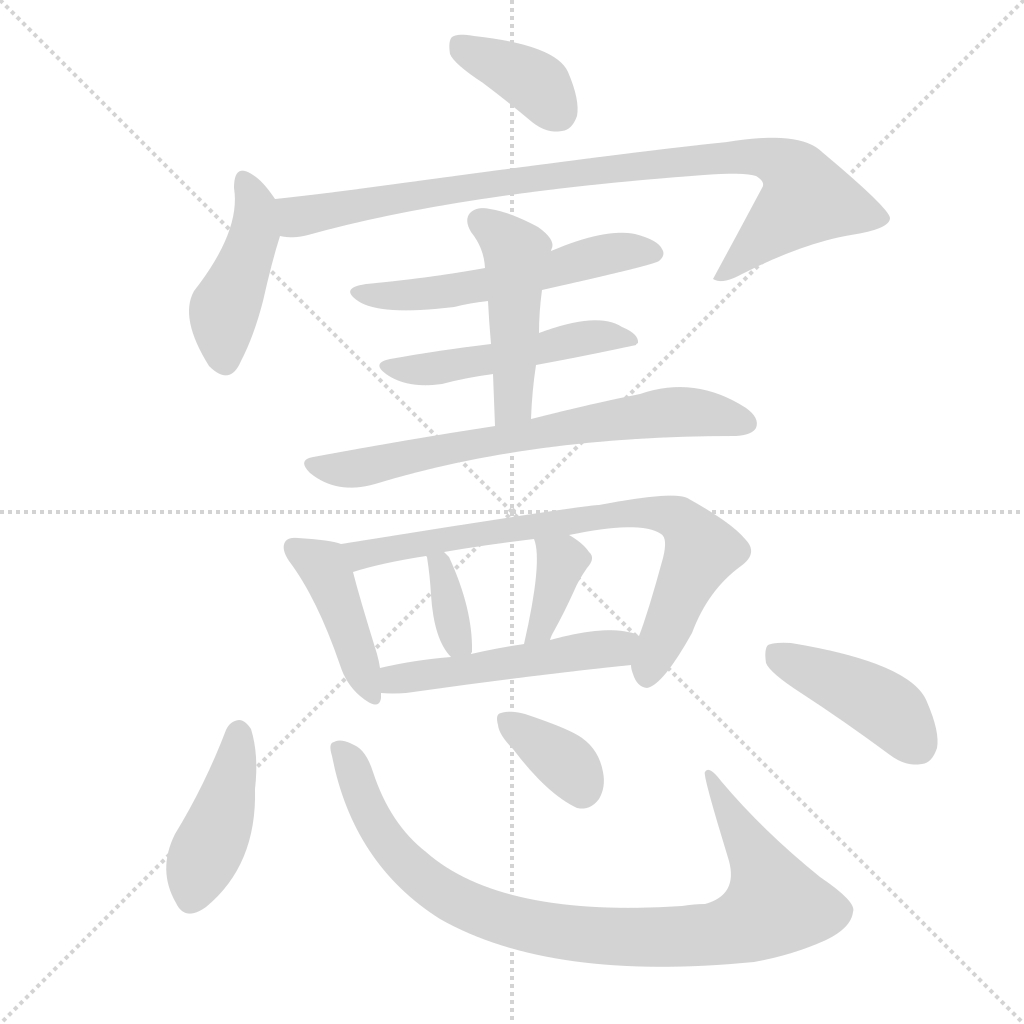
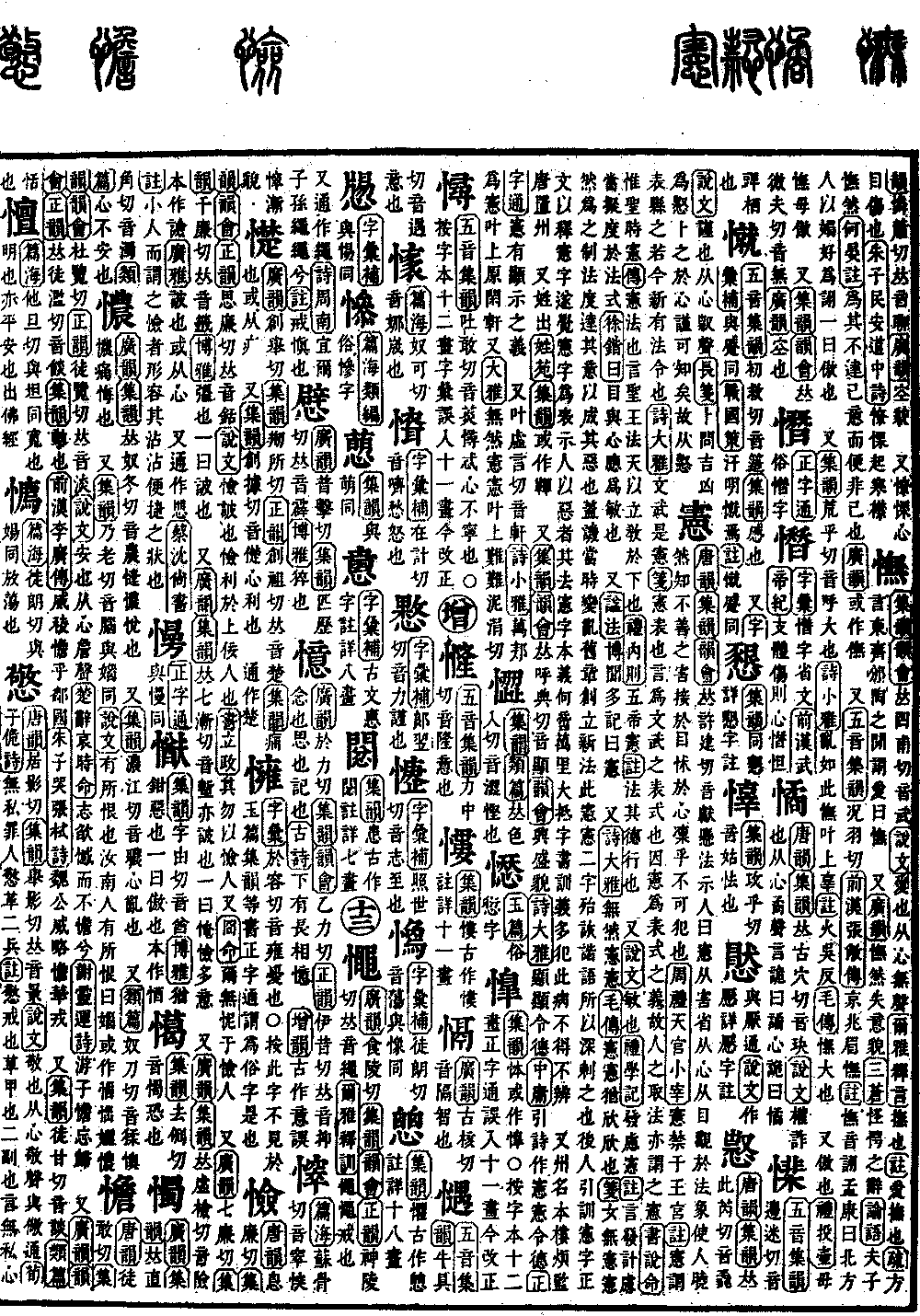
Mao Collection, Upper Volume
Radical: Heart (xīn)
Kangxi stroke count: 16
Page 404, Entry 11
Pronounced xian. To hang up laws to display them to others is called xian. The character structure is formed by a part of the character for harm (hai) combined with heart (xin) and eye (mu). It represents observing the appearance of the law so that people clearly understand the harm of evil behavior. When it meets the eyes and touches the heart, it is majestic and inviolable.
Book of Rites (Zhouli), Offices of Heaven (Tianguan), Small Administrator (Xiaozai): To hang prohibitions in the royal palace. Commentary: Xian refers to hanging up for display, just like newly issued decrees today.
Book of Odes (Shijing), Greater Odes (Daya): King Wen and King Wu are the models. Commentary: Xian means a model or standard, referring to the paradigm set by King Wen and King Wu. Because xian carries the meaning of a model, people take them as a standard to study, which is also called xian.
Book of Documents (Shujing), Charge to Yue (Shuoming): Only the sage king emulates Heaven. Commentary: Xian means law or regulation, referring to the sage king emulating Heaven to establish moral teachings for the world.
Book of Rites (Liji), Inner Teachings (Neize): Emulate the Five Emperors. Commentary: Emulate their virtues.
Also, from the Analytical Dictionary of Characters (Shuowen Jiezi), it means agile or quick.
Book of Rites (Liji), Record of Learning (Xueji): Initiating thoughts must conform to legal standards. Commentary: This means that when starting to plan or consider matters, one should compare them against legal standards to formulate them. Xu Kai states: When the eyes and the heart correspond, that is agility.
Also, in the posthumous title system (Shifa), broad knowledge and a strong memory are called xian.
Also, Book of Odes (Shijing), Greater Odes (Daya): Do not be so complacent. Mao Commentary: Xianxian, appearing like xinxin (a joyous appearance). Commentary: Do not be complacent in establishing laws for him or fulfilling his intentions to aid his evil deeds. This is likely a satire on the changing of old regulations and the creation of new decrees at the time. These two characters, xianxian, are likely used in a humorous sense to express deep satire. Later scholars have cited the main text of the dictionary to define the character xian, feeling that xian means displaying evil deeds to others, which is far from the original meaning of the character. In general, dictionaries often commit this error, and it must be clearly distinguished.
Also, the name of a prefecture. It was originally the Loufan Inspectorate, and a prefecture was established during the Tang Dynasty.
Also, a surname. From the Collection of Surnames (Xingyuan).
Collection of Rhymes (Jiyun): Sometimes also written in a variant form.
Also, Pronounced xian. Collection of Rhymes (Jiyun), Rhyme Compendium (Yunhui): A prosperous appearance. Book of Odes (Shijing), Greater Odes (Daya): Illustrious and beautiful virtue. Doctrine of the Mean (Zhongyong) cites the Book of Odes (Shijing) as xianxian lingde. The Correctness of Characters (Zhengzitong) notes that xian has the meaning of display or manifestation.
Also, rhymes with xuan. Book of Odes (Shijing), Lesser Odes (Xiaoya): The ten thousand states take this as their rule. Rhymes with the preceding yuan, xian, and xuan. Also, Greater Odes (Daya): Do not be so complacent. Rhymes with the preceding nan. Nan is pronounced ni.