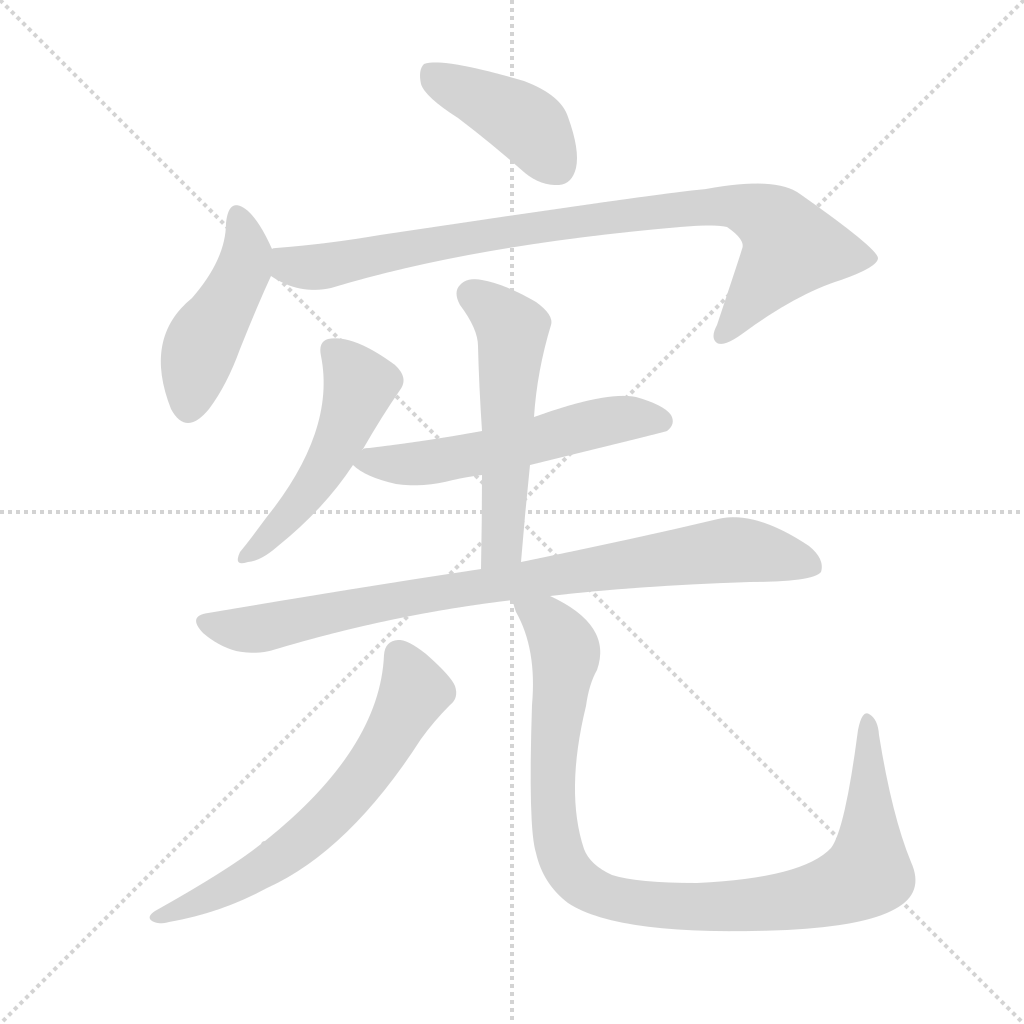
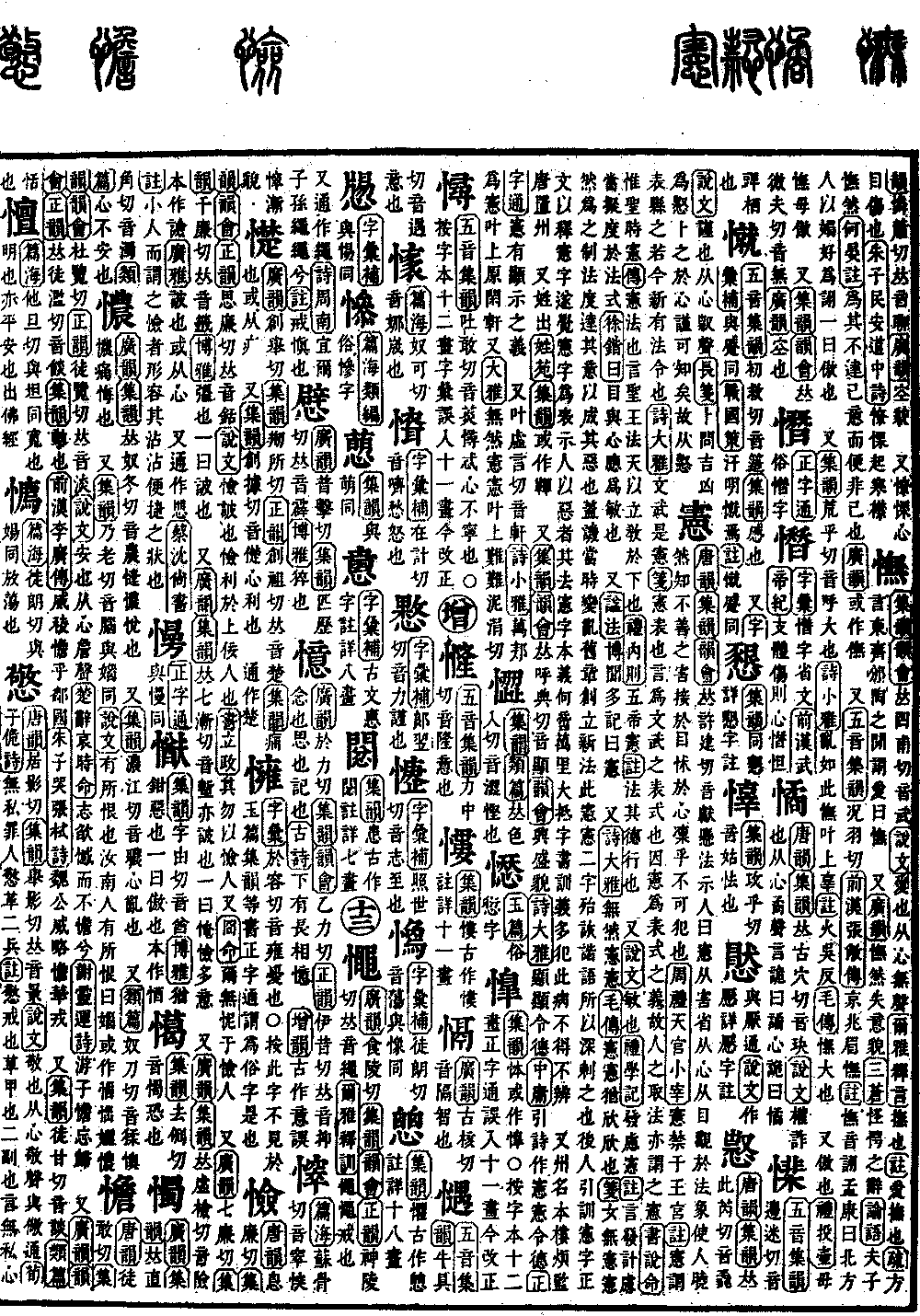
Supplementary Notes. Yin Collection. Radical: Roof (bù). Kangxi stroke count: 16. Page 404, Entry 06.
According to the Souzhen Yujing (Collection of True Jade Mirrors), pronounced xiang (level tone). Also pronounced mo (falling tone). Also pronounced hu (falling tone).
Xian. According to the Tangyun (Tang Dynasty Rhymes), Jiyun (Collection of Rhymes), and Yunhui (Compendium of Rhymes), pronounced xian (falling tone). To hang up laws to show the people is called xian. It is composed of a simplified form of harm, heart, and eye. By observing the image of the law, one is made to clearly understand the harm of evil acts. When perceived by the eye and felt in the heart, one is struck with awe and dares not commit an offense.
Rites of Zhou (Zhouli), Offices of Heaven (Tianguan), Lesser Minister (Xiaozai): Regulations and prohibitions for the royal palace. Commentary: Xian means to display or hang up, similar to how new laws are posted today.
Book of Odes (Shijing), Greater Odes (Daya): King Wen and King Wu are the models. Commentary: Xian means a model; it means they served as the model and pattern for King Wen and King Wu. Because xian signifies a model, one who takes something as a standard is also called xian.
Book of Documents (Shujing), Charge to Yue (Shuoming): Only the sage follows this law. Commentary: Xian means law; it means the sage king took heaven as his model to establish teachings for those below.
Book of Rites (Liji), Inner Chapters (Neize): The Five Emperors are the model. Commentary: One models oneself after their virtue and conduct.
Also, according to the Shuowen (Explaining Graphs and Analyzing Characters), it means agile.
Book of Rites (Liji), Record of Learning (Xueji): To initiate plans with awareness. Commentary: This refers to initiating plans and calculations by measuring them against established laws. Xu Kai said: When the eye and heart respond in unison, it is called being agile.
Also, in the Rules of Posthumous Titles (Shifa), to be widely learned and have a retentive memory is called xian.
Also, Book of Odes (Shijing), Greater Odes (Daya): Do not be so xian-xian. Mao Commentary: Xian-xian means joyful. Commentary: Do not be so xian-xian in establishing new laws, reaching your own intentions to fulfill your evil designs. This likely criticizes the times for changing old regulations and creating new laws. These two characters, xian-xian, are likely sarcastic in nature, used to deeply ridicule the situation. Later people cited the definitions of the text xian to explain the word xian, which led to the feeling that xian means to show evil to others, which is far from the original meaning of the word xian. In general, dictionaries often suffer from this error, so it is necessary to distinguish it.
Also, the name of a prefecture. Originally the Loufan prefecture, established as a prefecture during the Tang Dynasty.
Also, a surname. From the Surname Garden (Xingyuan). According to the Jiyun (Collection of Rhymes), sometimes written as a variant form.
Also, according to the Jiyun (Collection of Rhymes) and Yunhui (Compendium of Rhymes), pronounced xian (rising tone).
Yunhui: The appearance of being prosperous and flourishing.
Book of Odes (Shijing), Greater Odes (Daya): Clear and bright is the virtuous character. The Doctrine of the Mean (Zhongyong) cites the poem as xian-xian virtuous character.
Zhengzitong (Correct Character Guide): Xian has the meaning of being clear and displayed.
Also rhymes with xian (level tone). Book of Odes (Shijing), Lesser Odes (Xiaoyao): Ten thousand states take him as a model. Rhymes with yuan and xian.
Also, Greater Odes (Daya): Do not be so xian-xian. Rhymes with nan. Nan is pronounced ni (level tone).