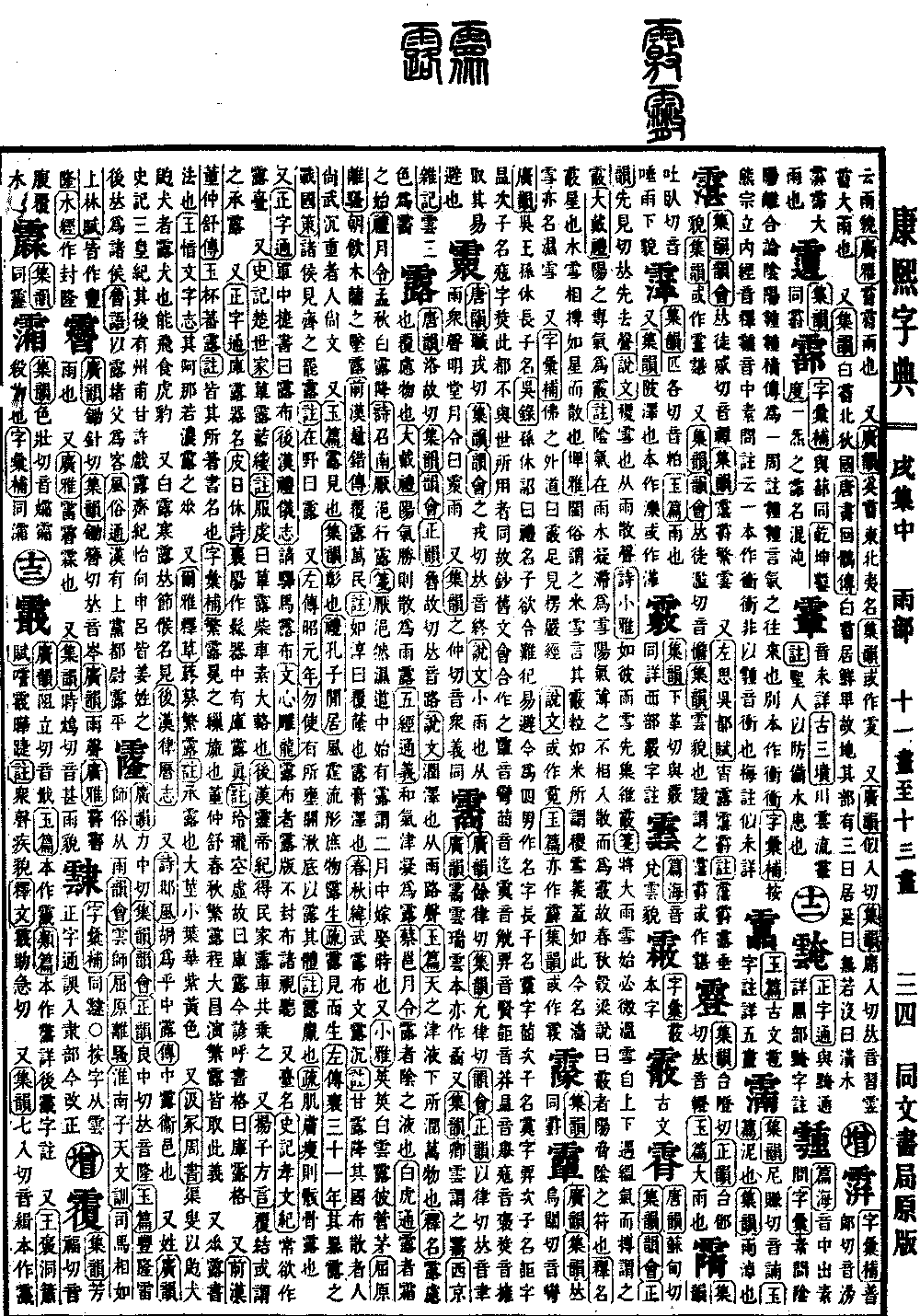
Xu Collection, Middle Volume
Radical: Rain (yǔ)
霰
Kangxi strokes: 20
Page 1378, Entry 16
According to Tang Yun, pronounced xian (falling tone). According to Jiyun, Yunhui, and Zhengyun, pronounced xian (falling tone). Shuowen Jiezi defines it as millet-like snow. The character is formed by the Rain radical, with san providing the phonetic.
Book of Odes (Shijing), Xiaoya section, states: Like falling snow, the first to descend is xian. Zheng Xuan, in his commentary, states: When heavy snow is about to fall, the air is initially slightly warm. Snow falls from above, encounters warm air, and congeals into small particles, which is called xian. Record of Rites by Dai the Elder (Da Dai Liji) states: The form in which yang qi (vital force) gathers is xian.
Commentary: Yin qi (dark, passive force) is present in rain; it congeals and stagnates to become snow. Yang qi presses upon it, they cannot merge, and it scatters to become xian. Therefore, the Spring and Autumn Annals of Guliang (Guliang Zhuan) states: Xian is a sign of yang qi coercing yin qi.
Explanations of Names (Shiming) explains: Xian, meaning star. Water and snow collide with each other, scattering like stars. Piya states: Folk customs in Fujian call it rice-snow, implying that the particles of xian resemble grains of rice. This is likely the meaning of millet-like snow. It is currently called se-snow, also known as wet-snow.
Furthermore, Dictionary Supplement (Zihuibu) states: A non-Buddhist sect is called xianni. Found in the Shurangama Sutra (Lengyan Jing). In Shuowen Jiezi, it is sometimes written in a variant form. In Yupian, it is also written in a variant form. In Jiyun, it is sometimes written as wu.
Verification: Book of Odes (Shijing), Xiaoya section: Like falling snow, the first to gather is xian. Zheng Xuan's commentary states: When heavy snow is about to fall, the air is initially slightly warm; snow falls from above, encounters warm air and congeals, which is called xian. Note: The original text was corrected to read warm air.