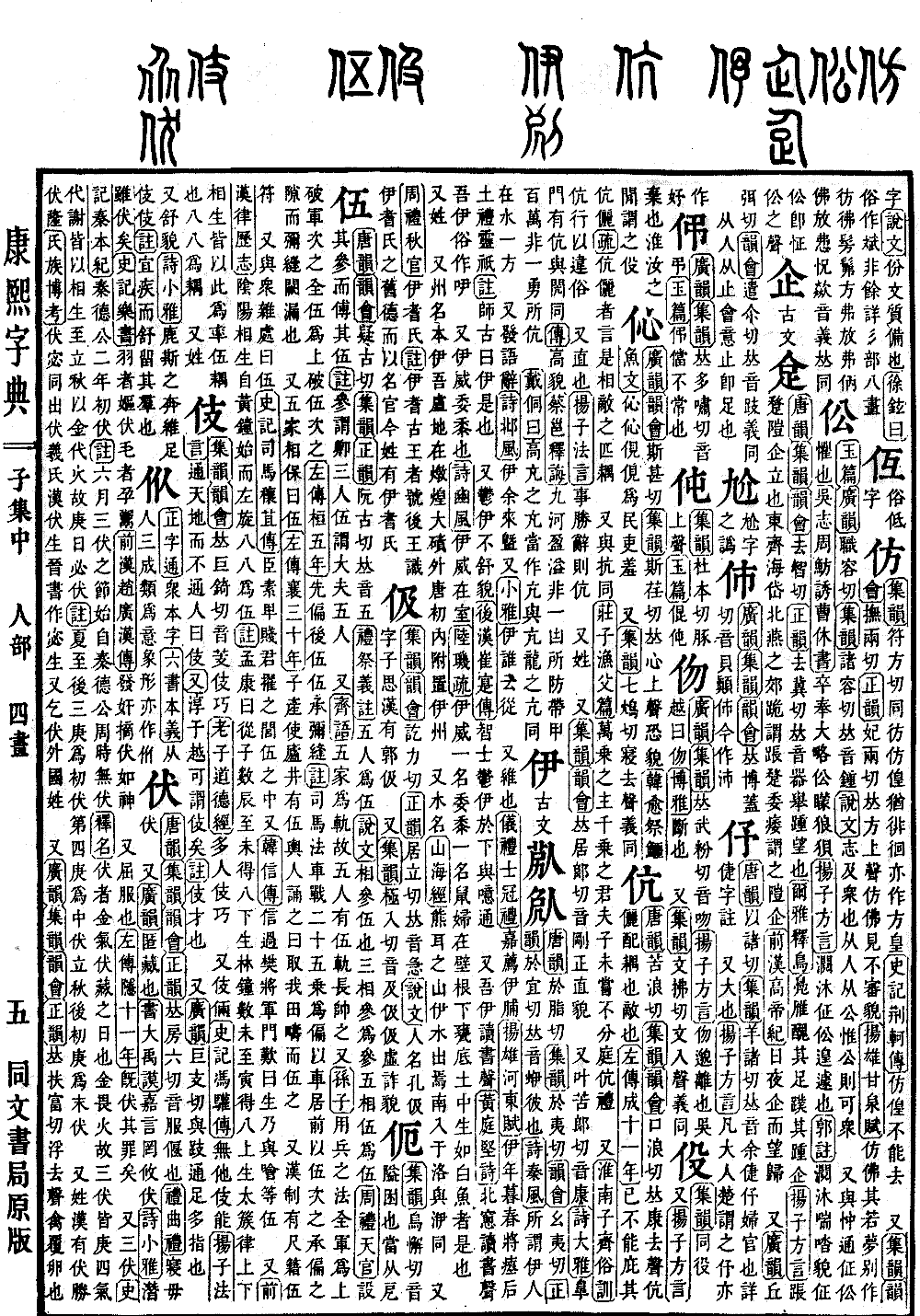
Zi Collection, Middle Volume Radical: Person (rén) Kangxi stroke count: 6 Page number: Page 95, entry 20.
Tangyun (Tangyun) and Yunhui (Yunhui) state the pronunciation is yí gǔ, while Jiyun (Jiyun) and Zhengyun (Zhengyun) state the pronunciation is ruǎn gǔ. Pronounced wǔ.
Rites of Zhou (Zhouli), Section on the Small Minister of Instruction (Xiao Situ): Five men form a unit (wǔ).
Shuowen Jiezi (Shuowen Jiezi): To be mutually intertwined and formed into a unit. Three individuals intertwined form a triad (cān); five individuals formed into a unit form a group (wǔ).
Rites of Zhou (Zhouli), Section on the Offices of Heaven (Tianguan): Establish their triads and support them with their units.
Commentary: Triads refer to the three high ministers; units refer to the five grand officers.
Discourses of Qi (Qiyu): Five families form a track (guǐ), therefore five men form a unit (wǔ). The track leader commands them.
Sun Tzu: In the methods of employing military forces, keeping the army intact is the superior approach, while destroying the enemy army is secondary. Keeping a unit (wǔ) intact is superior, while breaking up a unit is secondary.
Zuo Tradition (Zuozhuan), Fifth Year of Duke Huan: Advance the flank (piān) first and the unit (wǔ) later; the unit follows to close the gaps.
Commentary: According to the Regulations of the Minister of War (Simafa), in chariot warfare, twenty-five chariots form a flank (piān). The chariots are positioned in front, with the units following to fill the gaps in the flanks and correct any omissions.
Also, five families mutually protecting each other is called a unit (wǔ).
Zuo Tradition (Zuozhuan), Thirtieth Year of Duke Xiang: Zichan caused the fields to be divided into units (wǔ). The people sang about it, saying: You take our fields and divide them into units.
Also, the Han dynasty system included the tally-register and unit-tally.
Also, to be intermingled with the common people is called being in a unit (wǔ).
Records of the Grand Historian (Shiji), Biography of Sima Rangju: I was originally of humble status, but you elevated me from among the common folk.
Records of the Grand Historian (Shiji), Biography of Han Xin: Han Xin passed by General Fan's gate and sighed, saying: To think that I should be ranked alongside Kuai.
History of the Former Han (Qian Hanshu), Treatise on Harmonics and Calendars: Yin and Yang mutually give birth to one another, starting from the yellow bell (huángzhōng) pitch, rotating to the left, with eight times eight forming a unit (wǔ).
Commentary: Meng Kang says: Counting from Zi to Wei equals eight, which downwardly produces the forest bell (línzhōng) pitch; counting from Wei to Yin equals eight, which upwardly produces the great abundance (tàicù) pitch. The musical pitches produce one another through upward and downward movements, all using this as a standard. Unit (wǔ) means a pair (ǒu). Eight times eight makes a pair.
Also, a surname.
Textual collation: The commentary on the Rites, Meaning of Sacrifices (Liji, Jiyi) mentions five men forming a unit. We note that the definition of five men as a unit does not originate in Chen Hao's commentary on the Jiyi, so we have changed the citation to the Rites of Zhou, Section on the Small Minister of Instruction. In the Rites of Zhou, Section on the Offices of Heaven, the phrase establish their triads and support them with their units has been corrected by removing the word and to match the original text. In the Discourses of Qi, the phrase five men have units has been corrected to five men form units to match the original text.