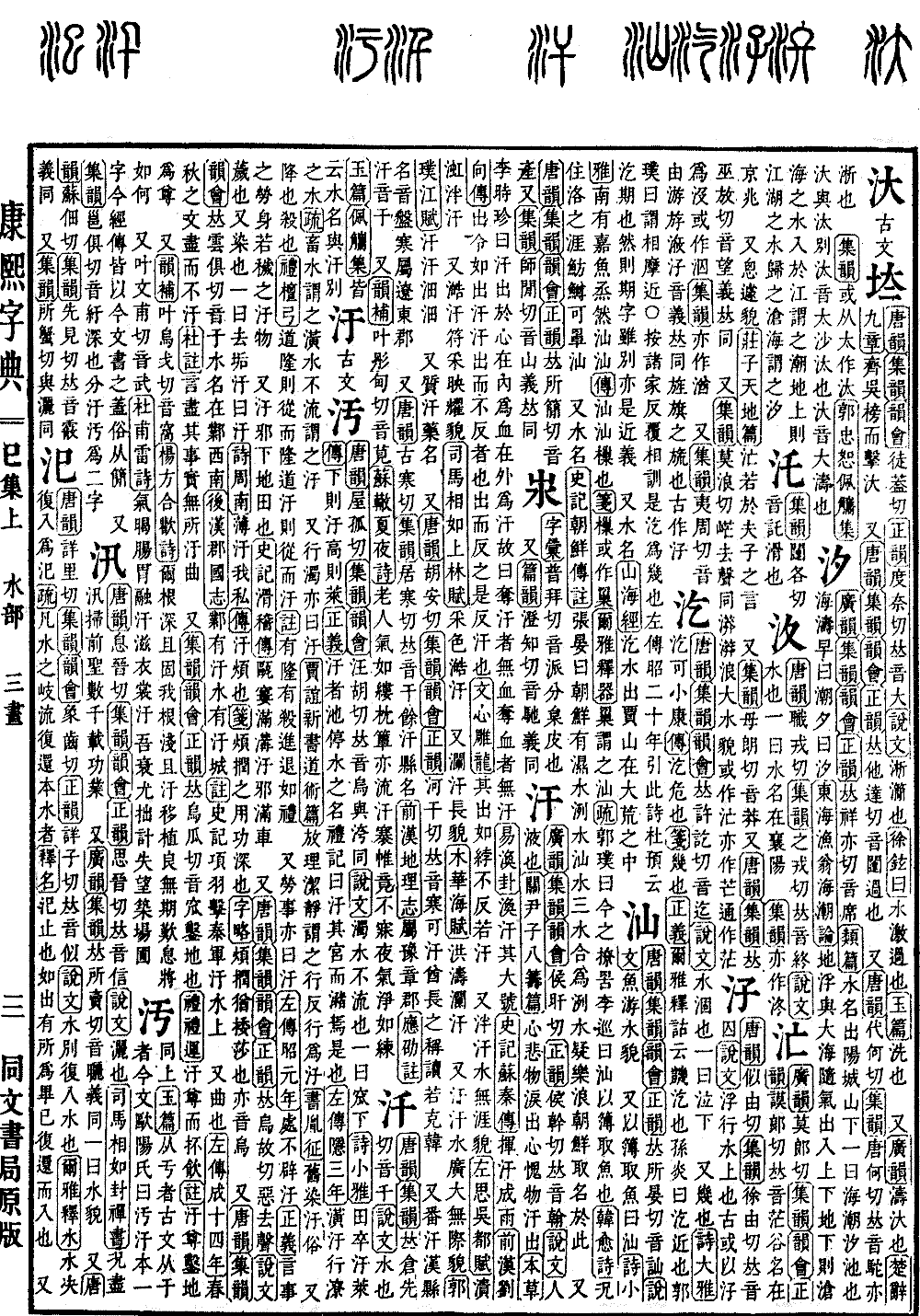
Si Collection, Upper Volume
Radical: Water (shuǐ)
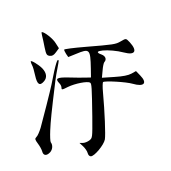
Entry: wu
Kangxi brush strokes: 7
Page 605, Entry 13
Ancient character form: wu
Pronounced wu
Same as the character pronounced wu.
According to the Explaining Graphs and Analyzing Characters (Shuowen Jiezi), it refers to stagnant water that does not flow. Another meaning is low-lying land.
From the Book of Odes (Shijing): Fields finally become overgrown and swampy.
Commentary: Low-lying land is called stagnant, high land is called overgrown.
Correct interpretation: The term stagnant refers to a pool of standing water. The Record of Rites (Liji) states: Dam the palace grounds to make a pond.
From the Zuo Tradition (Zuo Zhuan), Third Year of Duke Yin: Pools of stagnant water and flowing rainwater.
Commentary: Stagnant water is called a pool. Water that does not flow is called stagnant. Also, flowing muddy water is called stagnant.
From Jia Yi’s New Book (Xinshu), Dao Shu chapter: Following principles to reach purity and tranquility is called conduct, the opposite of this conduct is called impure.
From the Book of Documents (Shujing), Punitive Expedition of Yin: Long-standing stained by impure customs.
Also means to lower or to diminish.
From the Record of Rites (Liji), Tan Gong chapter: If the Way is flourishing, then follow it and flourish; if the Way is diminished, then follow it and diminish.
Notes: To have flourishing and to have diminishing, to advance and to retreat according to propriety.
Also, laborious tasks are called impure.
From the Zuo Tradition (Zuo Zhuan), First Year of Duke Zhao: One does not avoid laborious situations.
Commentary: This refers to tasks that labor the body, as if dirties them with filth.
Also, low-lying field land.
From the Records of the Grand Historian (Shiji), Biographies of Jesters: Small plots of land fill the ditches, low-lying fields fill the carts.
Pronounced wu (falling tone)
According to the Explaining Graphs and Analyzing Characters (Shuowen Jiezi), it means to cleanse. Also, to remove dirt or filth is called to clean.
From the Book of Odes (Shijing), Zhou Nan section: I lightly wash my private garments.
Commentary: The term here means to work at washing.
Supplementary notes: This means to laboriously wash with effort.
According to the Dictionary of Characters (Zilue), the term for laboriously washing is similar to the act of rubbing and scrubbing. Also pronounced wu.
Pronounced yu
Name of a river. Located southwest of Ye.
From the History of the Later Han (Hou Hanshu), Treatise on Administrative Geography: Ye has the Wu River and Wu City.
Notes: The Records of the Grand Historian (Shiji) mentions Xiang Yu attacking the Qin army at the Wu River.
Also means bent or crooked.
From the Zuo Tradition (Zuo Zhuan), Fourteenth Year of Duke Cheng: The historical records of the Spring and Autumn period are complete and not crooked.
Du Yu’s notes: It means the facts were fully stated without any bending or distortion.
Pronounced wa
To dig into the ground.
From the Record of Rites (Liji), Evolution of Rites chapter: Dig a hole for a wine vessel and drink by cupping hands.
Notes: Digging a hole in the ground to serve as a wine vessel.
Also rhymes with the sound wo.
From Yang Fang’s Poem of Combined Joy (Hehuan Shi): Your roots are deep and firm, my roots are shallow and muddy. Transplanting has no good time, I sigh and wonder what will be.
Also rhymes with the sound wu.
From Du Fu’s poem, Thunder: The heat melts the intestines and stomach, sweat dampens the clothes and stains them. In my decline, I have particularly clumsy plans, disappointed I build a threshing floor and garden.