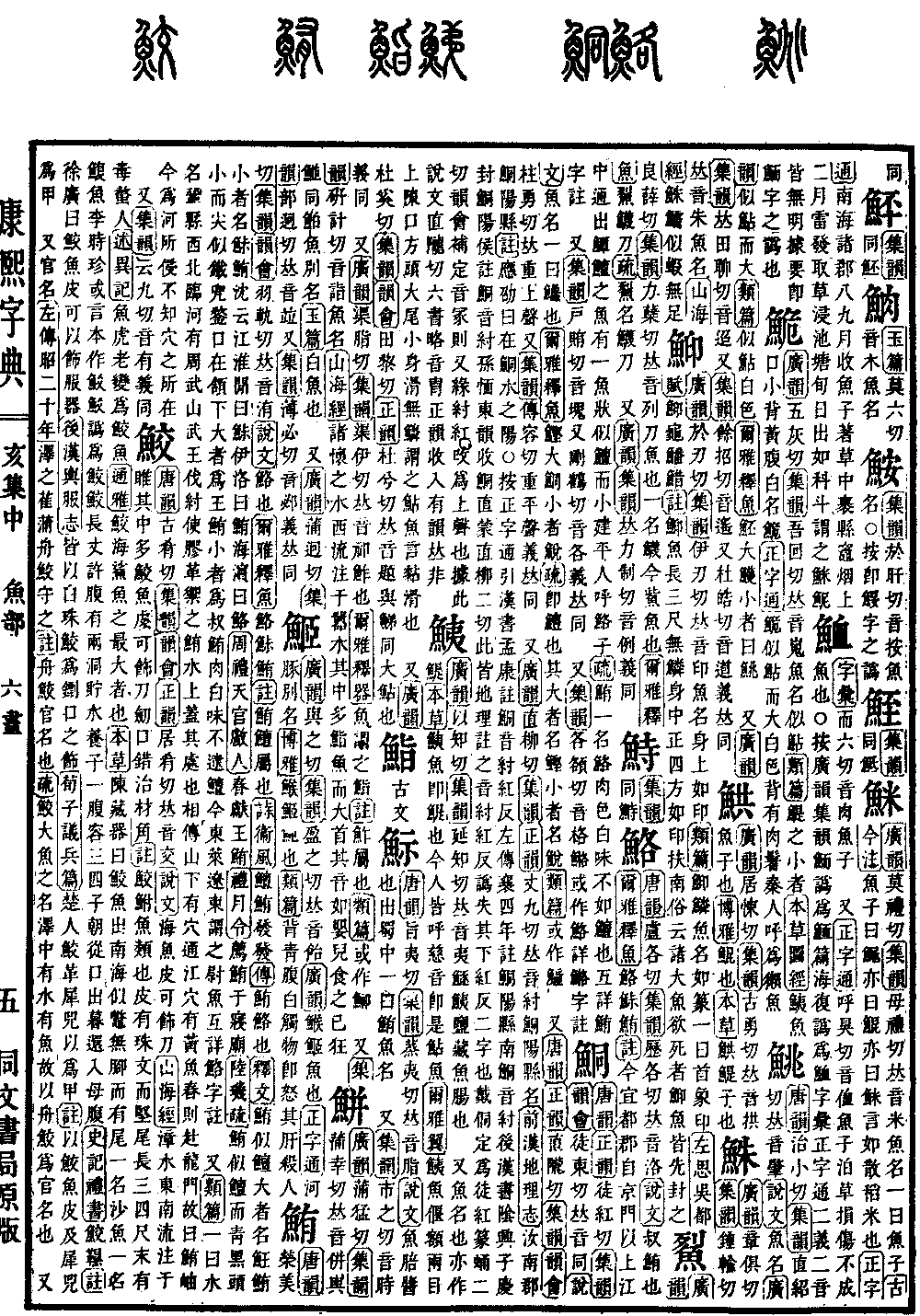
Hai Collection, Lower Volume
Radical: Fish (yú)
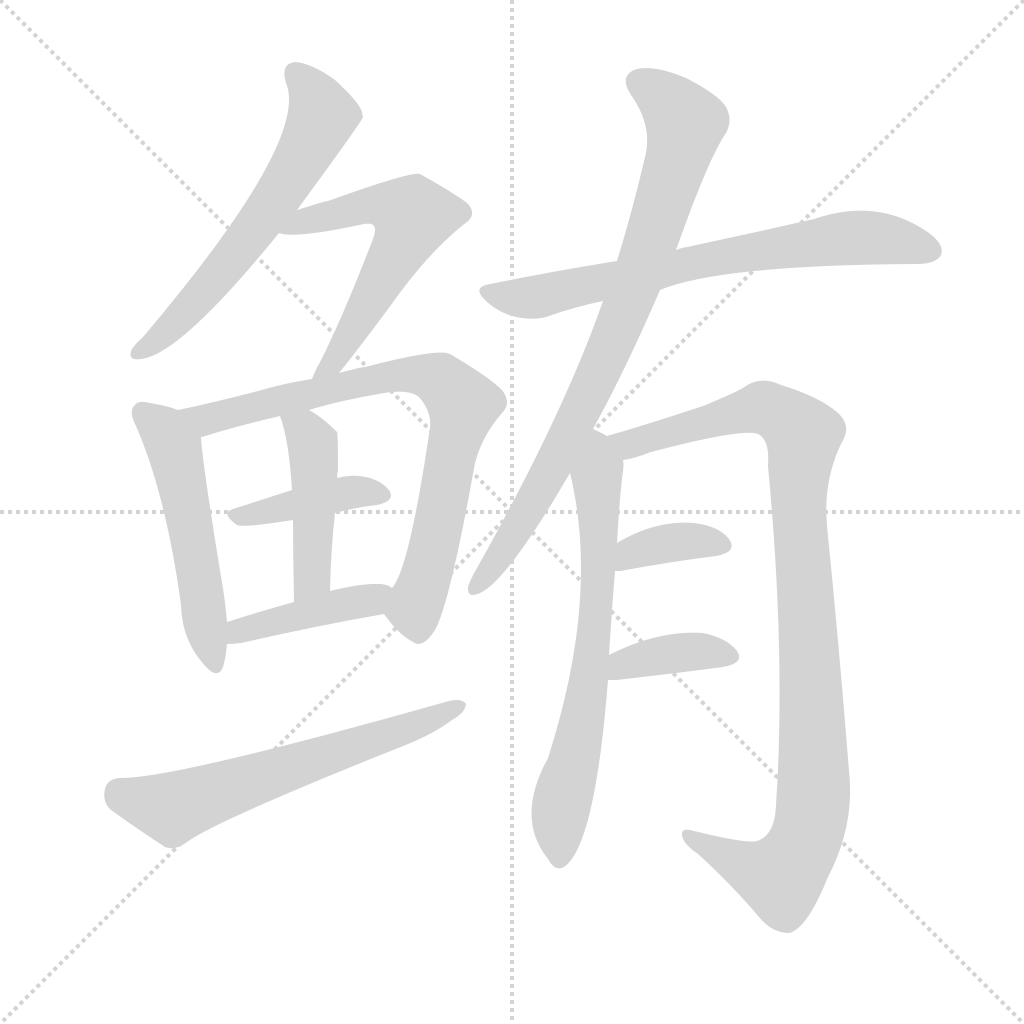
Wei
Kangxi Stroke Count: 17
Page 1469, Entry 06
Pronounced wei (rising tone).
According to Explaining Graphs and Analyzing Characters (Shuowen Jiezi), it is a type of sturgeon.
In the Er Ya: Explaining Fish (Er Ya: Shiyu), it is referred to as luo and shu-wei.
Commentary: The wei is a member of the sturgeon family.
In the Book of Odes (Shijing), Weifeng section: The sturgeon and the wei are splashing.
Commentary: The wei is the luo fish.
Explanation of Texts: The wei resembles a sturgeon; the large ones are called wei and the small ones are called shu-wei. Shen states: Between the Yangtze and Huai rivers they are called shu-wei, at the Yi and Luo rivers they are called wei, and at the seaside they are called luo.
In the Rites of Zhou (Zhouli), Office of the Heavenly Officials: In the spring, offer the king’s wei to the ruler.
In the Book of Rites (Liji), Monthly Ordinances: Present the wei at the寝 and 廟 temples.
Lu Ji’s commentary: The wei resembles the sturgeon but is bluish-black, with a small and pointed head resembling an iron helmet. Its mouth is located beneath the chin. The large ones are called royal wei and the small ones are called shu-wei. The meat is white, and the flavor is not as good as the sturgeon. Today, in Donglai and Liaodong, it is called wei-fish. See the entry for luo for further details.
Additionally, according to the Classified Chapters (Leipian), it is also the name of a river. Northwest of Gong County, facing the river, is Mount Zhouwu. When King Wu campaigned against King Zhou, he had Jia Ge defend the position at the Wei River; this is likely that location. Legend holds that beneath the mountain there is a cavern connected to the river, containing yellow fish that swim toward the Dragon Gate in the spring, hence it is called Wei-xiu. It has since been eroded by the river, and the location of the cavern is unknown.
Also, according to the Collected Rhymes (Jiyun), pronounced you (rising tone). The meaning is the same.