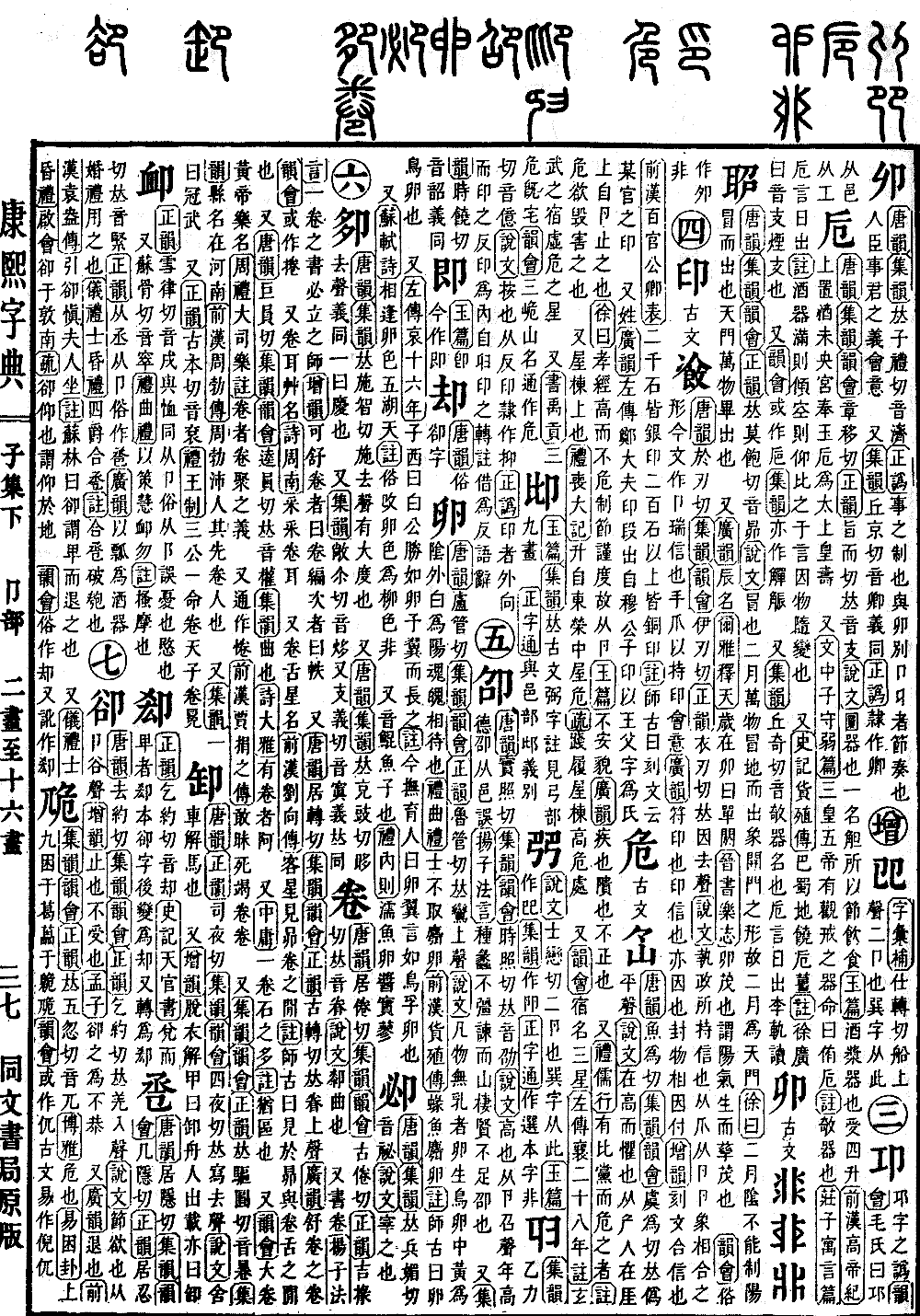
Zi Collection, Page Position: Lower
Radical: Seal (jié)
危
Kangxi Stroke Count: 6
Page 159, Entry 12
Classical text: Pronounced wei (level tone).
Explaining Graphs and Analyzing Characters (Shuowen): To be in a high place and feel fear. Composed of the graph for looking upward from a height, with a person on a cliff, constrained by the seal graph.
Xu states: The Classic of Filial Piety (Xiaojing) says, high but not in danger (wei), regulating conduct with prudence. Thus, it is composed with the seal graph.
Comprehensive Dictionary of Characters (Yupian): The appearance of being uneasy.
Wide Rhymes (Guangyun): Rapid. Ruined or decayed, not upright.
Also, in the Book of Rites (Liji), Records of the Confucian Scholars: There are those who form factions to endanger others.
Annotation: Wei means to wish to harm him.
Also refers to the roof ridge. In the Book of Rites (Liji), Record of Funeral Rites: Ascend from the eastern eaves, walk to the center of the roof, and step onto the ridge.
Commentary: Stepping on the high part of the roof.
Also, in the Encyclopedia of Rhymes (Yunhui): Name of a star constellation. Three stars.
Zuo Tradition (Zuo Zhuan), Twenty-eighth Year of Duke Xiang, Annotation: The martial asterisms, the stars of Xu and Wei.
Also, in the Book of Documents (Shujing), Tribute of Yu (Yugong): The three Wei areas are already habitable.
Encyclopedia of Rhymes (Yunhui): Three Wei, a mountain name. Commonly written as the variant character wei.
Textual Research: Ascend from the eastern eaves, walk to the center of the roof and step on the ridge. In accordance with the original text of the Book of Rites (Liji), the character step has been added before the character for ridge.