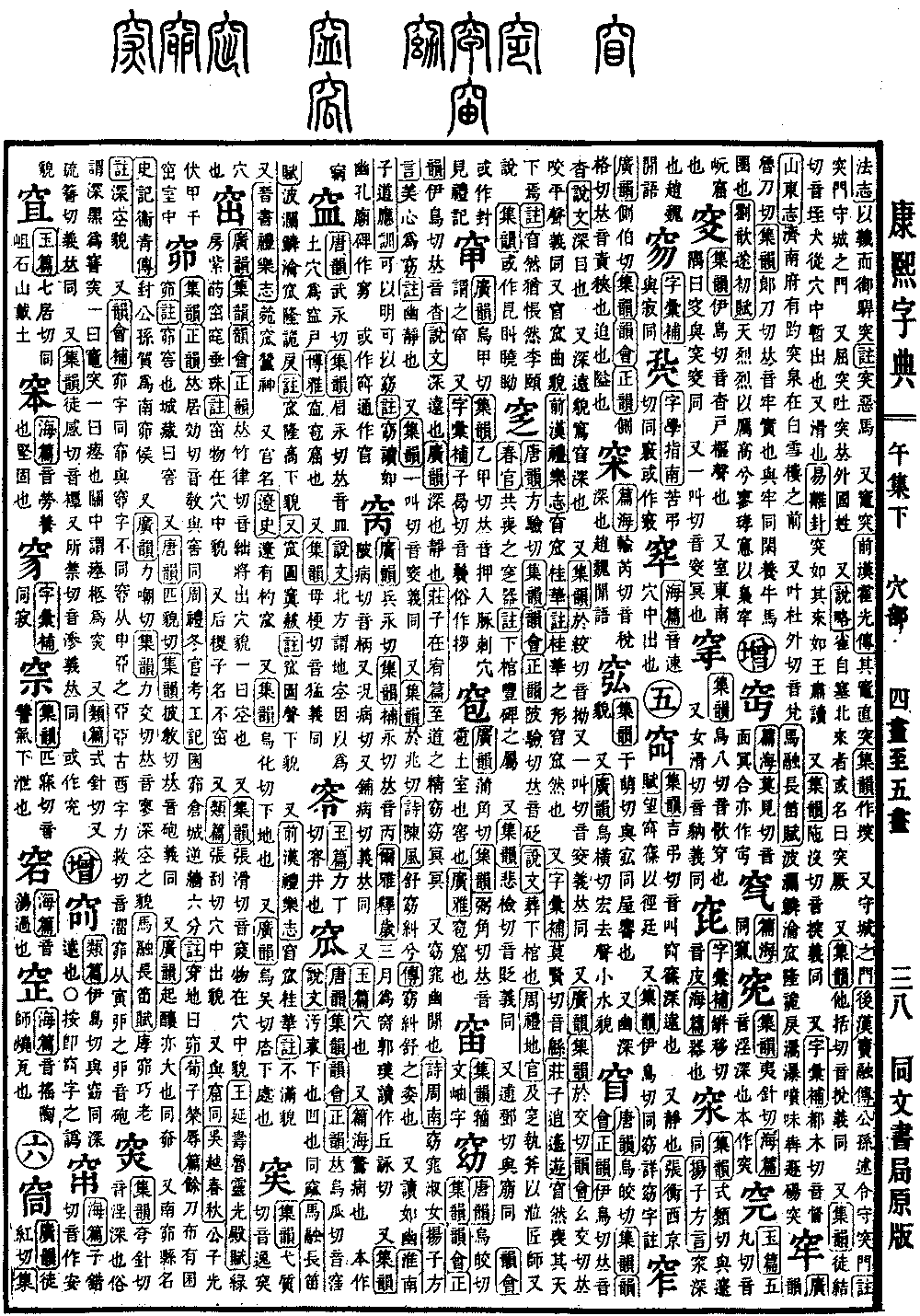
Wu Collection, Lower Volume
Radical: Cave (xué)
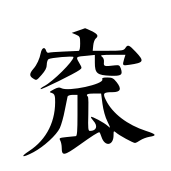
Wa
Kangxi Stroke Count: 10
Page 864, Entry 26
Pronounced wa. According to the Shuowen Jiezi, it means low-lying ground. It also means concave. It is identical to the character yu. In the Rhapsody on the Long Flute (Changdi Fu) by Ma Rong, it is written that the waves are like overlapping scales, rising and falling in an uneven manner. The commentary notes that this refers to the appearance of high and low. It also appears in the term waya. The commentary notes that this describes a low sound. It also appears in the Treatise on Rites and Music in the History of the Former Han (Hanshu) as being like the concave petals of a cassia flower. The commentary notes that this describes an incomplete or recessed appearance. It also appears in the Treatise on Rites and Music in the Book of Jin (Jinshu) as the place where the silkworm deity resides. It is also a name for an official post. The History of Liao (Liaoshi) notes that the Liao dynasty had a shaowa official. According to the Jiyun, it is pronounced hua and refers to low-lying land. According to the Guangyun, it is pronounced wa and refers to a low place.