Xu Collection, Middle Volume
Radical: Rain (yǔ)
Kangxi Strokes: 13
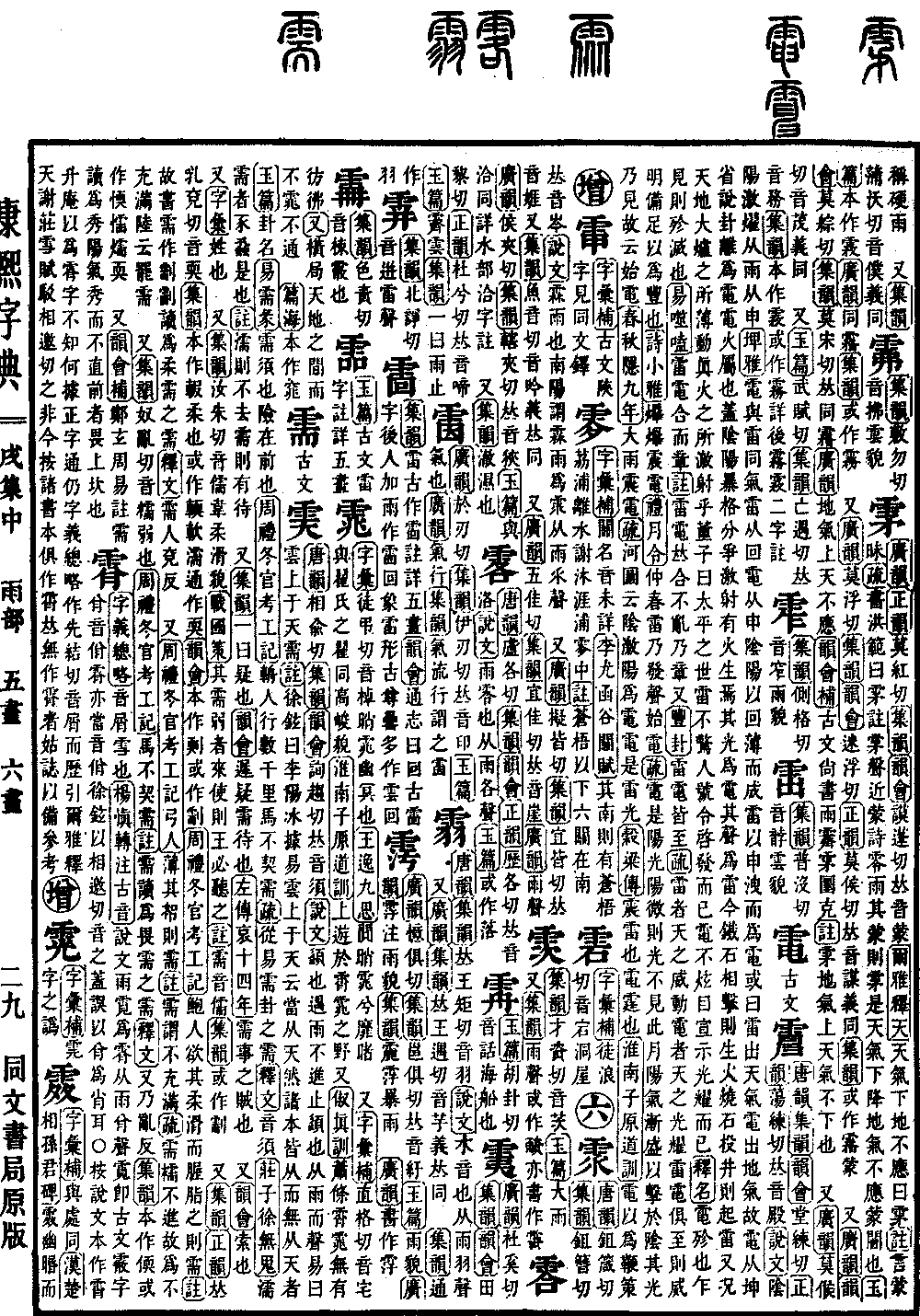
Page 1373, Entry 02
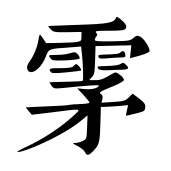
Broad Rhymes (Guangyun) and Collected Rhymes (Jiyun): Pronounced meng. Collected Rhymes (Jiyun) and Rhyme Compendium (Yunhui): Pronounced meng.
Erya, Explaining Heaven (Erya, Shitian): When heaven's essence descends and earth does not respond, it is called meng. Commentary: It refers to being obscured. Sub-commentary: The Book of Documents, Great Plan (Shujing, Hongfan) mentions meng; the commentary states that the sound of meng is close to the word for obscure; in the Book of Odes (Shijing), it says the drizzling rain makes it obscure; thus meng is when heaven's essence descends, earth does not respond, and it is dark and dim.
Jade Compendium (Yupian): Originally written as the variant form (wu).
Broad Rhymes (Guangyun): Same as the variant form (mao).
Collected Rhymes (Jiyun): Or written as fog (wu).
Also, Broad Rhymes (Guangyun): Pronounced mou. Collected Rhymes (Jiyun) and Rhyme Compendium (Yunhui): Pronounced mou. Correct Rhymes (Zhengyun): Pronounced mou. The meaning is the same. Collected Rhymes (Jiyun): Or written as the variant form (meng).
Also, Broad Rhymes (Guangyun) and Rhyme Compendium (Yunhui): Pronounced meng. Collected Rhymes (Jiyun): Pronounced meng. Same as the variant form (mao).
Broad Rhymes (Guangyun): When earth's essence ascends and heaven does not respond.
Rhyme Compendium Supplement (Yunhuibu): In the Ancient Text Book of Documents (Shangshu), it states the rain clears and it is dim (meng yi). Commentary: Meng refers to earth's essence ascending and heaven's essence not descending.
Also, Broad Rhymes (Guangyun): Pronounced mao. The meaning is the same.
Also, Jade Compendium (Yupian): Pronounced wu. Collected Rhymes (Jiyun): Pronounced wu. Collected Rhymes (Jiyun): Originally written as the variant form (wu). Or written as fog (wu). Refer to the detailed entries for the two characters fog (wu) and mist (wu) later.