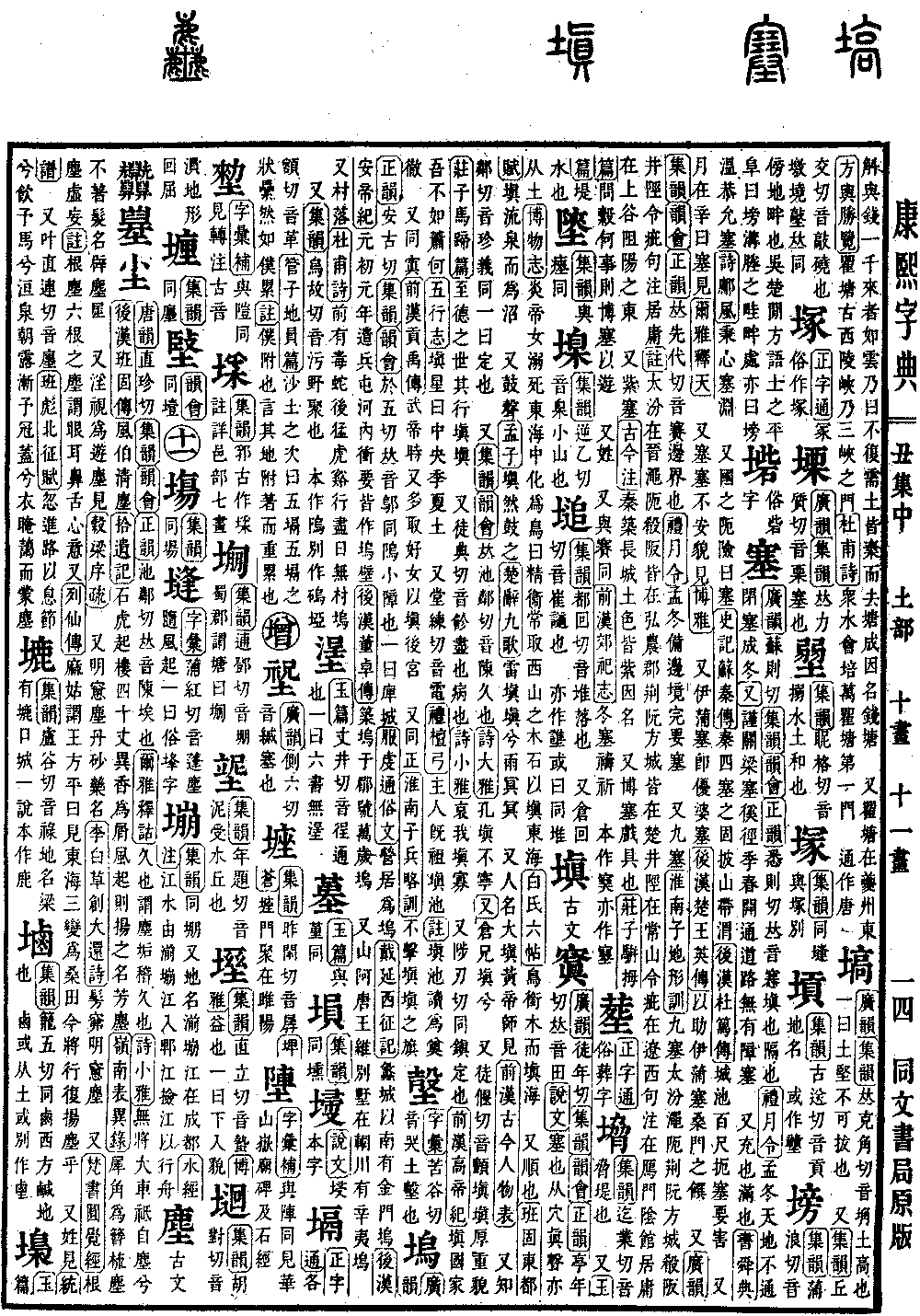
Chou Collection, Middle Volume. Radical: Earth (tǔ).
Kangxi strokes: 13.
Page 236, Entry 18.
Pronounced wu. Same as the character (wù). Refers to small defensive fortifications. One source states it refers to a low city wall.
According to Common Interpretations (Tongsu wen) by Fu Qian, a place where barracks are built and occupied is called a wu.
According to Western Expedition Records (Xizheng ji) by Dai Yan, there is a place south of Liche City called Jinmen Wu.
According to Records of Emperor An (An di ji) in the Book of the Later Han (Hou Hanshu): In the first year of the Yuanchu era, troops were dispatched to station at major thoroughfares in the Henei region, where defensive fortifications known as wubi were constructed.
According to Biography of Dong Zhuo in the Book of the Later Han (Hou Hanshu): Dong Zhuo built a fortress in Mei County, calling it the Wansui Wu.
It also refers to a mountain hollow. The Tang dynasty poet Wang Wei had a villa in Wangchuan, which included the Xinyi Wu.
It also refers to a village. In a poem by Du Fu: With poisonous snakes in front and fierce tigers behind, I walked all day through the valley without seeing a single village.
Also, according to Collected Rhymes (Jiyun), pronounced wu. Refers to a place where people gather in the wilderness. The original character is (wù). It is also written as (yà).