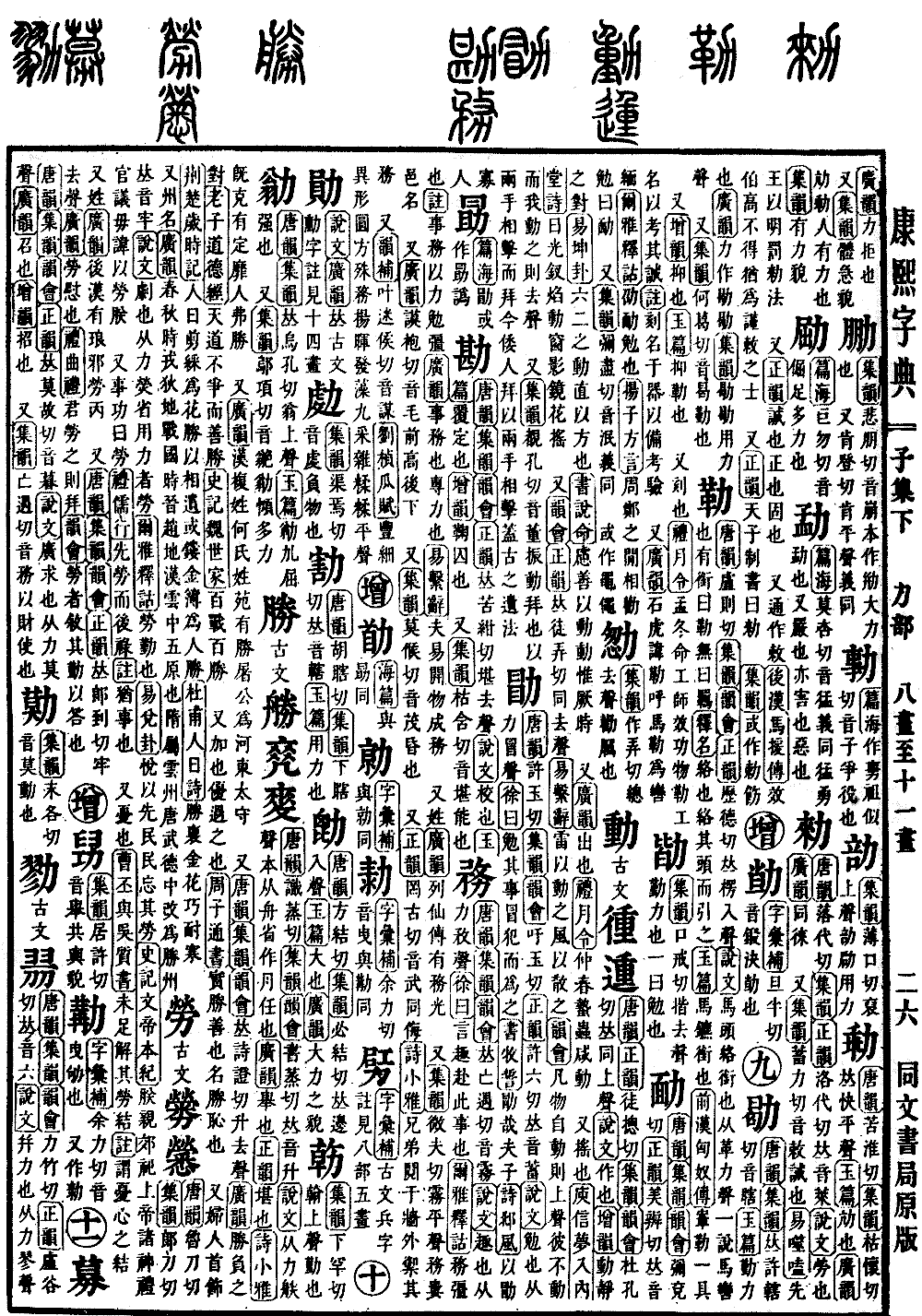
Zi Collection, Page Position: Lower
Radical: Strength (lì)
Character: 務
Kangxi strokes: 11
Page 148, Entry 20
According to Tang Rhymes (Tangyun), Collected Rhymes (Jiyun), and Rhyme Compendium (Yunhui), pronounced wù. Explanations of Characters (Shuowen Jiezi) states it means 'to hasten' or 'to approach'. It is formed from the Strength (lì) radical, with 敄 (wù) as the phonetic component. Xu Kai (Xu Yue) stated: It refers to hastening to and engaging in an affair. In Erudition (Erya), Interpretation of Words (Shigu), 務 (wù) means 'strength' or 'exertion'. The commentary explains: affairs are managed through effort and exertion. Vast Rhymes (Guangyun) states it means 'affairs' or 'matters', and 'to apply full strength'.
Book of Changes (Yijing), Appended Remarks (Xici): "Indeed, the Changes open things and complete affairs."
Also a surname. Vast Rhymes (Guangyun): In Biographies of Immortals (Liexian Zhuan) there was a person named Wu Guang.
Also, according to Collected Rhymes (Jiyun), pronounced wù in the level tone. Wùlóu is the name of a town.
Also, according to Vast Rhymes (Guangyun), pronounced máo. It describes something higher in front and lower behind.
Also, according to Collected Rhymes (Jiyun), pronounced mào. It means 'dim' or 'dusk'.
Also, according to Correct Rhymes (Zhengyun), pronounced wǔ. It is equivalent to 侮 (wǔ), meaning 'to insult' or 'to despise'.
Book of Odes (Shijing), Minor Odes (Xiaoya): "Brothers quarrel within the walls, but repel outside affronts."
Also, according to Rhyme Supplement (Yunbu), pronounced móu. From Liu Zhen's "Ode to Melons" (Liú Zhēn Guā Fù): "Of different shapes, plump or slender; round or square, with diverse patterns."