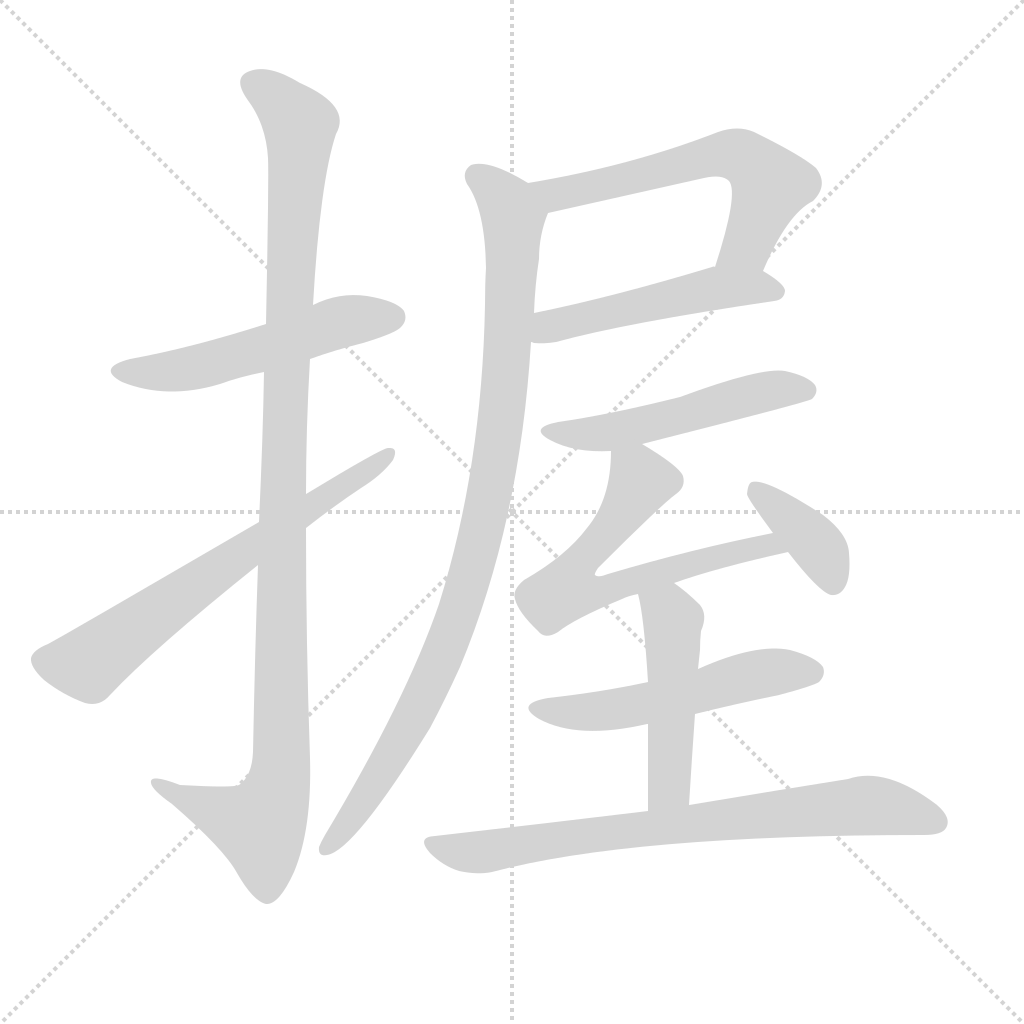
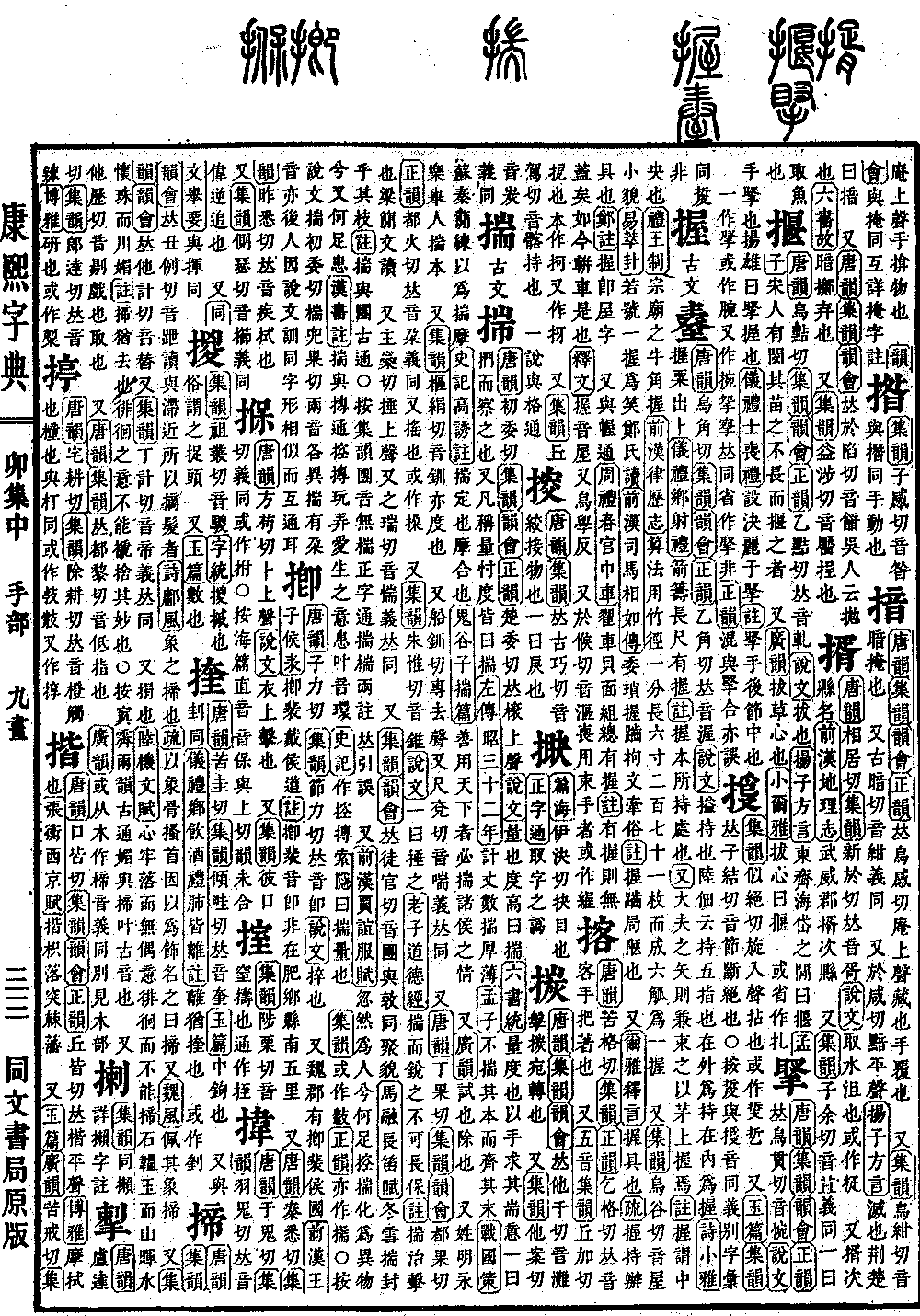
Mao Collection, Middle Volume
Radical: Hand (shǒu)
Kangxi stroke count: 13
Page 443, Entry 07
Ancient script.
Tang Rhymes (Tangyun): Pronounced wo (high level tone).
Collection of Rhymes (Jiyun), Rhyme Compilation (Yunhui), Correct Rhymes (Zhengyun): Pronounced wo (high level tone).
Shuowen Jiezi: To hold or grasp. Lu Dian stated: It is to hold with the five fingers. When held from the outside it is called holding (chi), when held from the inside it is called grasping (wo).
Book of Odes (Shijing), Lesser Odes (Xiao Ya): Grasping grain to perform divination.
Book of Etiquette and Ceremonial (Yili), Rural Archery Rite (Xiangshe Li): The arrow counting sticks are one chi in length and one grasp (wo) in width.
Commentary: The term grasp (wo) refers to the place where it is held.
Also: For the arrows of a grand master, they are bundled together with grass tied around the upper grasp.
Commentary: The term grasp (wo) refers to the central portion.
Book of Rites (Liji), Royal Regulations (Wang Zhi): For the oxen of the ancestral temple, the horns are one grasp (wo) in circumference.
History of the Former Han Dynasty (Qian Han Shu), Treatise on Pitch Pipes and Calendrical Methods (Luli Zhi): The calculation method uses bamboo sticks one fen in diameter and six cun in length, with two hundred and seventy-one pieces forming a hexagon, which constitutes one grasp (wo).
Also from Collection of Rhymes (Jiyun): Pronounced wu (high level tone). Small appearance.
Book of Changes (Yijing), Gather Together (Cui) hexagram: Crying out in one grasp, then turning to laughter. Zheng Xuan interprets it as such.
History of the Former Han Dynasty (Qian Han Shu), Biography of Sima Xiangru: Contorted and restricted (wo), fettered by literary convention and constrained by vulgar habits.
Commentary: The term grasp (wo) means narrow or cramped.
Also from Erya, Explanation of Words (Shi Yan): Grasp (wo) means to be fully equipped (ju).
Commentary: To hold and have things ready.
Zheng's Commentary: The term grasp (wo) is the same as the word for house (wu).
Also interchangeable with curtain (wo).
Rites of Zhou (Zhouli), Spring Offices (Chun Guan), Carriage Master (Jin Che): The pheasant-feather carriage has a shell-adorned face and braided tassels, with a grasp (wo).
Commentary: If it has a grasp, it lacks a roof covering. It is like the carriage with a folding canopy of the present day.
Explanation of Characters (Shiwen): The word grasp (wo) is pronounced wu (high level tone). Also pronounced o (rising tone).
Also pronounced ou (level tone). Used for binding the hands of the deceased. Sometimes written as a variant form.