Chou Collection, Upper Volume
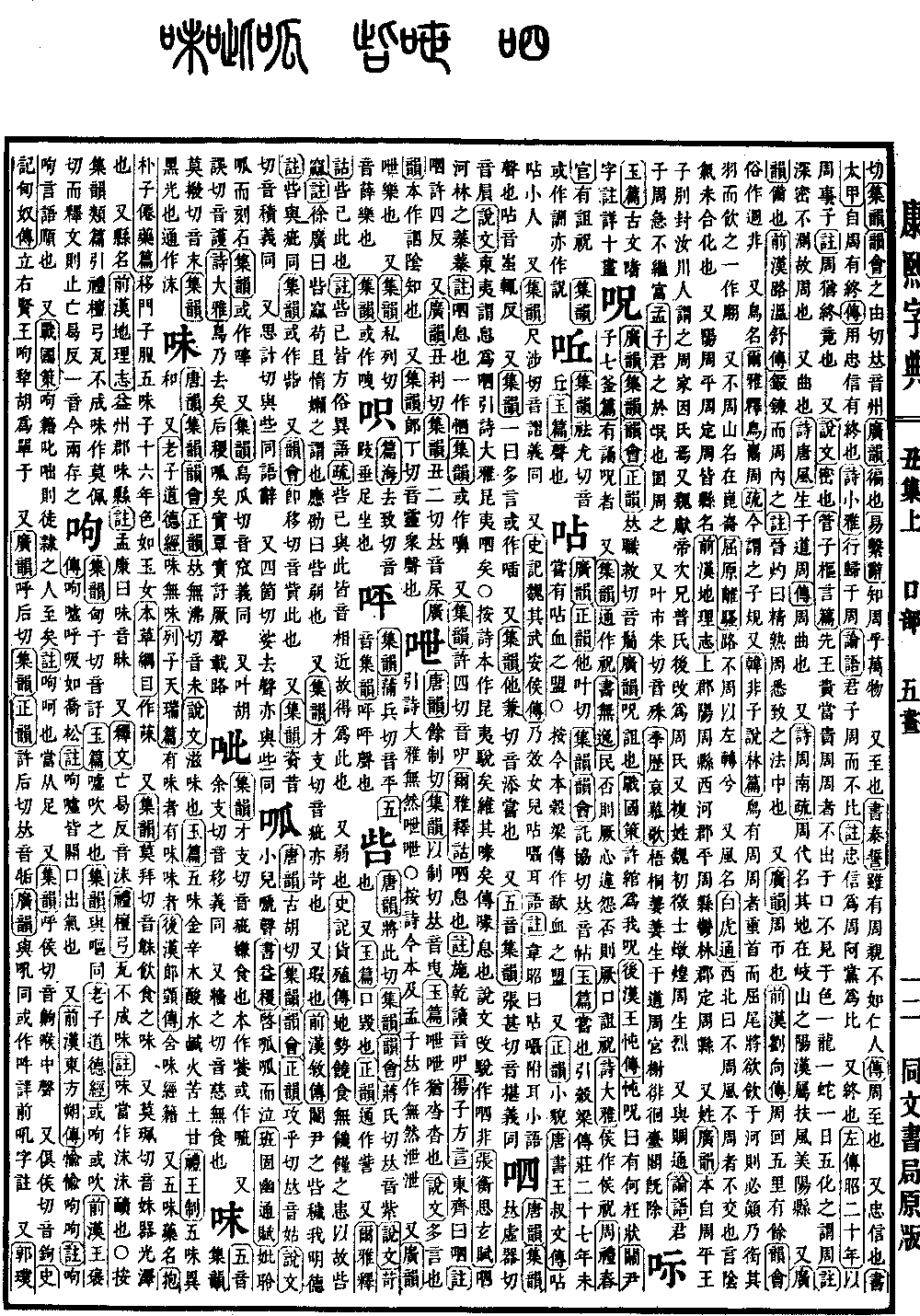
Radical: Mouth (kǒu)
Kangxi stroke count: 8
Page 182, Entry 13
Pronounced wei (falling tone).
Shuowen Jiezi defines this as the flavor of food.
Yupian states: The five flavors correspond to the five elements—metal is acrid, wood is sour, water is salty, fire is bitter, and earth is sweet.
Book of Rites (Liji), Wangzhi chapter records: The five flavors are prepared in different ways.
Dao De Jing (Daodejing) states: Experience the state of flavorlessness.
Liezi, Tianrui chapter mentions: There are things that have actual flavor, and there are people who perceive that flavor.
History of the Later Han (Hou Hanshu), Biography of Lang Yi describes: To concentrate on studying the classics.
Also, five flavors is the name of a medicine.
Baopuzi, Xianyao chapter records: Yi Menzi consumed five-flavor seeds for sixteen years, and his appearance became as clear and pure as a celestial maiden.
Compendium of Materia Medica (Bencao Gangmu) writes this as a variant form.
Also, in Jiyun, it is pronounced mai (falling tone). It refers to the flavor of food and drink.
Also pronounced mei (falling tone). It refers to the bright, fresh luster of an object.
Also the name of a county.
Book of the Former Han (Qian Hanshu), Treatise on Geography states: Yizhou Prefecture has Wei County.
Annotation: Meng Kang says the pronunciation of Wei is like mei.
Also, in Shiwen, it is annotated as being pronounced mo (entering tone).
Book of Rites (Liji), Tangong chapter contains the phrase "earthenware does not form a flavor."
Annotation: Wei should be written as mo. Mo refers to washing the face. According to Jiyun and Leipian, which cite the phrase "earthenware does not form a flavor" from the Book of Rites (Liji), the pronunciation is noted as mei (falling tone), while Shiwen only notes the pronunciation as mo (entering tone). Currently, both pronunciations coexist.