Xu Collection, Middle Volume
Radical: Rain (yǔ)
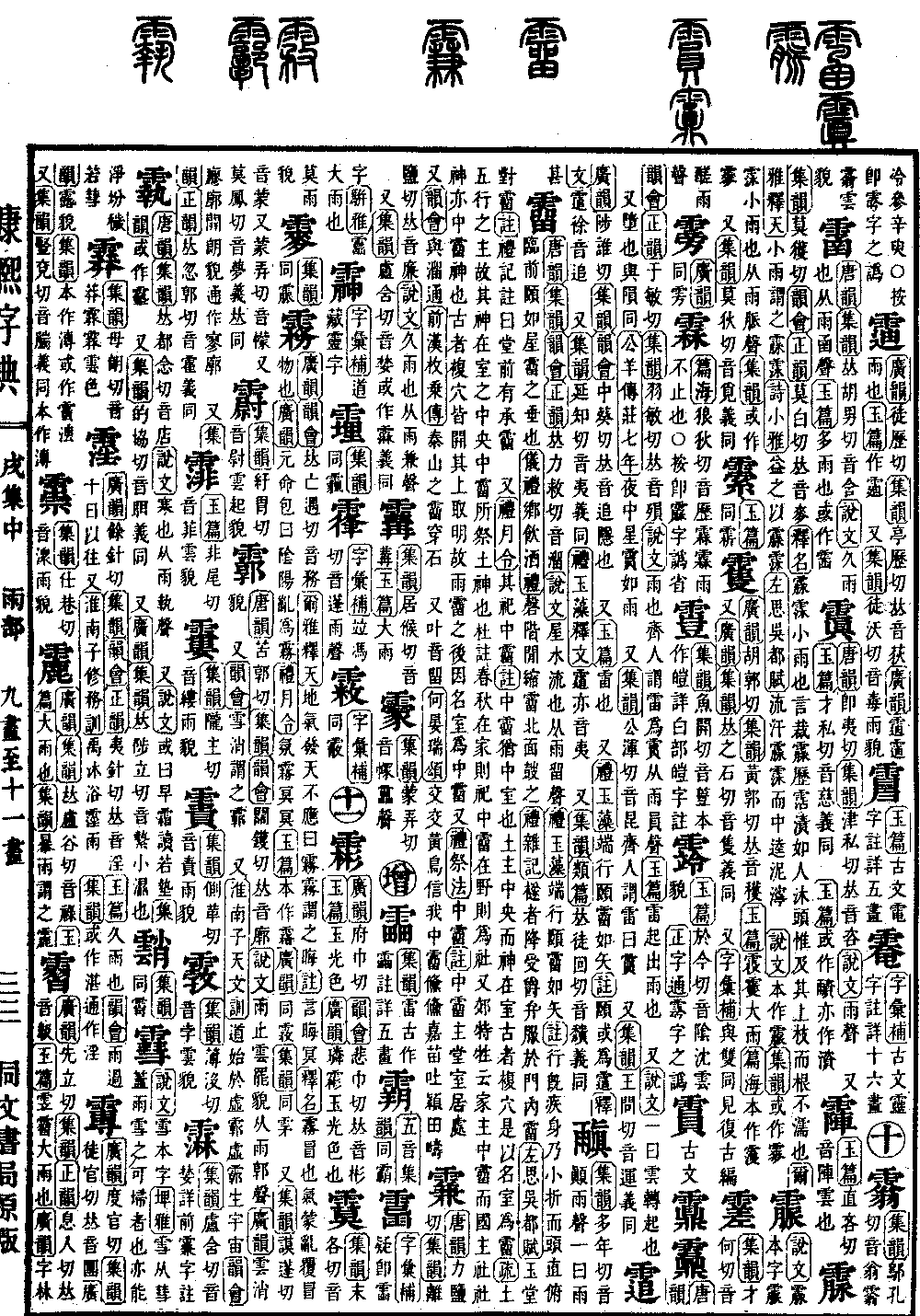
霧
Kangxi stroke count: 19
Page 1377, Entry 02
Broad Rhymes (Guangyun) and Rhyme Anthology (Yunhui): Pronounced wu (falling tone).
Erya (Erya), Explanation of Heaven: When the vapors of the earth rise and heaven does not respond, it is called mist (wu). Mist is also referred to as dark (hui). Note: This refers to darkness and obscurity.
Explanation of Names (Shiming): Mist (wu) means to cover (mao); it is a vapor that obscures, confuses, and covers objects.
Broad Rhymes (Guangyun): The Yuanmingbao (Yuanmingbao) states: When yin and yang are in chaos, it results in mist.
Book of Rites (Liji), Monthly Ordinances (Yueling): Vapors and mists are dark and obscure.
Jade Chapters (Yupian): Originally written as 霿.
Broad Rhymes (Guangyun): Same as 霚.
Collected Rhymes (Jiyun): Same as 雺.
Additionally, according to Collected Rhymes (Jiyun): Pronounced meng (level tone).
Also pronounced meng (falling tone).
Also pronounced meng (falling tone).
The meaning is the same.