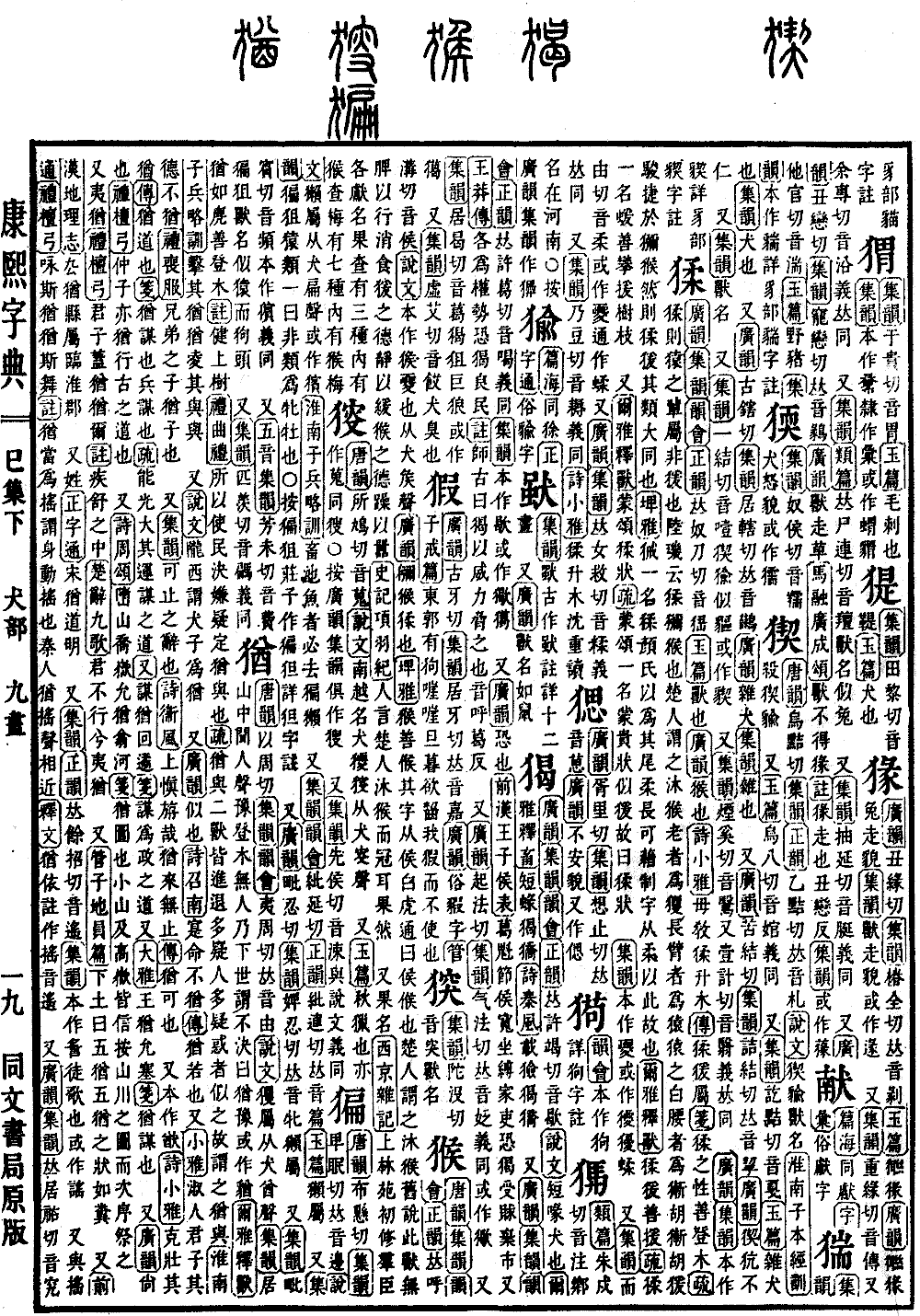
Shen Collection, Middle Volume
Radical: Insect (chóng)
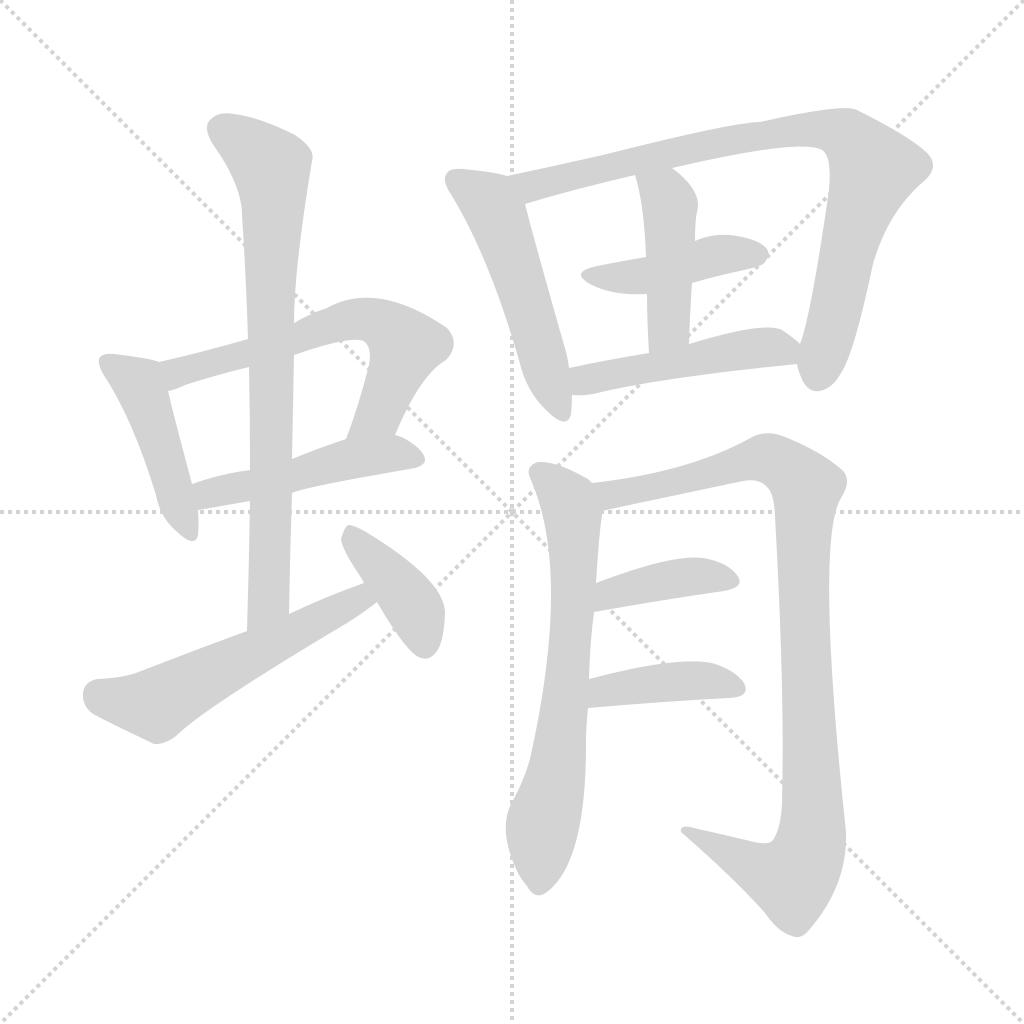
Hedgehog
Kangxi Strokes: 15
Page 715, Entry 06
Pronounced wèi.
Jade Chapters (Yupian): An insect, similar to a porcupine but smaller.
Rhyme Compilation (Yunhui): Also written in the variant form (huì).
Explication of Animals (Shijing - Erya): The hui, having bristly fur.
Commentary: This refers to the hedgehog.
Lu Dian states: It can be used to treat stomach ailments.
Zhiguzi states: When the tips of the bristles are split into two branches, it is a hedgehog; when they are like thorny needles, it is also a hedgehog. The hedgehog resembles a rat, by nature ferocious and slow; if any creature approaches it, its bristles stand up like arrows.
Biography of Jia Yi in the History of the Former Han (Qian Hanshu): The rebels rose up like the bristles of a hedgehog.
Records of the Grand Historian (Shiji), Treatise on Tortoise Divination: The hedgehog is humiliated by the magpie.
Commentary: Continued Records of Broad Knowledge (Xu Bowuzhi) states: The hedgehog can jump into a tiger's ear; when it sees a magpie, it exposes its belly to be pecked.
Jiao Gan's Forest of Changes (Yilin): A hungry tiger wanting to eat sees a hedgehog and crouches down.
Miscellaneous Records of the Western Capital (Xijing Zaji): In the second year of the Yuanfeng era, there was a great cold; cows and horses all curled up like hedgehogs.
Also a mountain name.
Gazetteer of Huayang (Huayang Guozhi): In Dianchi there is White Hedgehog Mountain; the mountain has no stones, only hedgehogs.
Sometimes also written in the variant form (wèi).
Zhang Heng, Rhapsody on the Eastern Capital (Dongjing Fu): Stretching out the hedgehog.
Rhyme Compilation (Yunhui): Also written in a variant form.