Wu Collection, Lower Volume
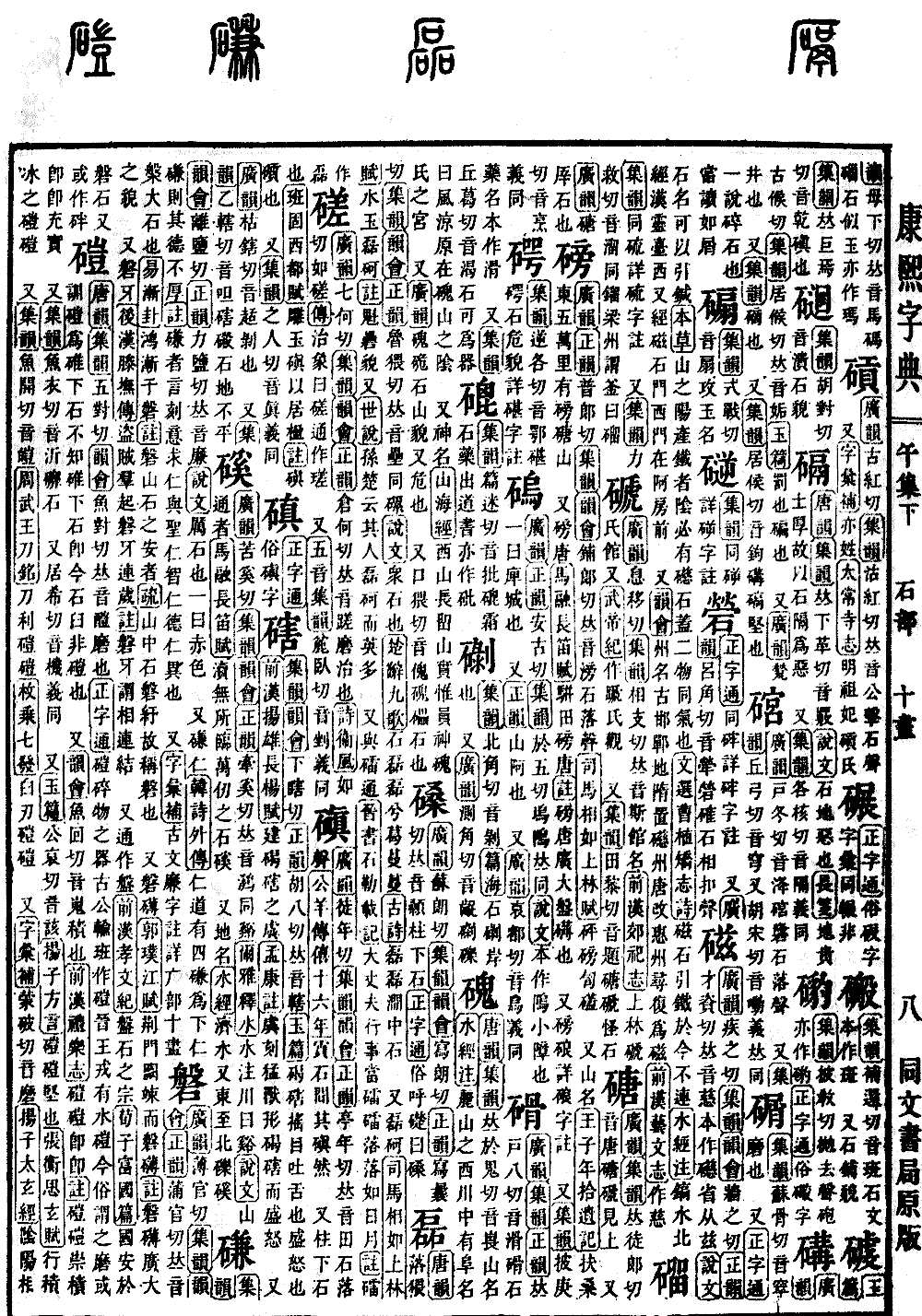
Radical: Stone (shí)
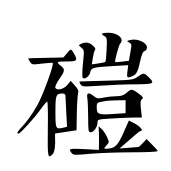
Gae
Kangxi strokes: 15
Page 834, Entry 34
Pronounced dui (falling tone) according to Tang Rhymes (Tangyun) and Collected Rhymes (Jiyun), or pronounced dui (falling tone) according to Rhyme Collection (Yunhui). A mill. According to Corrected Meaning (Zhengzitong), a mill is an implement for crushing things. In ancient times, Gongshu Ban invented the mill. During the Jin dynasty, Wang Rong owned a water-powered mill. Today it is commonly called a mill (mo). Some define it as the stone beneath a mortar, but this is incorrect; the stone beneath a mortar is a stone pestle, not a mill.
Also, pronounced wei (rising tone) according to Rhyme Collection (Yunhui). To accumulate. According to Book of Han (Qianshu), Ritual and Music Treatise: Accumulating and filling. Commentary: Great accumulation and fullness.
Also, pronounced yi (level tone) according to Collected Rhymes (Jiyun). Stone.
Also, pronounced ji (level tone). Same meaning as above.
Also, pronounced gai (level tone) according to Jade Chapters (Yupian). According to Yangzi’s Dialects (Fangyan), firm. In Zhang Heng’s Thinking Rhapsody (Si Fu), walking upon the piled ice, firm and solid.
Also, pronounced ai (rising tone) according to Collected Rhymes (Jiyun). According to the Sword Inscription of King Wu of Zhou (Zhouwuwang Daoming), a sharp blade. In Mei Sheng’s Seven Stimuli (Qi Fa), a white blade, gleaming and bright.
Also, pronounced mo (level tone) according to Supplement to the Collection of Characters (Zihuibu). According to Yangzi’s Great Mystery (Taijing), Yin and Yang grinding against each other, all things wither and separate. Commentary: Pronounced mo.