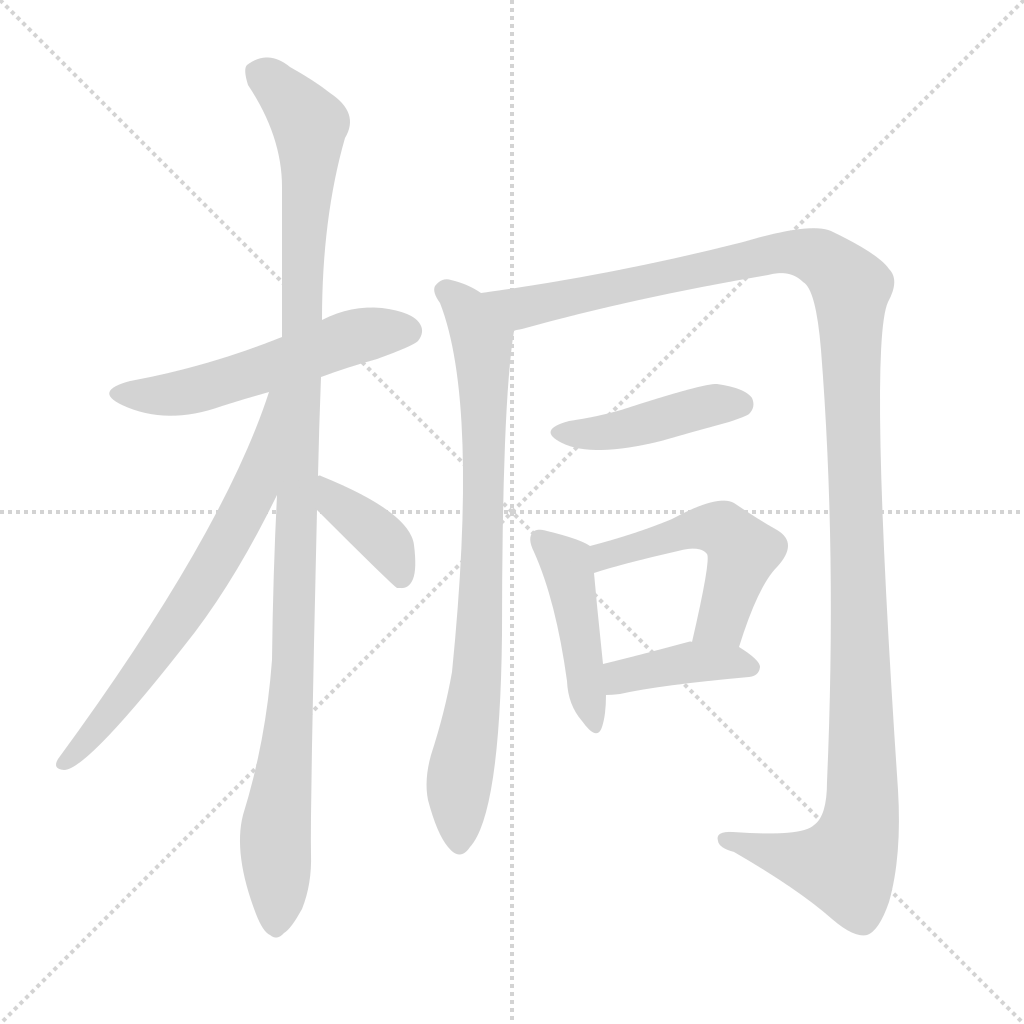
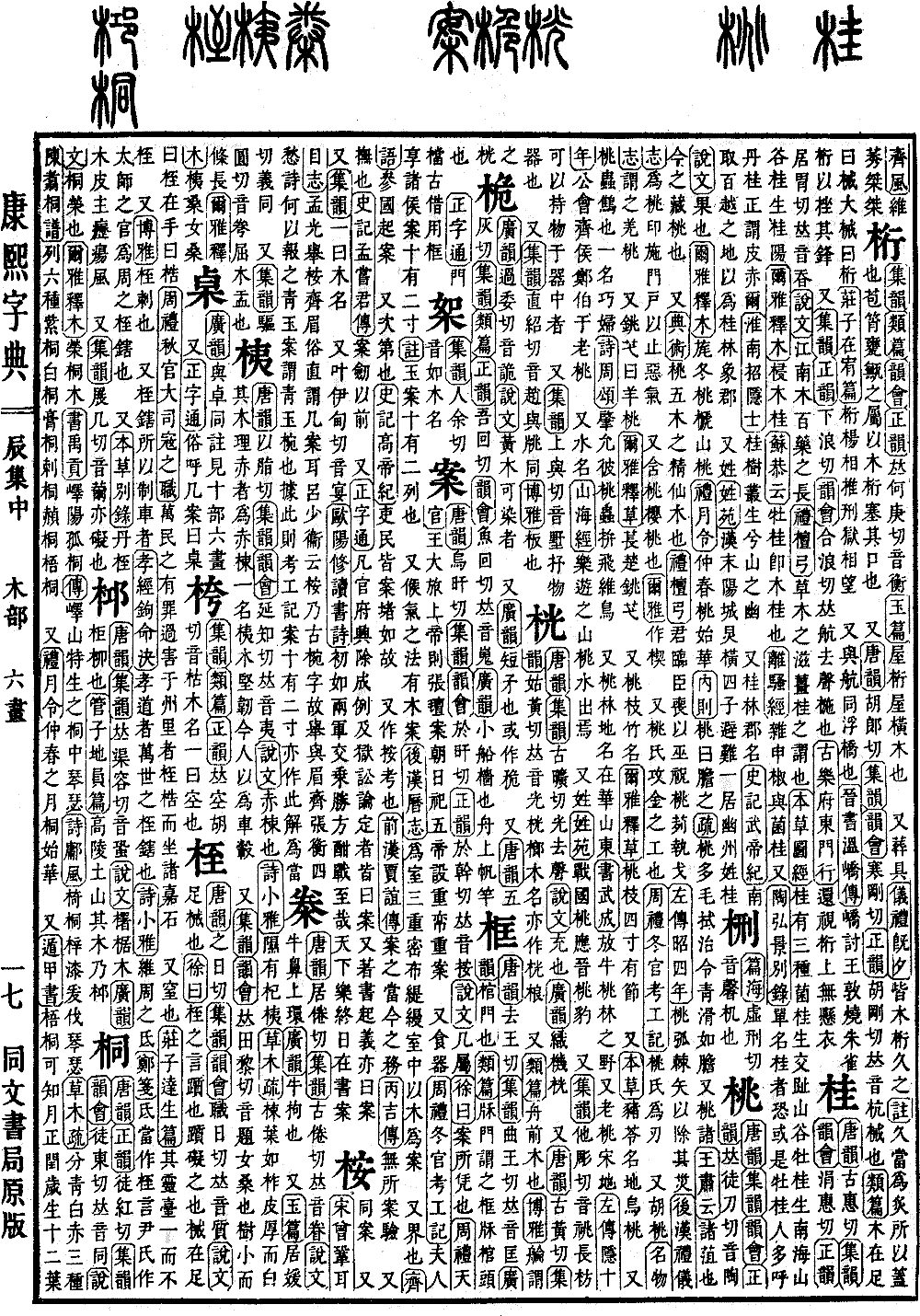
Chen Collection, Middle Volume. Radical: Tree (mù). Kangxi stroke count: 10. Page 525, Entry 17.
Pronounced tong.
Explaining the Characters (Shuowen): Tong is the flowering of the tree.
Approaching Elegance (Erya): Explaining Trees (Shimu): Rong is the tong tree.
Book of Documents (Shujing): Tribute of Yu (Yugong): The solitary tong trees of Mount Yi.
Commentary: The solitary tong trees growing on Mount Yi are suitable for making zithers and lutes.
Book of Odes (Shijing): Odes of Yong (Yongfeng): Cutting down the yi, tong, zi, and qi trees to make zithers and lutes.
Treatise on Grasses and Trees (Caomushu): Divided into three types: green, white, and red.
Chen Zhu's Record of Tong (Tongpu): Lists six types: purple tong, white tong, oil tong, thorny tong, scarlet tong, and wutong (Chinese parasol tree).
Also, Book of Rites (Liji): Monthly Ordinances (Yueling): In the final month of spring, the tong tree begins to bloom.
Also, Book of Hidden Stems (Dunjia Shu): The wutong tree can indicate the lunar calendar and leap years. It produces twelve leaves, six on each side. Counting the leaves from the bottom, each leaf represents one month. If there is a leap month, there are thirteen leaves. By observing the smaller leaves, one knows which month is the leap month. From the day of the beginning of autumn until the expected date, one leaf falls first.
Also, Extensive Elegant Records (Boya): Tong means pain.
Book of Etiquette and Ceremonial (Yili): Records on Mourning Garments (Sangfuzhi): For the mourning of a mother, the mourning staff is made of tong wood.
Also, Kongtong, a place name in the northern wilderness.
Erya: Explaining Geography (Shidi): That which carries the sun in the south is called the Cinnabar Cave, and that which carries the Dipper and the Pole in the north is called Kongtong.
Also, Tongguo, a city name.
History of the Former Han (Qianhan): Treatise on Geography: Belonged to Dingxiang Commandery.
Also, a surname.
Garden of Surnames (Xingyuan): Tong Jun authored the Record of Medicines (Yaolu).
Also pronounced tong.
Classified Chapters (Leipian): Appearing light and carefree.
History of the Former Han: Biography of Emperor Wu's Five Sons: No tong and fond of leisure.
Also, Han Dynasty: House Music Songs of Peace (Anshi Fangzhong Ge): The tong grows lush and flourishing.
Yan Shigu says: Tong is read as tong, meaning vegetation grows and reaches maturity.
Also pronounced dong.
Zhuangzi: Yielding the Throne (Rangwang): Cast oneself into the Tong River. Tong is sometimes written as chou, and the Sima edition writes it as dong.
Also pronounced tang (rhyming variant).
Records of the Grand Historian (Shiji): Biography of Tortoise Divination (Guice Zhuan): The state's good fortune and precious treasures are heard in neighboring villages. Slaughtering cattle to obtain hide, draped in the tong of Zheng.
Editorial Note: Book of Rites (Liji): Monthly Ordinances (Yueling): In the second month of spring, the tong tree begins to bloom. Adjusted according to the original text, changing second to final.