Yin Collection, Lower Volume
Radical: Broad (guǎng)
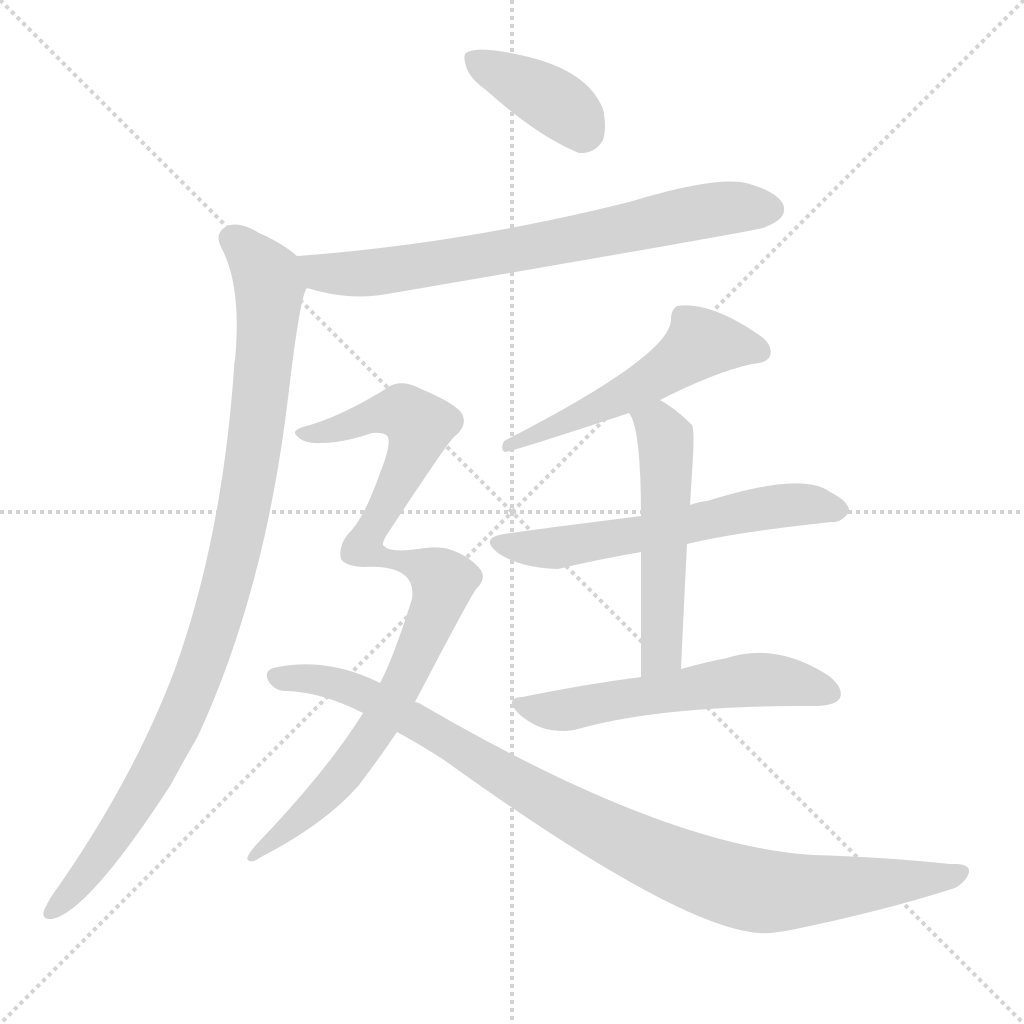
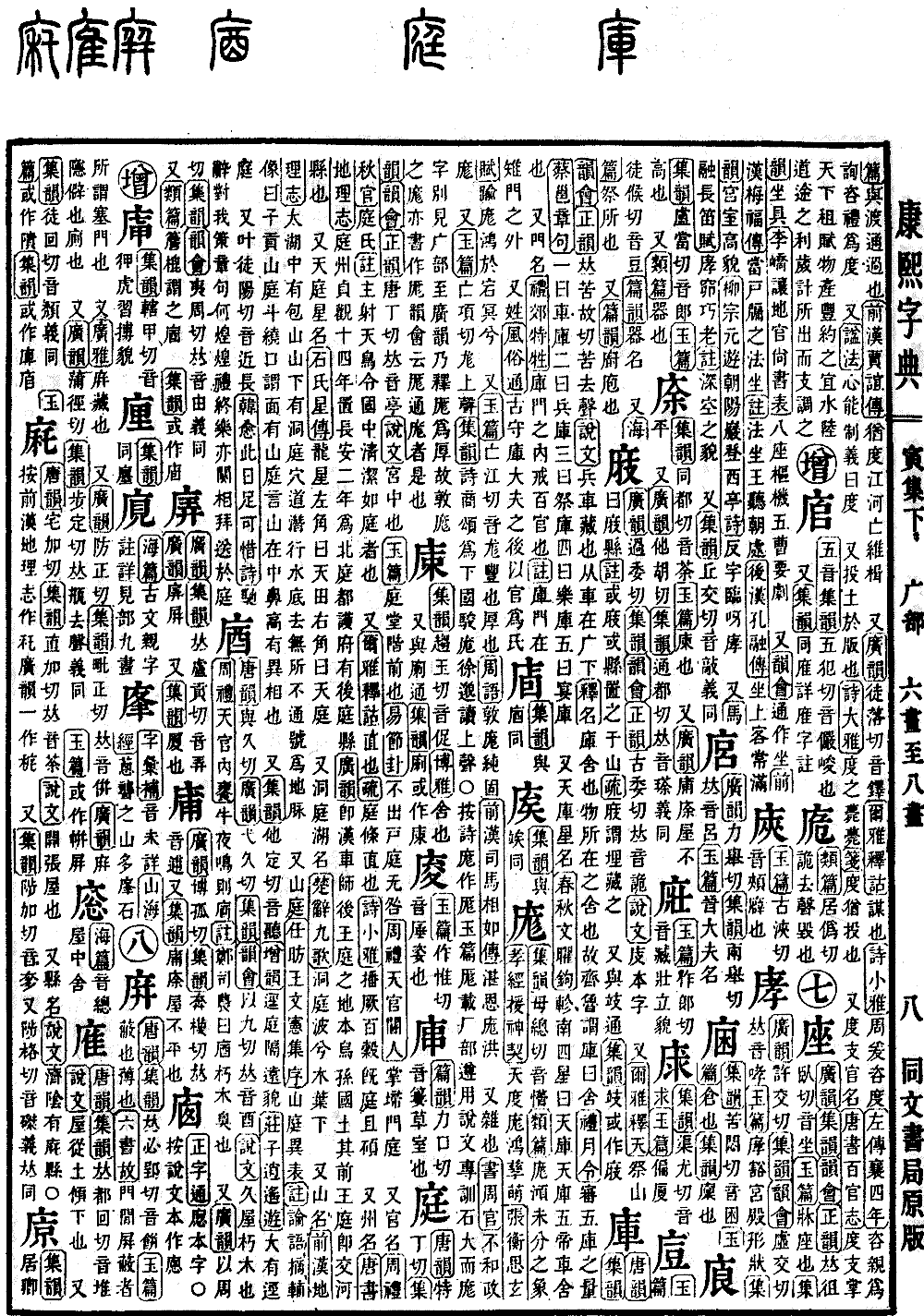
庭
Kangxi Stroke Count: 10
Page 346, Entry 21
Pronounced ting.
In the Shuowen Jiezi (Dictionary of Explaining Single Characters), it means inside the palace. In the Yupian (Jade Chapter), it is defined as the area in front of the hall steps. In the Book of Changes (Yijing), in the Jie hexagram: Do not go out the courtyard door, there will be no calamity. In the Rites of Zhou (Zhouli), Office of Heaven: The gatekeeper is in charge of sweeping the gate and courtyard.
Also a title of office. In the Rites of Zhou, Office of Autumn: The Master of the Court. The commentary states: He is in charge of shooting birds that bring bad omens, ensuring the capital remains as clean as a courtyard.
Also, as defined in the Erya (Approximation of Terms): Straight. The commentary notes: Courtyard-like, meaning straight. In the Book of Odes (Shijing), Lesser Odes: Planting their hundred grains, they are both straight and large.
Also a prefecture name. In the Book of Tang (Tangshu), Treatise on Geography: Ting Prefecture was established in the fourteenth year of the Zhenguan reign. In the second year of the Chang'an reign, it became the Beiting Protectorate, which included Houting County. In the Guangyun (Broad Rhymes), it is noted that this was the territory of the Later King of Jushi during the Han dynasty, originally the land of the Wusun people; the former king’s seat was what is now Jiaohe County.
Also Heavenly Court, a star name. In the Shishi Xingzhuan (Master Shi’s Traditions of the Stars): The left horn of the Dragon star is called Heavenly Field, and the right horn is called Heavenly Court.
Also Dongting, a lake name. In the Chu Ci (Songs of Chu), Nine Songs: The waves of Dongting, the leaves fall from the trees.
Also a mountain name. In the Book of Han (Hanshu), Treatise on Geography: Inside Lake Tai is Bao Mountain; beneath the mountain is the Dongting cave passage, which runs submerged beneath the water and leads everywhere without obstruction, referred to as the earth’s pulse.
Also Mountain Courtyard. In the Preface to the Collected Works of Wang Wenxian by Ren Fang: An unusual appearance like a mountain courtyard. The commentary notes: The Analects Zhaifu Xiang states: Zigong had a mountain-like forehead and a mouth surrounded by the Dipper; this refers to having a mountain-like forehead, meaning the mountain is in the center, and the nose is high, which is an unusual physiognomy.
Also pronounced ting. In the Zengyun (Expanded Rhymes): Distant, the appearance of being separated by a great space. In the Zhuangzi (Zhuangzi), Free and Easy Wandering: To have a great difference.
Also pronounced jin (long tone). In the poem This Day is Truly Regrettable by Han Yu: I present my words in response to the imperial exam, the chapters and sentences are so brilliant. The rituals end and the music stops, we bow to each other and see one another off at the courtyard.
Textual research: In the Rites of Zhou, Office of Autumn: The Master of the Court. The commentary states: He is in charge of shooting birds that bring bad omens, ensuring the capital remains as clean as a courtyard. The text has been corrected from the original, changing the word for ill-omened to the word for short-lived. In Han Yu’s poem This Day is Truly Regrettable: I present my words in response to the imperial exam, the chapters and sentences are so brilliant. The original poem has been corrected, changing the repetition of the word for brilliant to the version meaning bright and brilliant.