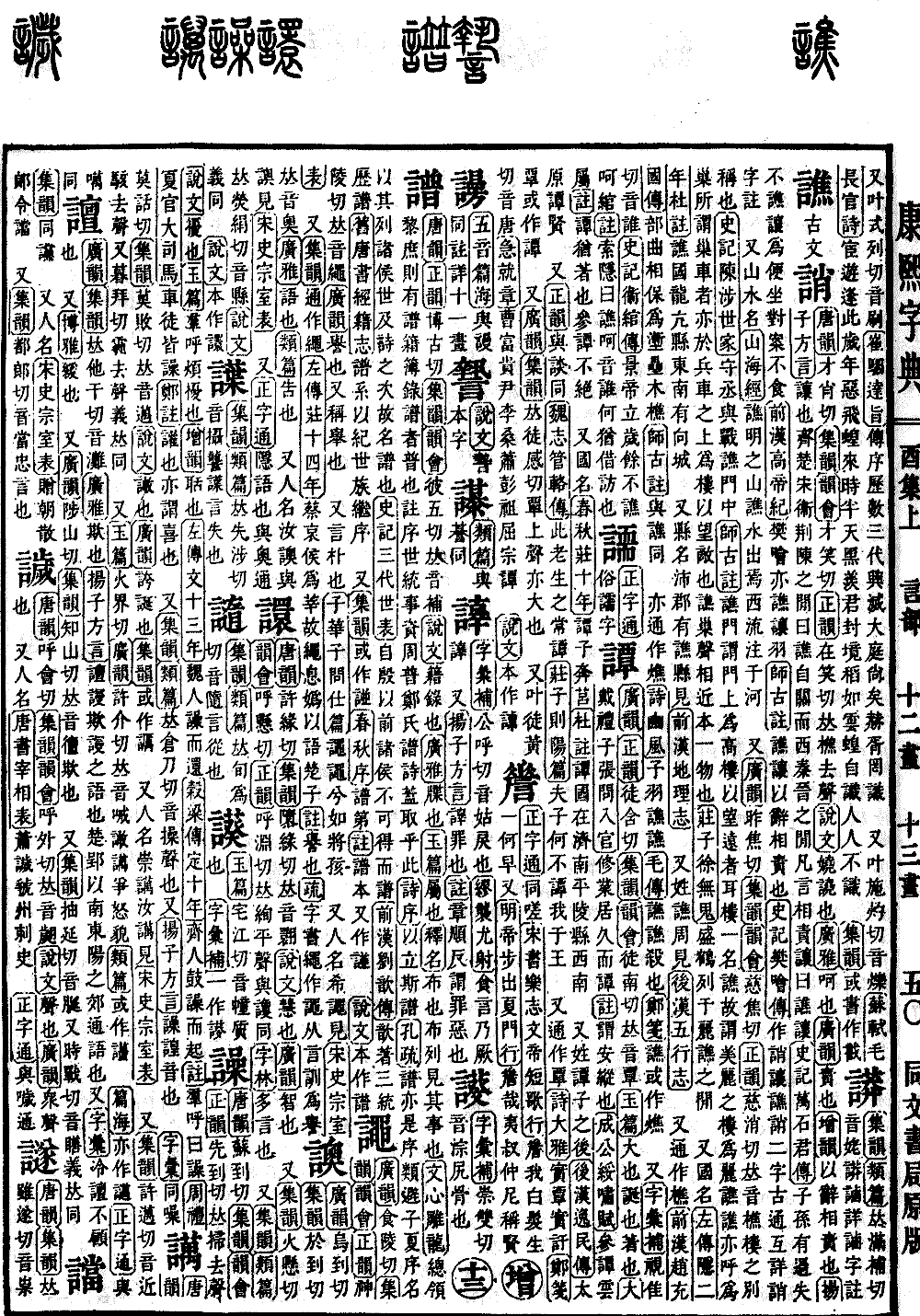
You Collection, Upper Volume
Radical: Speech (yán)
Kangxi Strokes: 19
Page 1182, Entry 05
Pronounced tan.
In Extensive Rhymes (Guangyun) and Correct Rhymes (Zhengyun), it is given as the combination of tu and han; in Collected Rhymes (Jiyun) and Rhyme Collection (Yunhui), it is the combination of tu and nan.
In Jade Chapters (Yupian): meaning great, to be born, or to manifest.
In Elder Dai's Book of Rites (Dadaili), section on Zizhang asking about entering official service: To cultivate one's occupation and dwell for a long time then tan. Commentary: This means to be at ease and unconstrained.
In Rhapsody on Whistling (Xiaofu) by Cheng Gongsuo: Gathering tan like clouds. Commentary: Tan means the same as manifest. Gathering tan means never-ending.
Also the name of a state. In Spring and Autumn Annals (Chunqiu), tenth year of Duke Zhuang: The Viscount of Tan fled to Ju. Du's commentary: The state of Tan was located southwest of Pingling County in Jinan.
Also a surname. Descendants of the Viscount of Tan. In History of the Later Han (Houhanshu), Biographies of Hermits: Tan Xian of Taiyuan.
Also, per Correct Rhymes (Zhengyun), the same as the word for discuss.
In Records of the Three Kingdoms (Weizhi), Biography of Guan Lu: This is the usual discuss of an old scholar.
In Book of Master Zhuang (Zhuangzi), Zeyang chapter: Why does the master not discuss me to the king?
Also commonly written as tan.
In Book of Odes (Shijing), Greater Odes (Daya): Truly deep, truly calling out. Zheng's notes: Tan is sometimes written as the character tan.
Also, in Extensive Rhymes (Guangyun) and Collected Rhymes (Jiyun), pronounced tan (rising tone). It also means great.
Also rhymes with tu and huang, pronounced tang.
In Urgent Notices (Jijiuzhang): Cao Fugui, Yin Li Sang, Xiao Pengzu, Qu Zongtan.
In Explaining Graphs and Analyzing Characters (Shuowen), it is originally written with the speech radical.