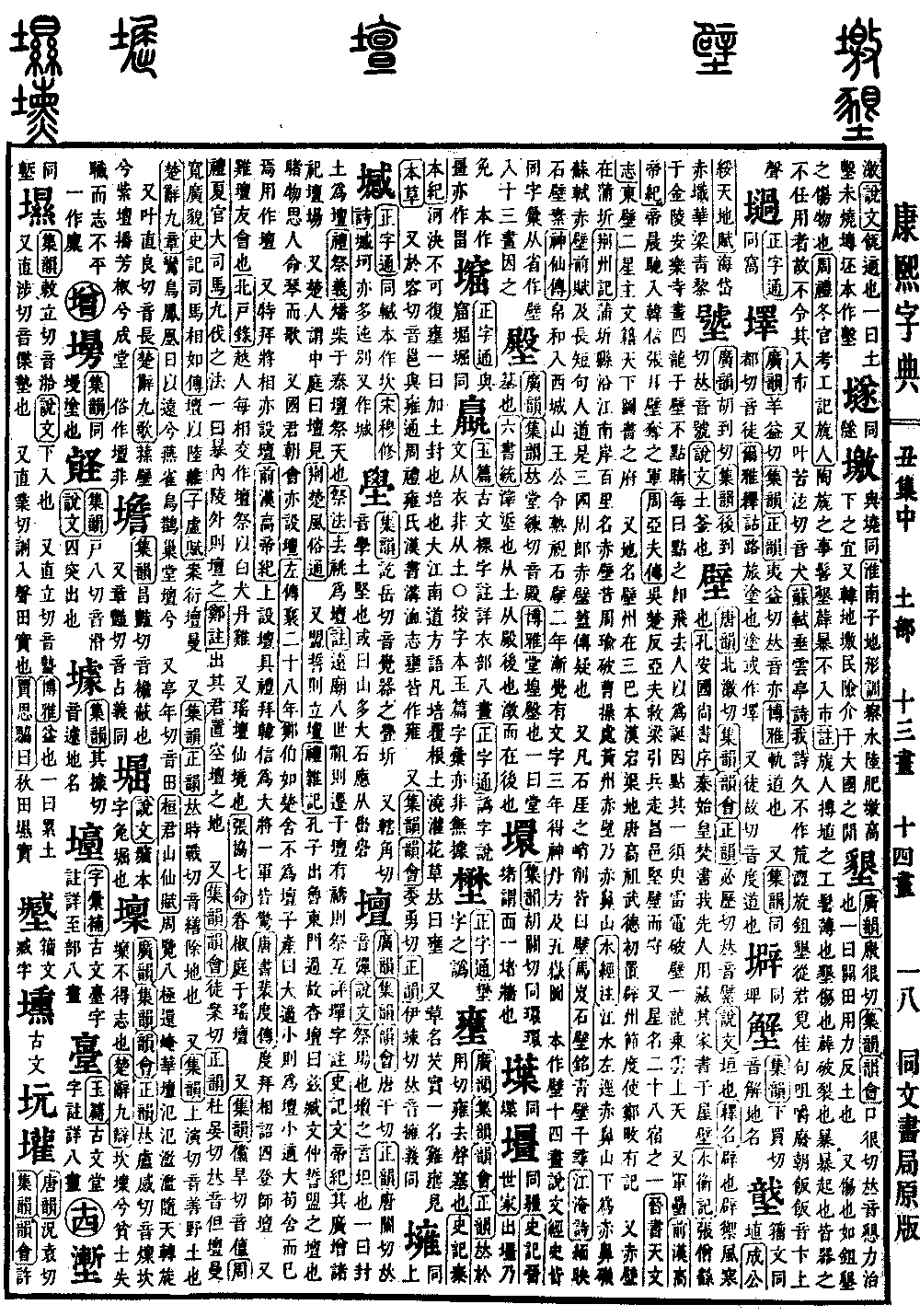
Chou Collection, Middle Volume
Radical: Earth (tǔ)
壇; Kangxi Strokes: 16; Page 240, Entry 22
Pronounced tan.
According to the Shuowen Jiezi (Explaining Graphs and Analyzing Characters), it is a place for sacrifices. The meaning of the character is level and flat. One interpretation states that a high platform built of piled earth is called a tan.
According to the Book of Rites (Liji), specifically the section on The Meaning of Sacrifice (Jiyi), burning firewood on the grand altar is to perform the sacrifice to Heaven.
According to the Laws of Sacrifice (Jifa), when the spirit tablet of a remote ancestor is moved out of the ancestral temple, an altar is established to perform sacrifices.
Commentary: The spirit tablet of an eight-generation ancestor from a remote temple is moved to the altar, and when there is a request for prayer, the sacrifice is performed there. For detailed content, see the annotations for the character shan (a cleared level area).
According to the Records of the Grand Historian (Shiji), in the annals of Emperor Wen, it is noted that he expanded and increased various sacrificial altars.
In the Chu region, people refer to a courtyard as a tan, as seen in the Jingchu Fengsu Tong (Customs and Traditions of Jing and Chu).
Altars are also established when making oaths or covenants.
According to the Book of Rites (Liji), in the Miscellaneous Records (Zaji), Confucius walked out of the east gate of the state of Lu, passed by the old Apricot Altar (Xingtan), and said: This is the altar where Zang Wenzhong stood to swear a covenant. Seeing the old site and thinking of the person of the past, he took his zither and sang.
Rulers also establish altars when holding court audiences.
According to the Zuo Commentary (Zuozhuan), in the twenty-eighth year of Duke Xiang, the Earl of Zheng went to the state of Chu, and there was no altar built at his lodging. Zichuan said: When a ruler of a great state visits a small state, the small state builds an altar; when a ruler of a small state visits a great state, having a place to lodge is sufficient, why would one need to build an altar?
Altars are also established when specially appointing generals or ministers.
According to the Book of Han (Hanshu), in the annals of Emperor Gaozu, the Emperor established an altar and prepared the proper rites to appoint Han Xin as Grand General; the entire army was astonished.
According to the Old Book of Tang (Jiutangshu), in the biography of Pei Du, when Pei Du was appointed chancellor, the imperial edict mentioned four times that he ascended the altar to be appointed general.
Chicken Altar (Jitan) refers to a gathering of friends.
According to the Beihu Lu (Records of the Northern Regions), when people in the Yue region make friends, they build an altar and perform a sacrifice using a white dog and a red chicken.
Yao Tan refers to a celestial realm.
According to Zhang Xie's Seven Admonitions (Qiming), yearning for the pepper-scented court at the Yao Altar.
Also pronounced tan (third tone).
According to the Rites of Zhou (Zhouli), in the section on the Summer Official, the Grand Marshal, there are nine methods for punitive expeditions. The first is: for those who are tyrannical internally and bully other states externally, one shall tan them.
Zheng's commentary notes: This means to expel their ruler and place them on an open, vacant altar ground.
Also pronounced dan. Tanman describes something vast and wide.
According to the Records of the Grand Historian (Shiji), in the biography of Sima Xiangru, it is described as tan in the sense of being multicolored.
According to the Zixu Fu (Rhapsody on Master Void), the terrain is low, level, and vast.
Also pronounced shan. Refers to clearing the ground.
Also pronounced shan. Refers to land in the wilderness.
According to the Chu Ci (Songs of Chu), in the section Nine Declarations (Jiuzhang), the luan and phoenix birds fly further away day by day, while swallows, sparrows, crows, and magpies build nests in the halls and on the sacrificial altars.
Also pronounced tian.
According to the Xian Fu (Rhapsody on Immortals) by Huan Junshan, wandering to the extreme ends of the eight directions, returning to Mount Yanzhi and the Hua Altar. Boundless and vast, rotating with the heavens.
Also pronounced chang.
According to the Chu Ci (Songs of Chu), in the Nine Songs (Jiuge), decorating the walls with sun grass, building the sacrificial altar with purple shells, and scattering fragrant Sichuan pepper throughout the hall.
The common practice of writing it as the character with the surface radical is incorrect. The character tan contains the face radical and cannot be written that way.