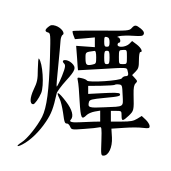
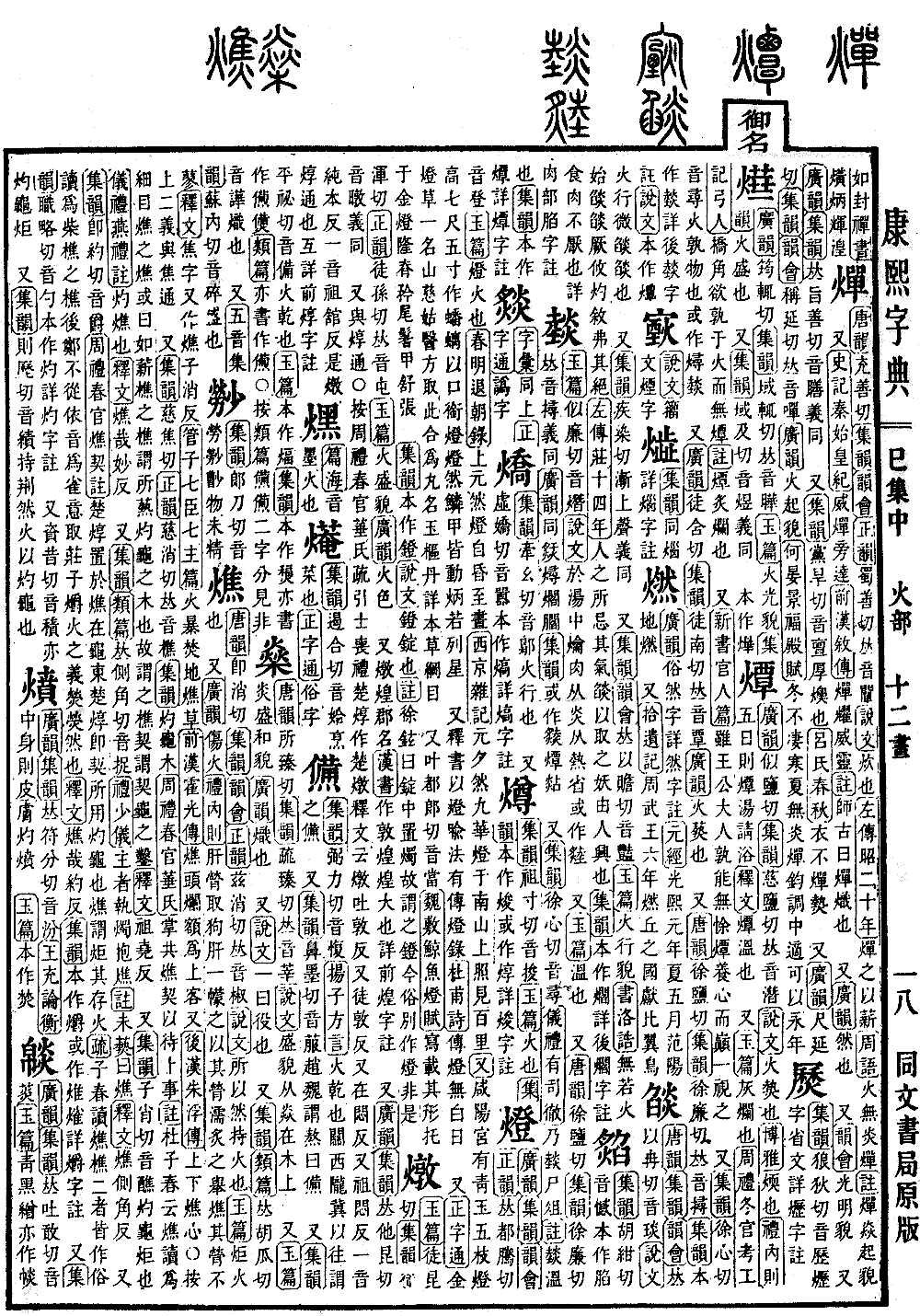
Si Collection, Middle Volume
Radical: Fire (huǒ)
Page 682, Entry 04
Guangyun (Guangyun): Pronounced qian (rising tone).
Shuowen Jiezi (Shuowen): Refers to fire.
Guangya (Guangya): Means warm.
Book of Rites (Liji), Inner Chapters: Every five days, one must prepare hot water to invite others to bathe.
Shuowen Interpretation: The character means to warm.
Yupian (Yupian): Refers to ashes and decomposition.
Rites of Zhou (Zhouli), Winter Bureau, Artificer's Record, Bow Maker: Straightening ox horns requires roasting them thoroughly over fire without scorching them.
Commentary: The character means to roast until ruined.
New Book (Xinshu), Official Persons Chapter: Even among princes and great men, who can exist without sorrows or vexations nourishing their hearts, and then suddenly see through everything entirely?
Jiyun (Jiyun): Pronounced xun. Refers to cooking food with fire. Sometimes also written in a variant form (xun) or variant form (xun).
Guangyun (Guangyun): Pronounced tan. Refers to fire.
Tangyun (Tangyun): Pronounced xun (rising tone).
Jiyun (Jiyun): The original form of the character is xun. Detailed explanation is provided in the entry for xun.
Shuowen Jiezi (Shuowen): The original form of the character is written as shown.