Wu Collection, Upper Volume
Radical: Jade (yù)
Kangxi stroke count: 14
Page 738, Entry 11
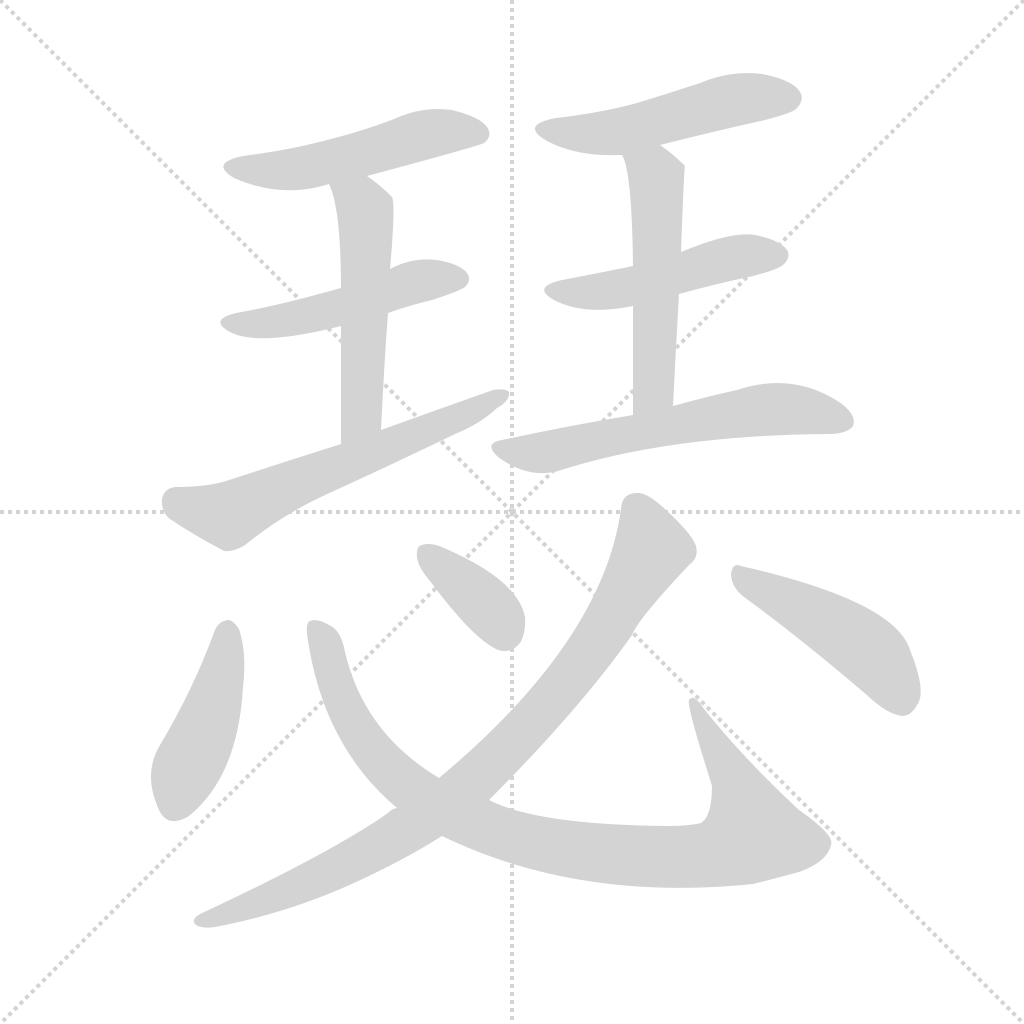
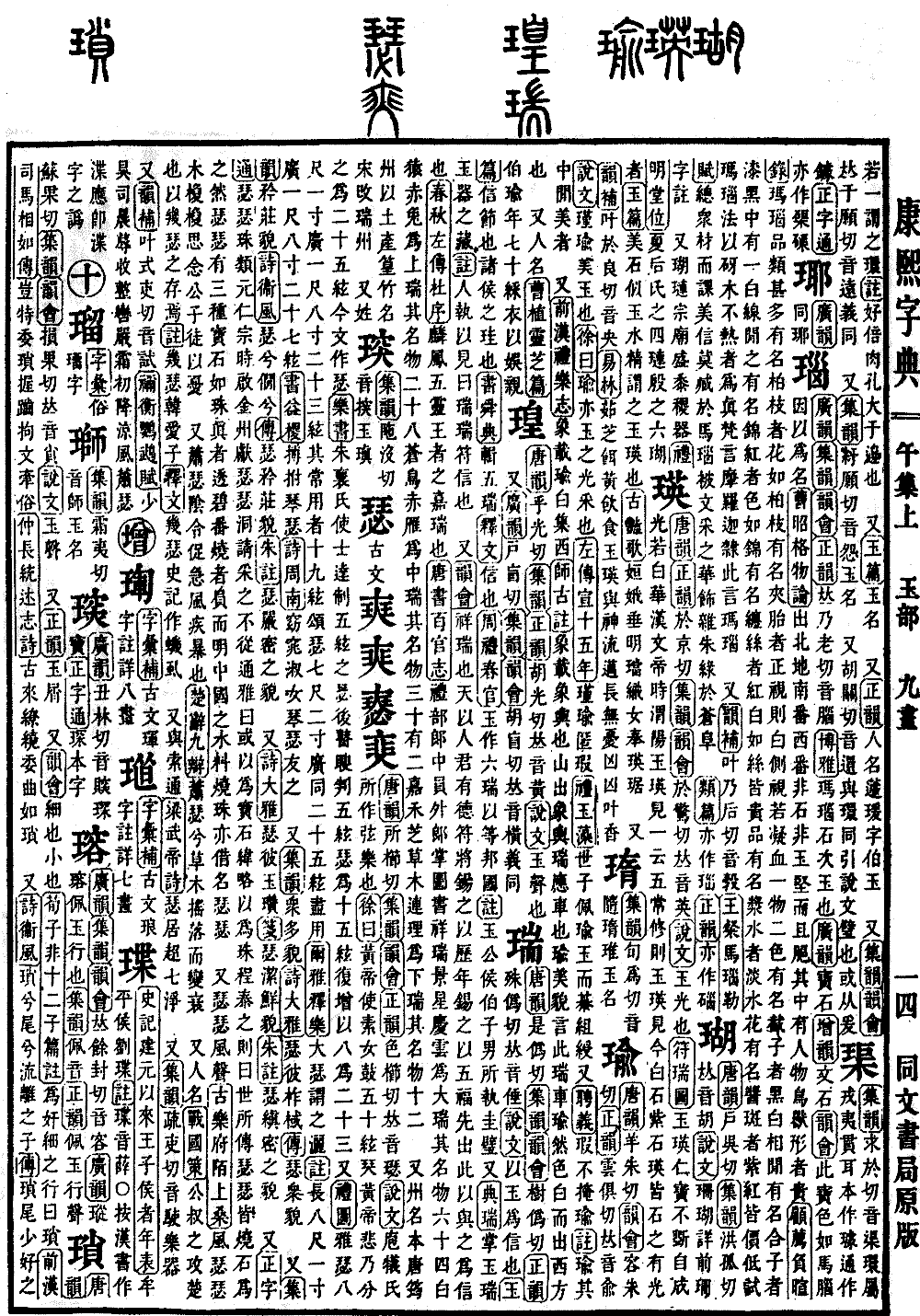
Ancient form. Tang Rhymes (Tangyun): Pronounced se. Collection Rhymes (Jiyun), Rhyme Meetings (Yunhui), Correct Rhymes (Zhengyun): Pronounced se. Explained in Explaining Graphs and Analyzing Characters (Shuowen): A stringed instrument created by Pao Xi. Xu says: The Yellow Emperor had Su Nu play a fifty-stringed zither, which made the Yellow Emperor sad, so he divided it into twenty-five strings. Current texts write it as se. Music Records (Yueshu): Zhu Xiang had Shi Da create a five-stringed se; later, Gu Sou divided the five-stringed se into fifteen strings, then added eight more to make twenty-three. Also, according to Illustrations of Rites (Litu): The elegant se is eight feet and one inch long, one foot and eight inches wide, with twenty-three strings, of which nineteen are commonly used. The ode se is seven feet and two inches long, with the same width, and all twenty-five strings are used. Literary Expositor (Erya), Explaining Music: The large se is called a sa. Commentary: It is eight feet and one inch long, one foot and eight inches wide, with twenty-seven strings. Book of Documents (Shujing), Yi and Ji: Play the bo, fu, qin, and se. Book of Odes (Shijing), Zhou Nan: A quiet and modest lady, the qin and se are her companions. Also, in Collection Rhymes (Jiyun): An appearance of many. Book of Odes (Shijing), Da Ya: Numerous are the yue trees. Commentary: Se means the appearance of many. Also, in Collection Rhymes (Jiyun): An appearance of dignified solemnity. Book of Odes (Shijing), Wei Feng: Solemn and grand. Commentary: Se means the appearance of dignified solemnity. Zhu Xi's commentary: Se means an appearance of severity and density. Also, in Book of Odes (Shijing), Da Ya: A clean and fresh jade libation cup. Jian commentary: Se means the appearance of cleanliness and brightness. Zhu Xi's commentary: Se means the appearance of density and closeness. Also, in Correct Character General (Zhengzitong): Se-se is a type of pearl. During the reign of Emperor Renzong of the Yuan Dynasty, an official in Jinzhou presented a se-se cave and requested to mine it, but was denied. Tongya states: Some think it is a precious stone; Weilue thinks it is a pearl. Cheng Taizhi states: The se-se passed down in the world is all made by firing stone. However, there are three types of se-se: precious stones that are like pearls, the true ones being transparent green. Foreign fired ones are round and bright. Chinese water-material fired beads also borrow the name se-se. Also, se-se is the sound of the wind. Old Music Bureau (Gu Yuefu), Mulberries on the Path: The wind is rustling (se-se), the trees, thinking of the young master only brings sorrow. Also, xiao-se describes the pressing urgency of the yin command and the swiftness of the wind. Chu Elegies (Chuci), Nine Arguments: Rustling (xiao-se) are the plants and trees as they sway, fall, and fade. Also a personal name. Strategies of the Warring States (Zhanguoce): When Gongshu attacked Chu, it was because of the existence of Jise. Commentary: Jise, a beloved son of the King of Han. Commentary text: Jise is written as Jishi in the Records of the Grand Historian (Shiji). Also used interchangeably with the character for search (suo). Emperor Wu of Liang's poems: Dwelling in solitude (se) transcends the seven purities. Also, in Collection Rhymes (Jiyun): Pronounced shi. A musical instrument. Also, in Rhyme Supplements (Yunbu): Rhymes with shi. Mi Heng's Rhapsody on the Parrot: Shao Hao manages the dawn, Ru Shou arranges the reins. The harsh frost has just descended, and the cold wind is rustling (xiao-se).