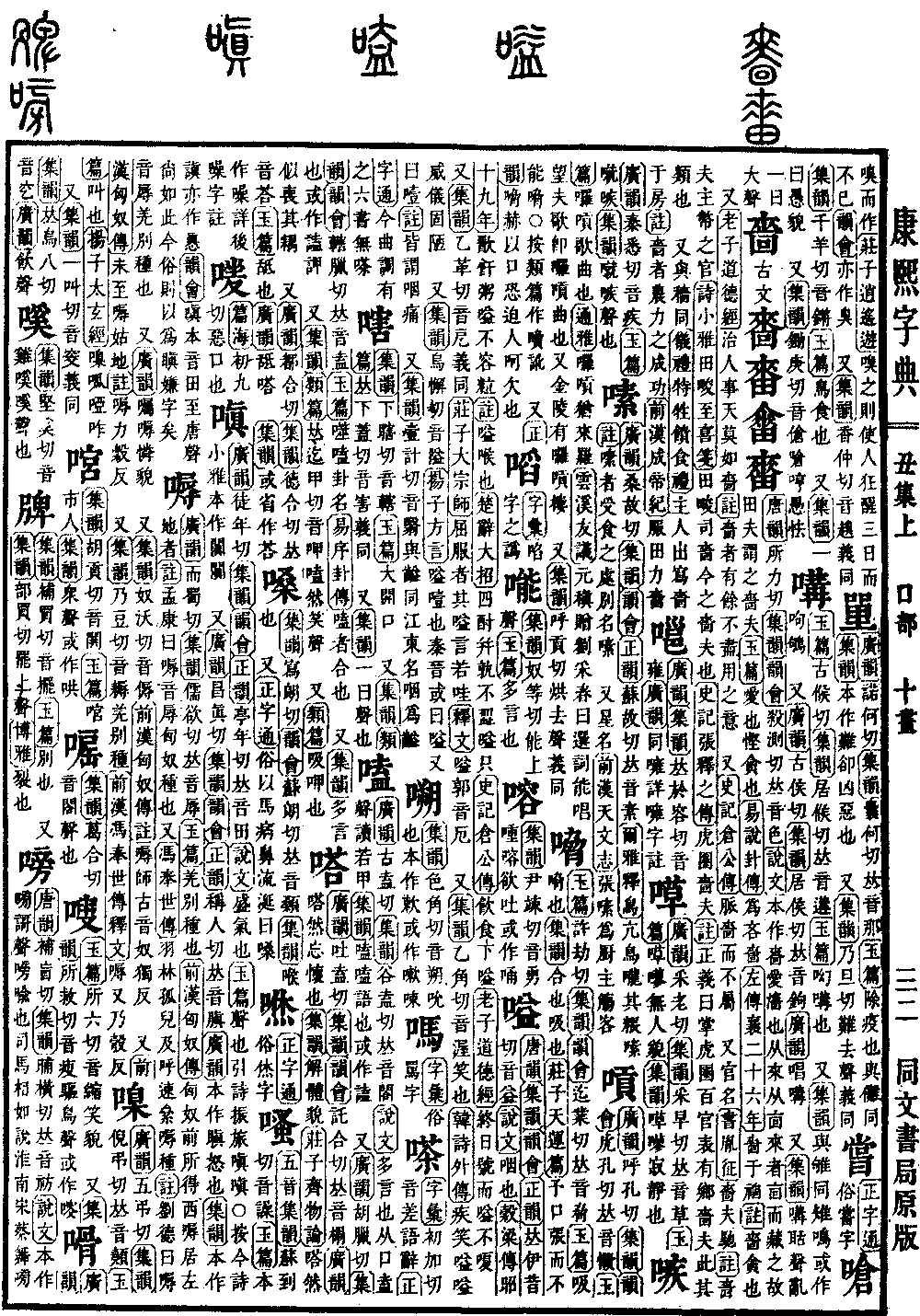
Chou Collection, Upper Volume
Radical: Mouth (kǒu)
Character: se
Kangxi strokes: 13
Page 202, Entry 05
Ancient form. According to the Tang Rhymes (Tangyun), it is pronounced se. According to the Collected Rhymes (Jiyun) and the Rhyme Anthology (Yunhui), it is pronounced se. According to the Explaining Graphs and Analyzing Characters (Shuowen), it was originally written as a different form. It means to love or to be astringent. It is composed of the radical for come and a component indicating storage. Because one comes and stores the harvest, farmers are called officials of husbandry (sefu). According to the Jade Chapters (Yupian), it means to love, to be stingy or greedy. According to the Book of Changes (Yijing), Commentary on the Symbols of the Trigrams (Shuoguazhuan), it signifies miserliness. According to the Zuo Commentary (Zuozhuan), twenty-sixth year of Duke Xiang, it mentions being stingy. The commentary states that it means to be greedy. Also, according to the Laozi (Daodejing), in governing men and serving Heaven, nothing is better than thrift. The commentary explains that thrift means having abundance and not using it all up. Also, according to the Records of the Grand Historian (Shiji), Biography of Canggong, it refers to a pulse that is constricted and disconnected. It also refers to an official title. According to the Book of Documents (Shujing), Expedition of Yin, it mentions the official of husbandry racing. The commentary states that the official of husbandry is the official in charge of currency. According to the Book of Odes (Shijing), Lesser Odes of the Kingdom, in the notes regarding the arrival of the inspector of agriculture, it is noted that the inspector of agriculture is the superintendent of husbandry, which is the official of husbandry of today. According to the Records of the Grand Historian (Shiji), Biography of Zhang Shizhi, it mentions the official of husbandry of the tiger enclosure. The commentary on the Correct Meaning states that this refers to the manager of the tiger enclosure; the Table of Hundred Officials also lists the village official of husbandry, which is of this category. It is also used interchangeably with the character for agriculture (se). According to the Book of Etiquette and Ceremonial (Yili), Ritual for the Offering of a Special Animal, the host brings out the harvested grain and places it in the side room. The commentary states that this refers to the successful result of agricultural labor. According to the History of the Former Han (Qianhan), Annals of Emperor Cheng, it refers to working the fields and exerting agricultural effort.