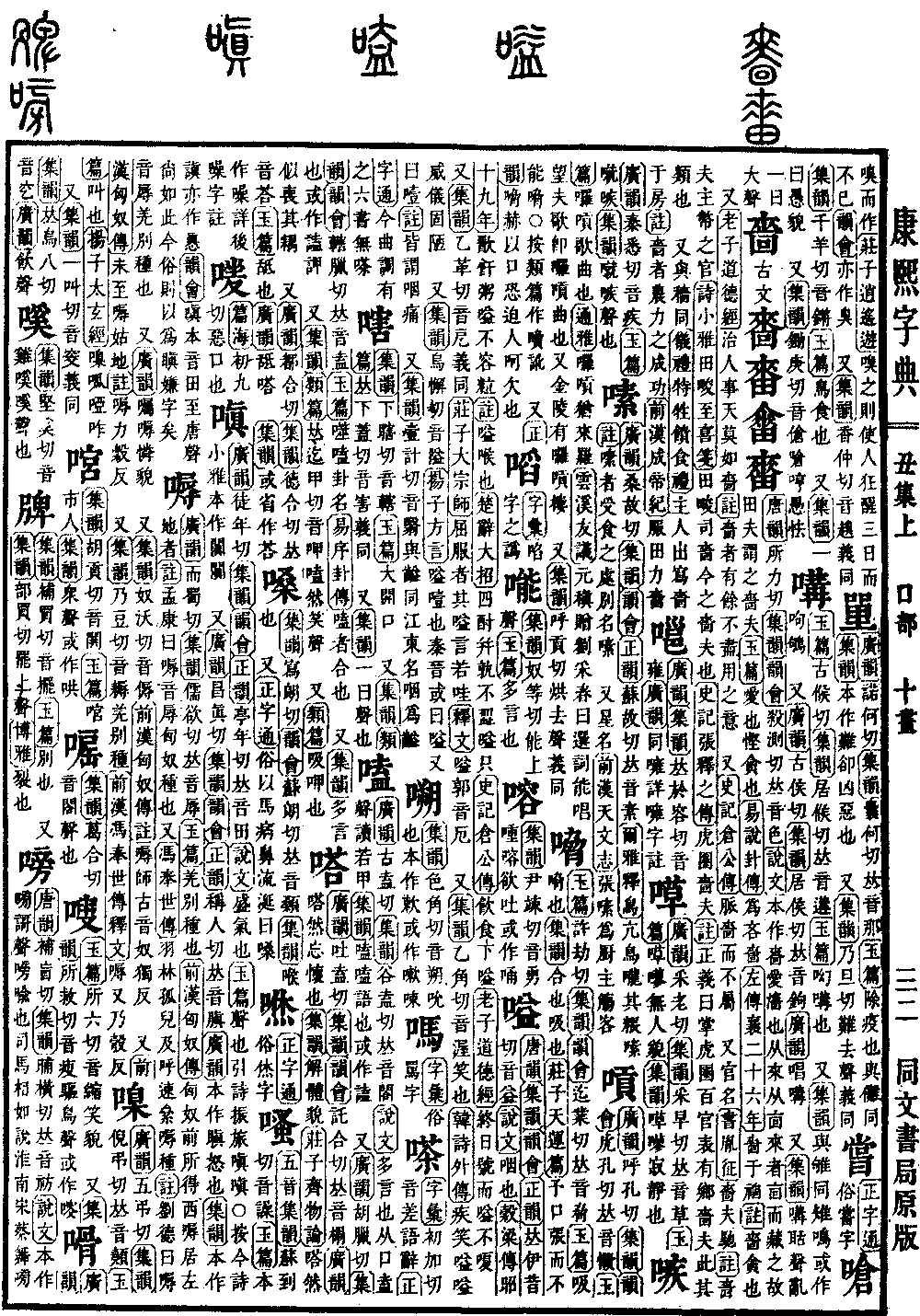
Chou Collection, Upper Volume
Radical: Mouth (kǒu)
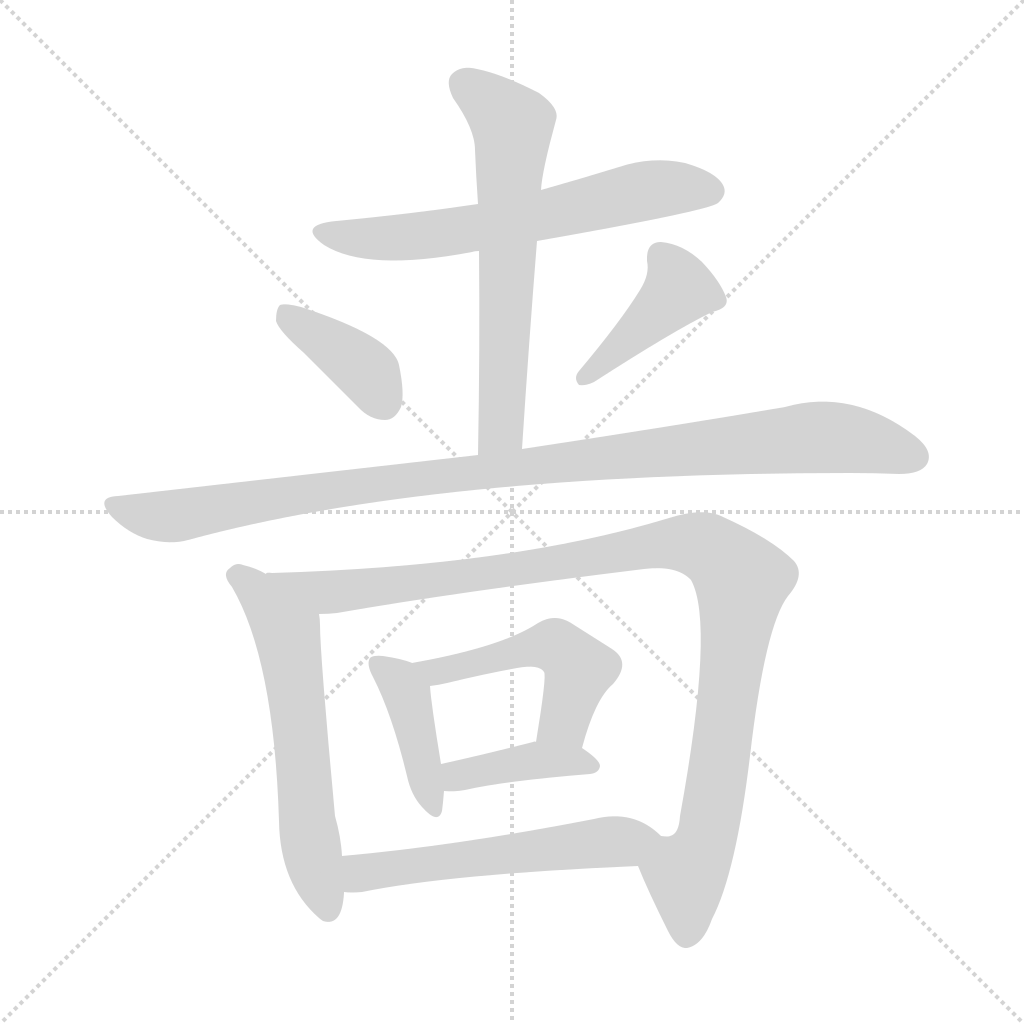
Character: se
Kangxi Stroke Count: 13
Page 202, Entry 03
Ancient form. According to the Tangyun, pronounced se (falling tone). According to the Jiyun and the Yunhui, pronounced se (entering tone). In the Shuowen Jiezi, the original form is written with components representing grain and coming. It describes the act of cherishing and being stingy. It consists of the radical for coming, but because what comes is hidden away, farmers are referred to as sefu. According to the Yupian, it means to cherish, to be stingy or greedy. In the Book of Changes (Yijing), in the Discussion of the Trigrams, it represents stinginess. In the Zuo Tradition (Zuozhuan), 26th year of Duke Xiang, it mentions being stingy. The commentary states that se means greedy. Also, in the Tao Te Ching (Daodejing), it states that for governing men and serving heaven, nothing is better than moderation. The commentary states that se refers to having a surplus but not using it all. Also, in the Records of the Grand Historian (Shiji), in the Biography of Master Cang, it refers to a pulse that is rough, stagnant, and disconnected. Also, it is a title for an official. In the Book of Documents (Shujing), in the Punitive Expedition of Yin, it mentions the sefu galloping. The commentary states that sefu is an official in charge of finances and currency. In the Book of Odes (Shijing), Xiaoya, in the commentary on the arrival of the field inspector, it is noted that the field inspector is an official in charge of agriculture, which is the same as the modern sefu. In the Records of the Grand Historian (Shiji), in the Biography of Zhang Shizhi, it mentions the sefu of the tiger enclosure. The commentary notes that according to the Zhengshi, he is in charge of the tiger enclosure, and among the tables of various officials, there is the local sefu, which is an official of the same category. Also, it is the same as the character for harvest (se). In the Book of Etiquette and Ceremonial (Yili), in the rituals for special offerings, the host brings out the harvest and places it in the room. The commentary states that se refers to the harvest obtained from agricultural labor. In the History of the Former Han (Qianhan Shu), in the Annals of Emperor Cheng, it refers to engaging in agricultural work and striving to cultivate and harvest.