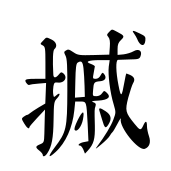
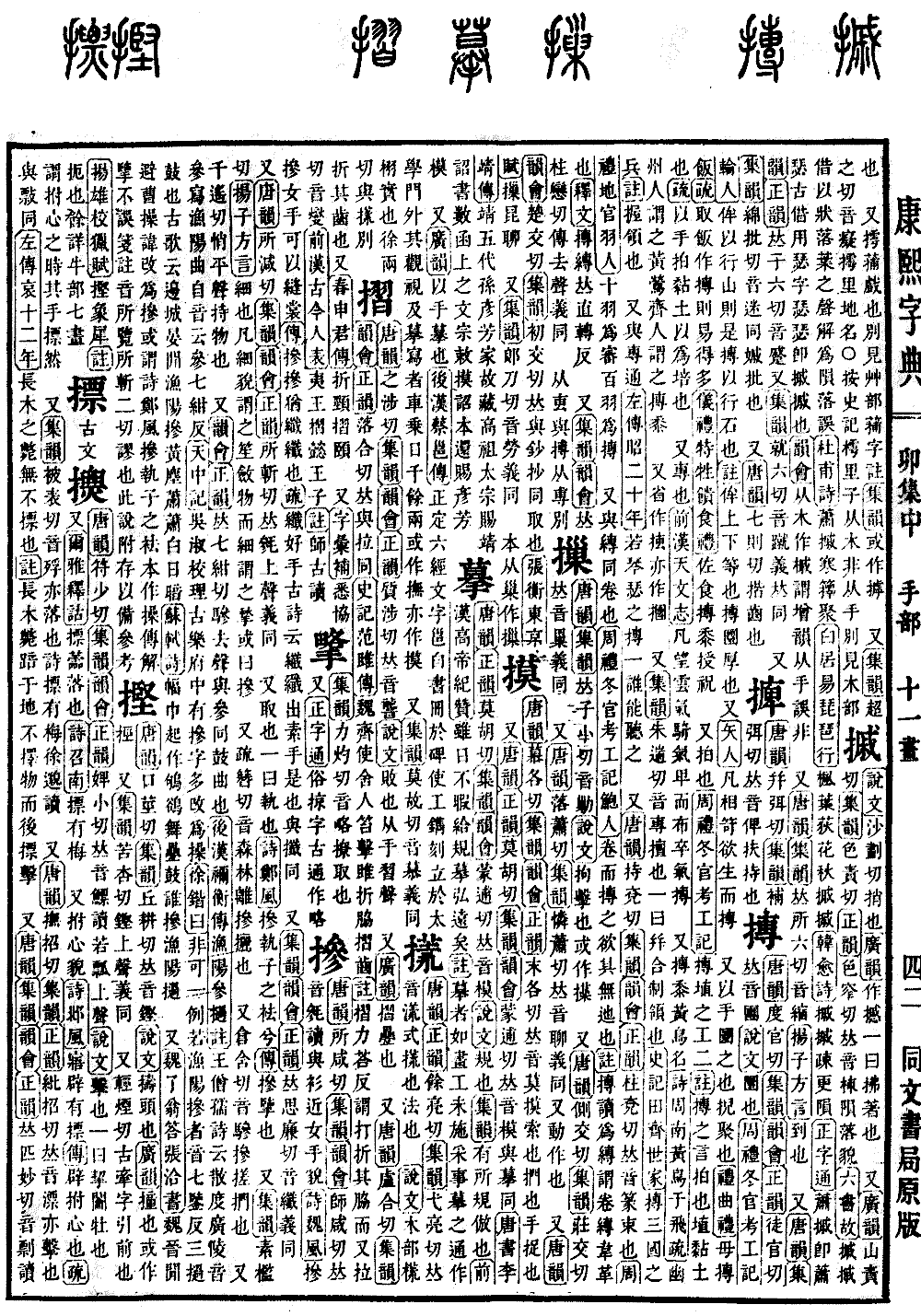
Mao Collection, Middle Volume
Radical: Hand (shǒu)
Kangxi strokes: 15
Page 452, Entry 01
According to the Explaining Graphs and Analyzing Characters (Shuowen Jiezi), it is pronounced sha. It means to brush away.
According to the Expanded Dictionary of Sounds and Meanings (Guangyun), it is written as a variant. One source defines it as to strike or brush against.
Also, according to the Expanded Dictionary of Sounds and Meanings (Guangyun), the Collected Phonology (Jiyun), and the Corrected Pronunciations (Zhengyun), it is pronounced se. It describes the appearance of falling or dropping.
According to the Explanations of the Six Writings (Liushugu), the reduplicated form describes the sound of falling leaves; it is a mistake to interpret it as falling.
In the poetry of Du Fu: The cold bamboo shoots gather with a rustling sound.
In the Lute Song (Pipa Xing) by Bai Juyi: Maple leaves and reed flowers rustle in the autumn.
In the poetry of Han Yu: Sparse leaves fall with a rustling sound.
According to the Correct Guide to Characters (Zhengzitong), the term for rustling is interchangeable with the term for melancholy or soughing. The ancient text uses the character for zither (se) interchangeably. The rustling sound is the same as the sound of falling.
According to the Rhyme Collection (Yunhui), the form written with the wood radical is the correct one. It is a mistake to add the hand radical, as it is incorrect.
Also, according to the Tang Rhymes (Tangyun) and the Collected Phonology (Jiyun), it is pronounced suo. According to the Regional Speech (Fangyan) by Yang Xiong, it means to arrive.
Also, according to the Tang Rhymes (Tangyun), the Collected Phonology (Jiyun), and the Corrected Pronunciations (Zhengyun), it is pronounced cu.
Also, according to the Collected Phonology (Jiyun), it is pronounced cu. The meaning is the same.
Also, according to the Collected Phonology (Jiyun), it is pronounced mi. It is the same as the character for peel or strike.
Also, according to the Tang Rhymes (Tangyun), it is pronounced ze. It means to scrape the teeth.