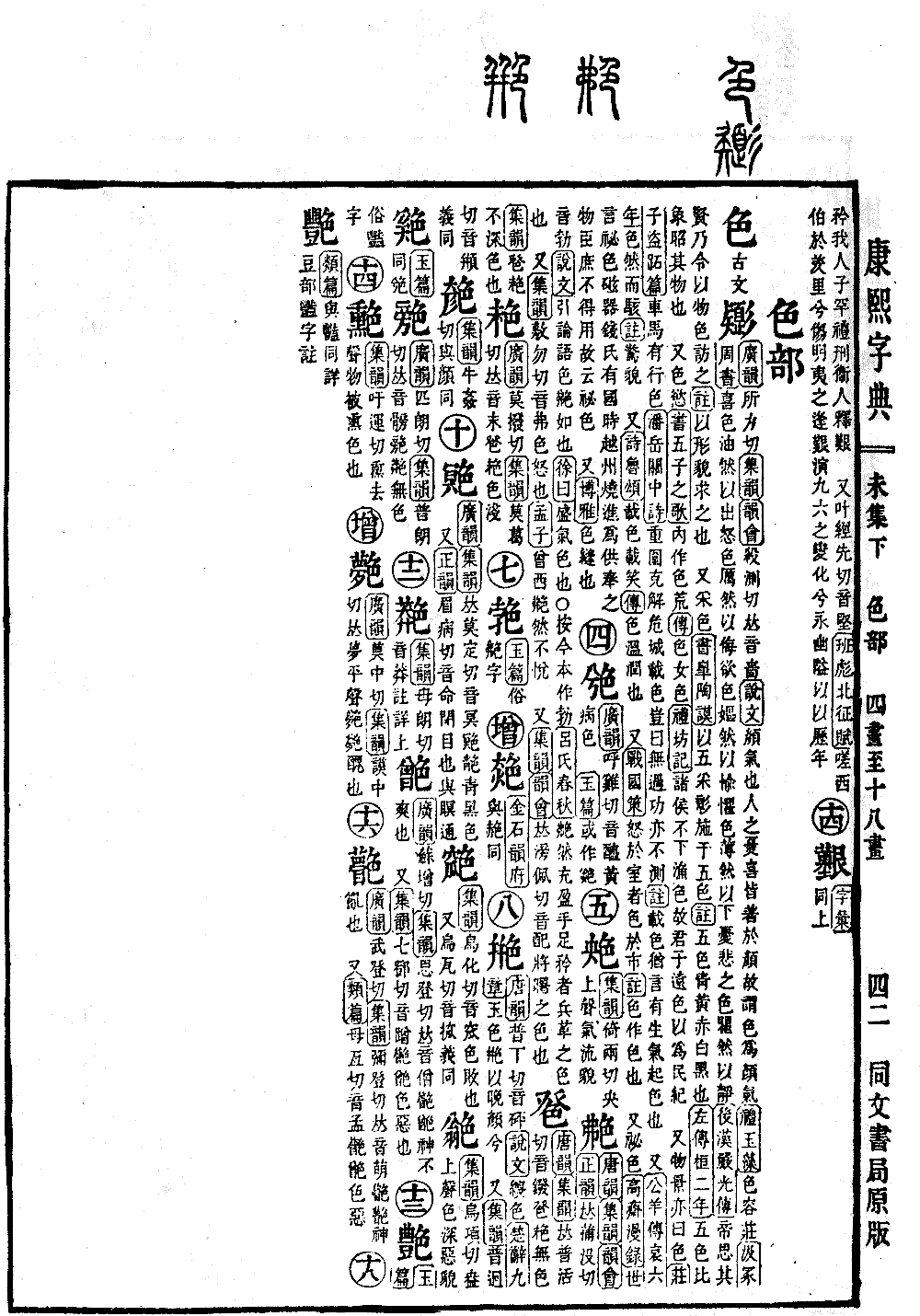
Wei Collection, Lower Volume
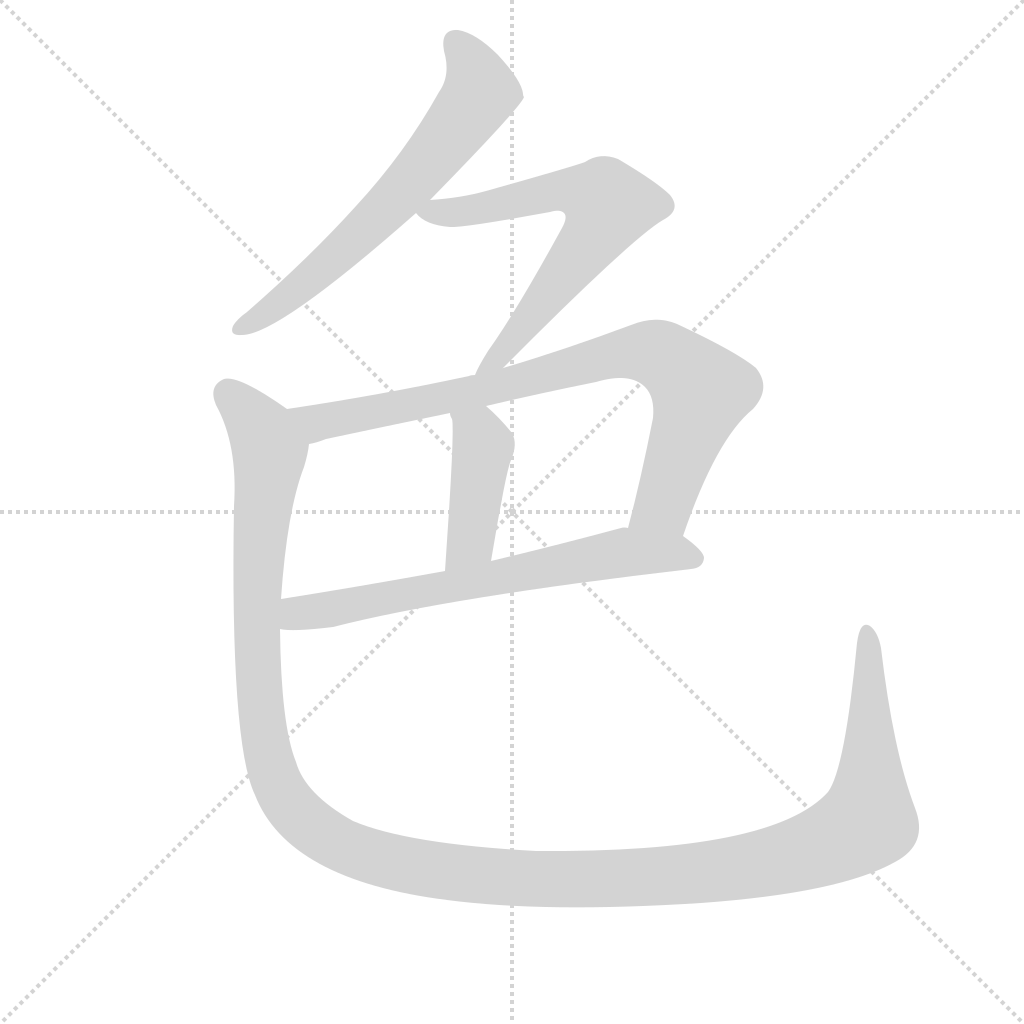
Radical: Color (sè)
Kangxi Strokes: 6
Page 1014, Entry 02
In ancient texts, according to the Guangyun (Guangyun), pronounced se. According to the Jiyun (Jiyun) and the Yunhui (Yunhui), pronounced se. According to the Shuowen Jiezi (Shuowen), it refers to facial expression and spirit. A person's sorrow or joy is reflected on their face, hence color denotes facial expression.
Book of Rites (Liji): One's facial expression and demeanor should be grave and solemn.
Jizhu Zhoushu (Jizhu Zhoushu): A joyful expression manifests naturally, an angry expression appears stern and contemptuous, a desirous expression appears agreeable and happy, a fearful expression appears shrinking and base, and a sorrowful expression appears startled and shifts into stillness.
Book of the Later Han (Hou Hanshu): The Emperor missed his virtuous nature and commanded that he be sought out based on his physical appearance. Note: This means to search based on one's outward look and countenance.
It also refers to color or pigment.
Book of Documents (Shangshu): Use five pigments to display the five colors vividly. Note: The five colors are blue, yellow, red, white, and black.
Zuo Commentary (Zuozhuan): Use five colors to represent various objects, so as to distinguish the differences between them.
It also refers to sexual desire.
Book of Documents (Shangshu): Indulging in female beauty within the palace leads to the neglect of state affairs. Commentary: Color refers to female beauty.
Book of Rites (Liji): Feudal lords do not take women from their own states as wives or concubines; therefore, the superior man keeps his distance from female beauty, taking this as a standard for the people.
Scenery and vitality are also referred to as color.
Zhuangzi (Zhuangzi): The carriages and horses showed signs of departure.
Pan Yue: The heavy siege was lifted, and the imperiled city revealed signs of vitality. How can it be said that there were no faults, yet the achievements were unfathomable? Note: Carrying color is like saying having vitality or showing signs of improvement.
According to the Gongyang Commentary (Gongyang Zhuan): The facial expression changed suddenly in shock. Note: An appearance of being startled and afraid.
Book of Odes (Shijing): A facial expression that is gentle and smiling. Commentary: Color refers to a mild and moist expression.
Strategies of the Warring States (Zhanguo Ce): One who is angry at home will vent their temper on others in the marketplace. Note: Color refers to a look of anger shown on the face.
It also refers to secret color.
Gaozhai Manlu: What the world calls secret color refers to porcelain. When the Qian family established the Wuyue Kingdom, the Yue region fired these items as tribute for the palace, and officials and commoners were not allowed to use them, hence they were called secret color.
According to the Boya (Boya), color refers to a crack or crevice.