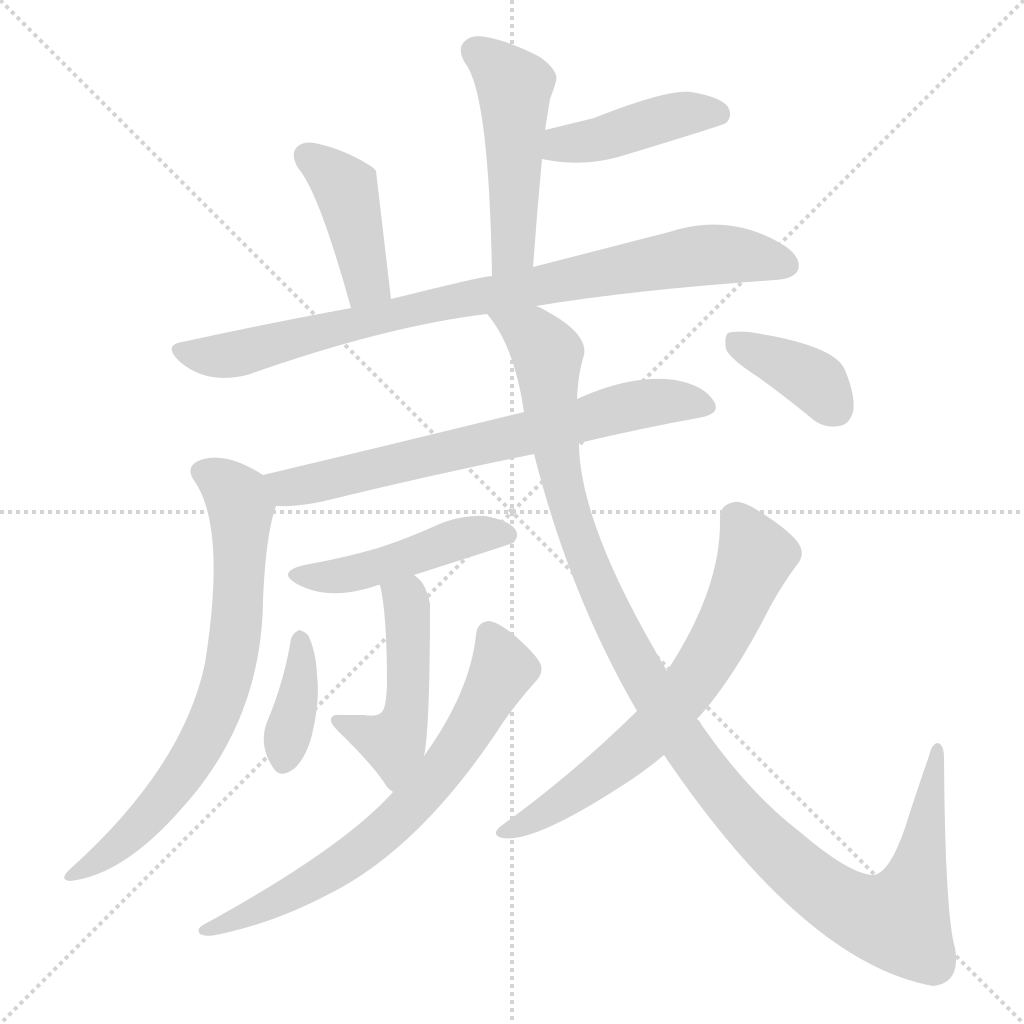
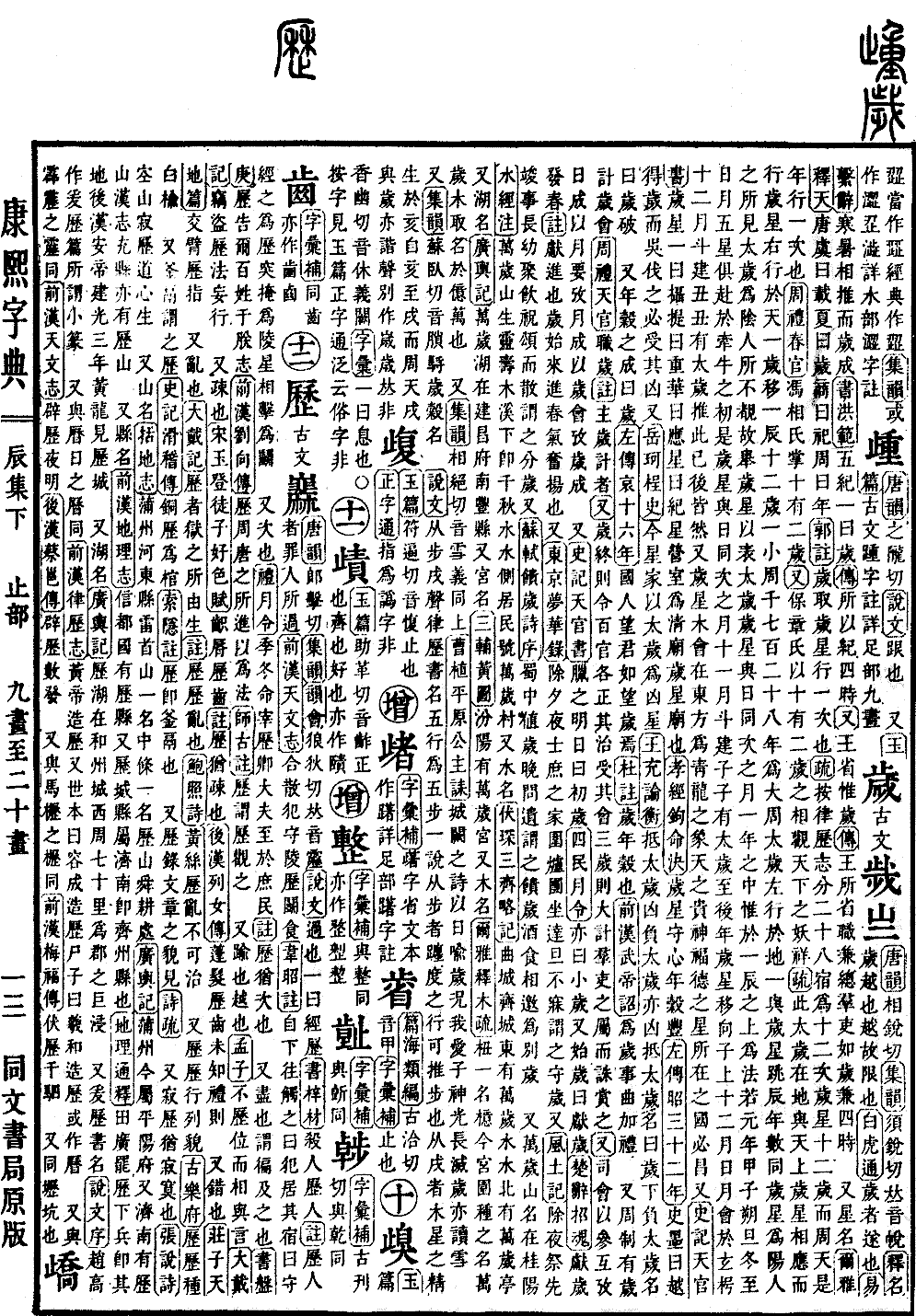
Chen Collection, Lower Volume
Radical: Stop (zhǐ)
Page 577, Entry 02
Ancient form written as 亗.
Pronounced sui.
Pronounced sui. Pronounced same as shui (rising tone).
Shiming (Explanation of Names) states: Sui means to pass over, referring to exceeding the boundaries of the past.
Baihu Tong (Comprehensive Discussions in the White Tiger Hall) states: Sui means sui (to complete/accomplish).
Book of Changes (Yijing), Xici: The cold and heat alternate to form a year (sui).
Book of Documents (Shangshu), Hongfan: The five chronologies, the first of which is called sui.
Commentary: Sui is used to record the four seasons.
Also: A ruler inspecting government affairs should focus on the annual cycle.
Commentary: The responsibilities a ruler inspects are intended to oversee all officials, just as the year (sui) encompasses the four seasons.
Also a star name.
Erya (Approaching the Standard), Shitian: During the Tang and Yu eras it was called zai, during the Xia it was called sui, during the Shang it was called si, and during the Zhou it was called nian.
Guo Commentary: Sui is derived from the period of one revolution of the Jupiter (suixing).
Sub-commentary: According to the Treatise on Music and Calendars, the twenty-eight constellations are divided into twelve celestial positions (ci). Jupiter orbits the celestial sphere in twelve years, making one revolution per year.
Book of Rites (Zhouli), Chunguan: The Fengxiang official manages the twelve-year cycle.
Also: The Baozhang official observes the auspicious and inauspicious signs of the world based on the twelve-year stellar cycle.
Sub-commentary: This refers to Tai Sui (the Grand Year star) moving on Earth, which corresponds to the movement of Jupiter in the heavens. Jupiter moves to the right in the sky, shifting one position per year, making a minor cycle in twelve years and a major cycle in 1,728 years. Tai Sui moves to the left on Earth, corresponding to the movement of Jupiter, with the same number of years. Jupiter is yang and visible, while Tai Sui is yin and invisible; thus, Jupiter is cited to represent Tai Sui. When Jupiter and the Sun are in the same celestial position in a given month, that position serves as the rule for that year. If in the first year of the cycle, the winter solstice falls at dawn on the first day of the eleventh lunar month, and the Sun, Moon, and five planets gather at the start of the Ox constellation, that is the month when Jupiter and the Sun share the same position. In the eleventh month, the handle of the Big Dipper points to the Zi position, where Tai Sui resides. By the next year, Jupiter moves to the Zi position, and in the twelfth month, the Sun and Moon meet in the Xuanxiao constellation. In the twelfth month, the handle of the Big Dipper points to the Chou position, where Tai Sui resides. It continues in this manner. Furthermore, Jupiter is of the wood element and gathers in the East, representing the Azure Dragon, the noble spirit and fortune-bringing star of heaven; the state where it resides will surely flourish.
Also Shiji (Records of the Grand Historian), Tianguanshu: Jupiter is also called Sheti, Chonghua, Yingxing, and Jixing. The Ying chamber constellation is the Qing temple, the sanctuary of Jupiter.
Xiao Jing (Classic of Filial Piety), Goumingjue: When Jupiter dwells in the Heart constellation, the grain harvest that year is abundant.
Zuo Zhuan, 32nd Year of Duke Zhao: Shi Mo stated: The state of Yue obtained the favor of Jupiter, and when the state of Wu attacked it, it surely suffered calamity.
Also Yue Ke, Chu Shi: Contemporary astrologers consider Tai Sui to be an inauspicious star.
Wang Chong, Lunheng: To offend (di) Tai Sui is inauspicious, and to have one's back to (fu) Tai Sui is also inauspicious. Offending Tai Sui is called suixia, and having one's back to it is called suipo.
Also, a good grain harvest is called sui.
Zuo Zhuan, 16th Year of Duke Ai: The common people of the state yearned for their ruler as if yearning for a good harvest.
Du Commentary: Sui refers to the grain harvest of a year.
Former Han, Decree of Emperor Wu: Special honors were granted in regard to annual harvest sacrifices and similar matters.
Also, the Zhou system included suiji (annual statistics) and suihui (annual audits).
Book of Rites (Zhouli), Chunguan: There is an official position called zhuisui (Official of the Year).
Commentary: This is the official in charge of annual statistics.
Also: At the end of each year, the ruler orders all officials to organize their affairs and undergo assessment. Every three years, a comprehensive review of all officials' performance is conducted to determine punishments or rewards.
Also: The Siahui (Audit official) uses cross-verification to evaluate daily performance, monthly reports to evaluate monthly performance, and annual reports to evaluate annual performance.
Also Shiji, Tianguanshu: The second day of the twelfth lunar month is called chusui.
Simin Yueling (Monthly Ordinances for the Four Classes): This is also called xiaosui.
Also, the beginning of a year is called xiansui.
Chu Ci (Songs of Chu), Zhaohun: Entering the new year, the spring energy surges.
Commentary: Xian means to enter. The start of the year comes to enter, and the spring energy rises.
Also Dongjing Mengualu (Record of the Eastern Capital's Dreams): On New Year's Eve, scholar families and commoners gather around a hearth, staying awake all night, which is called shousui.
Also Fengtuji (Record of Local Customs): On New Year's Eve, sacrifices are made to ancestors; afterwards, young and old gather to drink, exchanging blessings before dispersing, which is called fensui.
Also Su Shi, Kui Sui Poem Preface: In Shu, people exchange gifts at the end of the year, called kuisui. Inviting each other for food and drink is called biesui.
Also Wansui (Ten Thousand Years), a mountain name. Located in Guiyang.
Shuijingzhu (Commentary on the Classic of Waterways): Ling-shou wood grows on Wansui Mountain, and the stream at the foot is the Qianqiu (Thousand Autumns) River. The village by the water is called Wansui Village.
Also a river name.
Fu Chen, Sanci Lueji: To the east of the Qi city in Qu-cheng there is Wansui River, and north of the water is Wansui Pavilion.
Also a lake name.
Guangyu Ji (Records of the Vast World): Wansui Lake is located in Nanfeng County, Jianchang Prefecture.
Also a palace name.
Sanfu Huangtu (Map of the Three Supplements): There is a Wansui Palace in Fenyang.
Also a tree name.
Erya, Shimuzhu: The niu tree is also called the yi tree; today it is planted in palace gardens and is named wansui wood, signifying longevity (ten thousand years).
Also: Pronounced jue (falling tone). The meaning is the same as the character for 'sui' (a type of wooden beam).
Cao Zhi, Pingyuan Gongzhu Lei (Lament for the Princess of Pingyuan): The poem in the Book of Odes (Shijing) about the city gate uses the sun to metaphorically represent the years. How much more so for my dear child, whose brilliant spirit is extinguished forever. Here, sui is also pronounced like xue.
Also: Pronounced kui (rising tone). Kui-sui is the name of a grain.
Shuowen Jiezi (Explanation of Writing): The character is composed of 'walk' and 'xu' which provides the phonetic. In texts on music and calendars, the five elements are called the five 'walks' (bu). One theory states it is formed from 'walk' because the tracks of celestial movement can be calculated (tuibu). It is formed from 'xu' because the vital essence of Jupiter is born in Hai, and from Hai it reaches Xu and permeates the entire heavens. Xu and sui are also phonetic cognates. The forms written as sui and sui are incorrect.